2 months ago
95
2 months ago
95
‘Sometimes she understands things better than I,” says Abraham Lincoln’s secretary of the treasury, Salmon P Chase, about his politically savvy, social heavyweight of a daughter, Kate.
Kate Chase has a lot on her plate. She is helping Salmon prepare to challenge Lincoln in the 1864 elections – managing alliances and optics, and planning a party to announce his campaign, plus a lucrative marriage to finance it, despite her deep connection with Lincoln’s secretary, John Hay.
But while this production from Brooklyn-based company the american vicarious raises interesting questions about female power, ambition and the psychological fallout of an emotionally distant father, it struggles to answer them fully or with enough heft.
Thomas Klingenstein’s script too often strays into the expositional weeds of the civil war. (A major Republican donor, Klingenstein believes the US is in a “cold civil war” with the “woke regime”, though he keeps things historical here.) In a production directed by Christopher McElroen, there is little badinage to lift the dense dialogue, a missed trick given Kate’s intellect, and her political manoeuvrings are confined to the house. As she mines Hay for information, primes military commander George B McClellan (Haydn Hoskins) and prods Salmon’s love interest Carlotta (Christy Meyer), you long to witness her prowess in the wild – or at least at her own party. Deliberate side-lining, perhaps, but frustrating nonetheless.
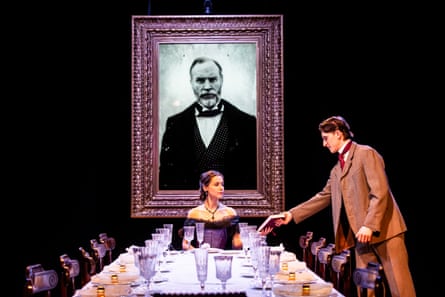
Neal Wilkinson’s set, a huge dining table bedecked for the party, screams of the importance of appearances, and the people who don’t get a seat, while images changing in a gilded frame keep pace with the war. Occasionally, an actor turns unnecessarily upstage and the frame shows a live feed of them – a technical flourish that simply robs us of watching characters face-to-face. The enormous table further hamstrings connection, as the cast skirt around it, although this works for Kate and Hay’s flirtatious sparring.
Their relationship is the play’s most successful element, and the pair are the strongest of the cast of five. Tom Victor’s sensitive Hay stokes sparks of vulnerability in Wallis Currie-Wood’s steely Kate, which later ignite a bonfire of repressed pain. Darrell Brockis is suitably impassive as Salmon, though his accent is distractingly patchy.
In the end, the play’s biggest challenge becomes managing both Kate’s fictional motivations and real-world actions. It leaves us unsure about what truly drove this formidable woman.