2 months ago
139
2 months ago
139
Ten years ago the UK voted 52% to 48% to leave the European Union, triggering a long and tortuous political process.
It took until 1 January 2021 for the country to sever its links to the single market and customs union, but the fractures Brexit left in Britain’s body politic, international relations and economy remain.
How to understand such a seismic split? Here we look at five of the touchstones of the 2016 referendum and what they can tell us about the reality that followed the rhetoric.
Nissan Sunderland

The fate of Nissan’s factory in north-east England was a totemic issue in the run-up to the 23 June 2016 referendum. For leavers, the site near Sunderland symbolised the British manufacturing prowess that allowed it to sell to the world. For remainers, it represented what could be lost.
The British car industry was firmly opposed to leaving the EU. Carlos Ghosn, Nissan’s chief executive at the time, argued that remaining made “the most sense for jobs, trade and costs”. The people of Sunderland thought differently, voting by 61% to 39% in favour of Brexit.
Theresa May, installed as prime minister in the chaos after the vote, could not publicly admit Brexit threatened jobs at Nissan, giving Ghosn huge leverage. In a deal whose details remained secret for more than two years, the Japanese carmaker was eventually granted £61m in state aid to persuade it to invest in new models. The money has kept flowing since: the government gave it another £101m in late 2022, and it is now in talks for more support for Nissan’s latest investment plans.
Yet even that support could not fully compensate for the years of uncertainty with the prospect of a “no deal” Brexit threatening 10% tariffs on exports overnight. The UK finally averted that fate by signing the trade and cooperation agreement with the EU in 2021, which added extra non-tariff barriers to car exports.
In 2016, the Sunderland factory made 507,000 cars, just shy of its 2012 record. Last year, it managed just 273,000 cars. It is hard to disentangle exactly how much of that decline is due to Brexit – although Nissan warned privately that being left out of the latest batch of EU rules could create another “existential threat”.
The negative impact has been partly masked by a run of other challenges: the coronavirus pandemic; the Ukraine war energy crisis; Donald Trump’s deglobalisation drive; and Nissan’s leadership chaos and 20,000 global job cuts.
However, this month the Sunderland factory secured a lifeline: a potential deal to produce cars for the Chinese manufacturer Chery. If that is confirmed it could transform the fortunes of the factory – albeit preserving jobs rather than adding thousands of new ones.
Yet Brexit’s cost to the wider UK automotive industry is beyond doubt. Brian Gu, the vice-chair of the Chinese carmaker Xpeng, is looking to make its cars in Europe, an investment that could create thousands of jobs. Asked this month whether the UK could be on the shortlist, he said: “We will probably want to focus on the largest market first. The EU is one big market.” JJ
The Thames flotilla
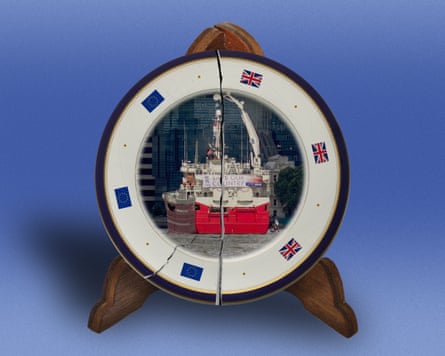
One of the campaign’s most striking images was the clash between a fleet of Brexit-supporting fishing crews that sailed up the Thames led by the then Ukip leader, Nigel Farage, and a rival pro-remain flotilla headed by the rock star Bob Geldof.
Many of the protesters blamed the EU for their industry’s decline, arguing Britain got a bad deal when it entered the bloc in the 1970s. More than nine in 10 fishers told pollsters they intended to vote leave. A little over a week later, they got their wish.
Despite making up only about 0.3% of the British economy, the fishing and aquaculture sector played an outsized role in the debate, with the leave campaign touting control of UK waters as a considerable Brexit prize.
Freed from Brussels’ common fisheries policy, Britain was supposed to be able to control access of foreign boats to UK waters and negotiate its own catch quotas.
But Brexit failed to turn around the fortunes of the dwindling and ageing industry. Boris Johnson’s 2020 deal left many fishers feeling betrayed. EU boats could continue fishing six miles off the coast until 2025, although Britain did regain management of fish stocks.
That anger reignited last year after Keir Starmer extended EU vessels’ access to British waters up to 2038 as part of his “reset” deal. Fishers were “enormously aggrieved” by this, says Mike Cohen, the head of the National Federation of Fishermen’s Organisations. “Given access to British waters was a valuable thing, we thought we’d be able to get something in return.”
A notable loser from Brexit was the UK distant waters fleet. It now comprises just the Hull-based Kirkella, which catches cod and haddock in Arctic waters. The vessel’s owner sold the other boat in 2022 after the UK’s whitefish quota was slashed during negotiations with Norway.
Britain imported £4.1bn of seafood last year, double the value of its exports (£2bn), according to the public body Seafish. Britons have little appetite for the shellfish plentiful in their waters such as lobsters, crab and langoustines, with most of the catch exported to Europe, a process that has become much more complicated post-Brexit. More restrictive immigration rules made it harder to recruit skilled overseas workers for crews.
“Nothing changed with Brexit,” says Derek Meredith, the owner of three fishing boats at Brixham in Devon. Soaring fuel prices and other rising costs are making it harder to make a living, he says. “If I could sell all three of them today, they’d be gone.” JP
Blue passports

Among all the promised Brexit benefits, the blue passport was something Britons would literally be able to grasp. It was rolled out in 2020, just as Covid suspended travel, but about 70% of the 54m UK passports in circulation are now the old navy colour, with the remaining burgundy all but extinct by 2030.
Brandished with relish by victorious Brexiter ministers, it proved a pyrrhic win. About 70m of the 90m UK overseas trips a year are made to Europe, the latest data shows. Where British passport holders were once fast-tracked through the borders with EU or EEA nationals, they now share a lane with the same rights as any far-flung visitor. And that blue passport needs stamping every time.
The rocky introduction of the EU’s entry-exit system (EES) has, in places, turned the queues into a fraught six-hour bunfight, as the bloc’s border officers take down non-citizens’ biometrics. Even if most people experience little delay, the anxiety has clearly spread: Greece, announcing an exemption for UK travellers this summer, has seen bookings bounce up compared with Portugal or Spain.
Regardless of how well EES eventually functions, Britons will still face a €20 (£17) charge to visit the EU when an additional layer of border formality, Etias, is introduced in the coming year.
The passenger may perceive only pricier travel and time-consuming queues, but international transport operators have stumped up at the back end too. Tens of millions have been spent on EES machines for Eurostar, Eurotunnel and ferries. Airlines such as easyJet had to create new companies and relicense aircraft and crew. Planes and parts are now certified under separate UK and EU safety agencies, and airline chief executives privately express huge frustration at the painful cross-border friction for their supply chain.
Perhaps the most damning statistic of all is the surging demand, up 2,500% since the year before the referendum, for one passport granted to those of particular foreign ancestry. Its cover bears not the royal coat of arms but, of course, an Irish harp. It’s not blue, though. GT
Care home workers
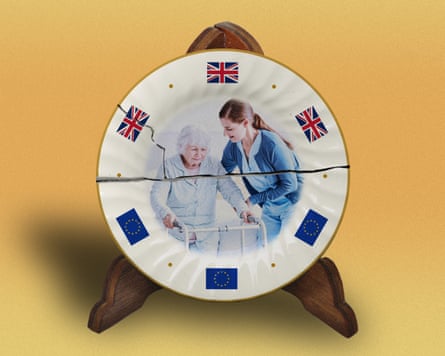
The febrile debate in the run-up to the vote left many of the thousands of EU staff caring for elderly people and disabled people in UK residential homes anxious about their future.
“I think for six months before the referendum, we started to see this disquiet amongst our European colleagues,” recalls Nadra Ahmed, the chair of the National Care Association. “The Brexit debate was quite toxic. It kind of didn’t feel like they were going to be very welcome.”
In the years that followed, recruiting and retaining EU workers got increasingly hard. “It just became impossible: we weren’t getting the applications,” says Raj Sehgal, who operates six care homes in rural Norfolk, with about 150 staff.
Kieran McCormick, who runs a recruitment agency for nurses and care workers across Northern Ireland, says: “We have seen the volume of European healthcare workers coming to work for us fall off the face of the earth.”
When Covid hit in 2020, despite the formidable pressures on care homes, it became easier to find workers for a while, as other opportunities dried up. But, as the economy reopened, the sector lost some staff to hospitality and retail. Meanwhile, many EU workers who had gone home to ride out the pandemic did not return.
That picture was being repeated nationwide, with knock-on effects for the NHS. The number of unfilled vacancies across the care sector in England shot up, from 78,000 in 2016-17, to 132,000 five years later.
Ministers were so concerned they announced that from February 2022, social care employers would be able to recruit and sponsor workers from overseas. What followed was an explosion in overseas recruitment – annual applications for health and care visas peaked at 161,600 in the year ending November 2023. That year, one in three new starters in the sector was recruited from abroad.
As of last year, 24% of the social care workforce was from a non-EU country – with Nigerians, Indians and Zimbabweans the top three nationalities. That was up from 9% in 2017. Over the same period, the share of EU care workers declined only slightly from 7% to 6%.
By 2024, the Conservatives had become so concerned about the rapid pace of migration that they tightened the rules, including banning care workers from bringing in their families. Labour cracked down further, effectively ending the overseas recruitment of care workers altogether.
Sehgal says with local workers still hard to come by, he has been left casting around for overseas students, but “the calibre of applicants is not the same”.
“We don’t have a sufficient workforce to meet demand,” says McCormick. “It is typically minimum wage, and folks are saying, ‘I’m not doing that: I can go to Marks & Spencer or Lidl and get an extra £2 to £3 an hour for nowhere near the level of responsibility.” HS
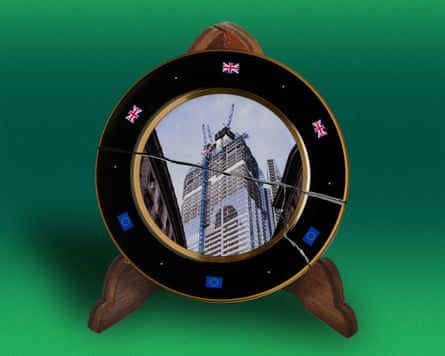
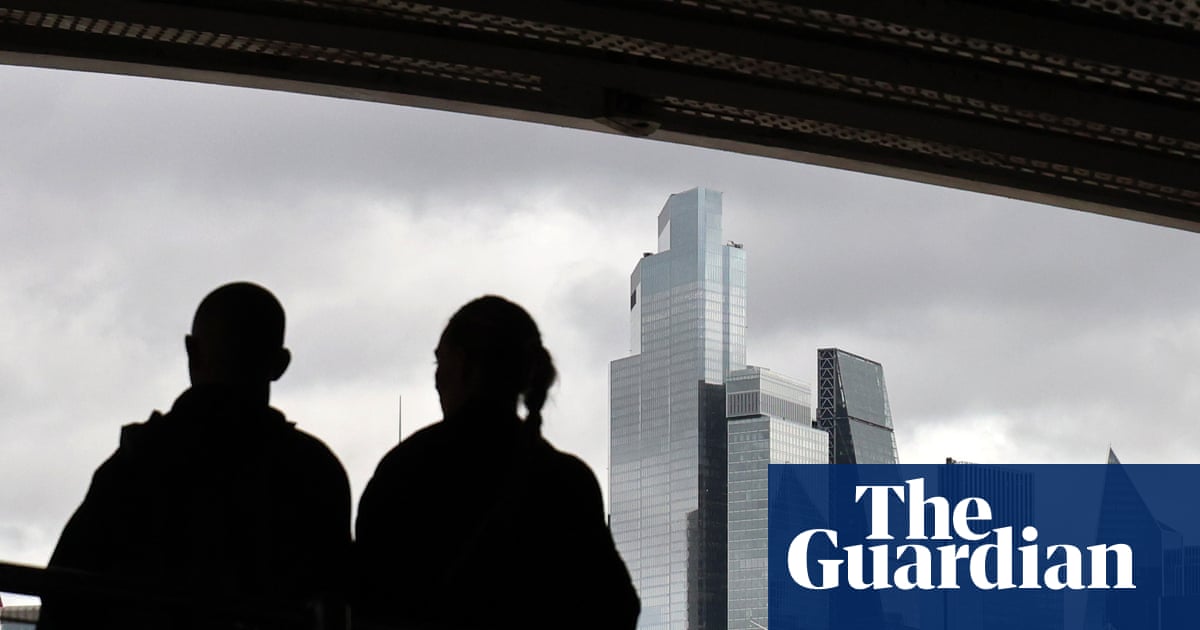
A couple of days before the referendum, the developer of what was due to be the City’s tallest skyscraper – 22 Bishopsgate – put the project on ice. “We want to see the results of the Brexit,” said Pierre Vaquier, the then head of Axa’s property arm.
He was far from alone in fearing the damage to London’s status as Europe’s premier financial hub. Executives warned after the vote that bankers, wealth managers and underwriters would flock to Frankfurt, Paris, Luxembourg, Milan and Dublin instead.
Bosses, fearful of falling foul of EU rules, laid plans to transfer assets and staff. Estimates swung widely as banks like HSBC geared up to move up to 1,000 staff to Paris, while JP Morgan said 4,000 of its 16,000 UK jobs could be exported.
Up to 75,000 City jobs and as much as £10bn in tax revenue could be lost, according to calculations from the consultants Oliver Wyman. Xavier Rolet, the then boss of the London Stock Exchange, went further, saying that 232,000 of the UK’s 1.1m financial sector jobs could be at risk.
“Nobody really knew how this was going to play out,” recalls Miles Celic, the chief executive of lobby group TheCityUK. But when his team met the then Brexit minister, David Davis, in October 2016, in hopes of getting the City included in UK Brexit negotiations plans, Celic was rebuffed.
“[Davis] listened very politely and at the end of it, he said: ‘I’m not worried about your industry, your industry is big enough and smart enough to look after itself.’ And that pretty much was what we subsequently saw … The industry has basically been fine. It has adapted.”
Firms faced extra costs and were forced to duplicate jobs and paperwork, while regulators scrambled to make sure banking and payments would not be disrupted when article 50 was triggered in January 2020.
But the City, arguably, has continued to boom. Ultimately only 7,000 jobs were lost to continental Europe, according to EY’s last Brexit tracker report in 2022. About 1.1 million people are still employed across the City today, where bosses have toasted regulators for tearing up the EU rulebook, scrapping banker bonus caps and loosening listing rules that could help revive the UK stock market.
As for 22 Bishopsgate, it only took four months for the developers to decide Brexit was not such a threat after all and restart the project. It was completed in 2020. KM