2 months ago
169
2 months ago
169
Our age of what Mark Carney called global rupture is also often described as following the “law of the jungle”, in which the strong do what they can and the weak suffer what they must, with international law shattered and multilateral organisations hollowed out. Russia’s invasion of Ukraine, Israel’s onslaught on Gaza, and the US and Israel’s attacks on Iran and Lebanon seem to confirm this bleak outlook. On closer inspection, however, these wars offer a different, and far brighter, clue to the way forward.
Russia, once seen as a formidable military power, was expected to overwhelm Ukraine, a much smaller and weaker country backed by a divided, fearful and hesitant west. Even after the war settled into a protracted stalemate, the prevailing belief was that Ukraine was doomed to lose. But the narrative has shifted.
Yes, Russia has trampled all over international law and remains the stronger party both militarily and demographically. Yes, Donald Trump’s US has betrayed Ukraine, and while European support has been strong and consistent, it remains insufficient. Yet Ukraine stands tall.
In the Middle East, the US and Israel attacked Iran twice, again in blatant violation of international law. European leaders, initially shamefully evasive on the question of legality, eventually acknowledged as much. There was never any doubt about who held the power: the US, the world’s major military superpower, alongside Israel, aspiring to assert itself as the regional hegemon, struck Iran, a country weakened by internal protest and an unprecedented wave of repression. Benjamin Netanyahu convinced Trump that one final push would topple the Islamic Republic like a house of cards.
Four months later, a memorandum of understanding (MoU) was agreed by the US and the same Iranian regime – now younger, more militaristic and more hardline – reopening the strait of Hormuz. Iranian control of the strait is de facto recognised, its frozen assets are expected to start flowing again and oil sanctions will be temporarily waived as nuclear negotiations resume. The MoU was the best deal Trump could secure, but it was not a good deal for the US or Israel – and criticism in both countries is mounting. But this cannot alter the implicit acknowledgement in the MoU that the strongest have not prevailed.
These two wars simultaneously represent egregious violations of international law and demonstrate that even those at the top of the food chain can fail.
Will Europe, which has stood with Kyiv and international law while hypocritically flirting with its abandonment in the Middle East, use this moment to reassert its commitment to international norms? There are two encouraging signals.
A coalition of about 40 countries, led by France and the UK, has assembled a taskforce to be deployed to the strait of Hormuz to clear it of mines and secure the waterway for shipping. This initiative signals Europe’s willingness to play an active and constructive role. It revives Europe’s multilateral instincts by involving a broad group of countries not directly involved in hostilities. It also clarifies that any deployment would be grounded in international law and coordinated with all coastal states, beginning with Iran.
The operation will probably not proceed. Much like the “coalition of the willing” to deploy a reassurance force in Ukraine after an eventual ceasefire, the hypothetical Hormuz coalition is mainly aimed at managing the US – it is a signal to Washington that while European governments were unwilling to fight in the war, they are ready to contribute to securing the peace. Trump has made it clear he is not interested in Europe’s overtures, however, as he reiterated at the G7 summit in Evian. Above all, Iran rejects the idea of European warships in the strait. Without Tehran’s consent, Europeans acknowledge, there will be no operation.
A second European initiative – one which is far more concrete and useful – has quietly taken shape below the radar. Norway, which has strong political credentials in the Middle East (having clearly condemned the war from the outset, like Spain), possesses both credibility and expertise in the law of the sea. The UN convention on the law of the sea (Unclos) has been ratified by most states – among the few holdouts are the US, Israel and Iran.
The good news is that, while not parties to Unclos, both the US and Iran are interested in respecting its terms in the strait. Norway has thus provided invaluable legal counsel to Iran and Oman, as well as Pakistani and Qatari mediators, to ensure that any post-strait arrangements remain compliant with Unclos’s core principle: the freedom of navigation. It is through this kind of unassuming, soft and demand-driven contribution that Europeans can restore their credibility and play a useful role in the region.
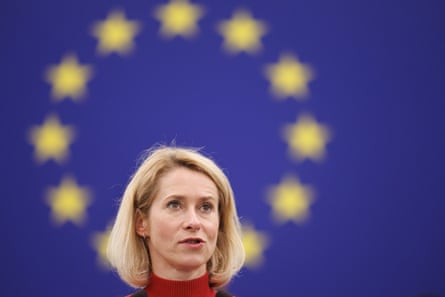
Where European credibility remains in shreds is in relation to the Israeli-Palestinian conflict, where just as in Lebanon, European “concern” about Israel’s actions has failed to translate into meaningful policy. The trampling of international law by Israel is most acute, as it remains completely unaccountable for its war crimes, crimes against humanity and possibly the crime of genocide in Gaza. European governments have played no small part in shielding Israel from its international legal obligations.
Yet perhaps change is finally on the horizon. EU sanctions on extremist Israeli ministers Itamar Ben-Gvir and Bezalel Smotrich will not come to pass, as they require an unattainable unanimity. But in any case it is the Israeli state that should be held accountable, not individual ministers.
A far more significant move, which the EU’s legal service has clarified would require only a qualified majority vote, would be to ban imports from illegal Israeli settlements in the occupied West Bank. A majority of member states already support this. Others, like Italy, which were once opposed, have signalled a possible shift. Germany remains the only large country in opposition, arguing that banning settlement trade would be reminiscent of Nazi discrimination against Jews. This argument is obscene, suggesting a moral equivalence between illegal Israeli settlements today and the Jewish people persecuted in Germany in the 1930s.
Fortunately the pressure is mounting. The EU’s high representative, Kaja Kallas, pushed by the majority of member state governments, has formally asked the European Commission to table a proposal on the matter. Commission president, Ursula von der Leyen, may still try to obfuscate. But the indefensibility of the EU’s trade with Israel’s illegal settlements is clear for all to see. Rather than fighting a losing battle and stubbornly refusing to uphold international law, Europe would do well to return to the winning side by once again embracing its rule.
-
Nathalie Tocci is a Guardian Europe columnist