3 months ago
152
3 months ago
152
Cabinet Office suggested Mandelson did not even need security vetting, Robbins tells MPs
In his letter to the committee, Robbins says the Cabinet Office suggested that Mandelson would not have to go through security vetting. He says:
After the announcement, I believe the Cabinet Office (CO) raised whether Developed Vetitng (DV) was actually necessary. I understand the FCDO insisted that DV was a requirement before Mandelson took up his post in Washington.
Key events Show key events only Please turn on JavaScript to use this feature
Robbins says Mandelson's appointment should have been blocked after Cabinet Office's 'due diligence' scrutiny
In response to a question from Emily Thornberry, Robbins told the committee that he thought Peter Mandelson appointment should have been blocked following the due diligence scrutiny carried out by the Cabinet Office. This is the ‘soft vetting’ that happened before the security vetting.
Robbins said:
Due diligence was done before the appointment. And I think that has been now released in the humble address papers.
What I am, what I feel sad about, is that the prime minister’s nominee went ahead despite that due diligence.
Robbins says No 10 wanted Foreign Office to be clear vetting decisisons 'taken entirely independently of ministers'
Robbins confirmed that he did not tell No 10 about the recommendation from UKSA about Mandelson.
He said:
And months and months later, when in the immediate aftermath of Mandelson’s sacking, we were obviously thinking internally about how to respond to legitimate questions this committee and others had about that process.
My recollection is, in a way, I wasn’t surprised by the direction from No 10 was we must make clear that these decisions were taken entirely independently of ministers and that they were not consulted other than to be told the outcome.
Robbins tells committee he opposed proposal from No 10 for Matthew Doyle to be given ambassadorial post
Emily Thornberry asked Robbins if he could confirm that No 10 suggested that Matthew Doyle should be given an ambassadorial job somewhere.
Doyle, who is now a peer, was Starmer’s head of communications at the time. He was also close to Peter Mandelson, and he was one of the No 10 people asked by Keir Starmer to question Mandelson about his links with Jeffrey Epstein ahead of Starmer’s decision to appoint him.
Doyle has had the Labour whip suspended in the Lords over his own links with a friend convicted of a child sex offence.
Robbins said he did not know where that suggestion came from.
He went on:
It was serious enough for the No 10 private office to bring up the head of the diplomatic service and ask for a forward look of available head of mission jobs. And that’s the point at which I thought that I needed to lay down some markers.
He also said that Mandelson was asked if there might be a job available for Doyle in the US embassy team.
Robbins says he can't confirm Morgan McSweeeney told Foreign Office about Mandelson vetting 'just fucking approve it'
Robbins was asked about a repor from Sam Coates at Sky News that Morgan McSweeney, the then chief of staff to the PM, called Philip Barton, Robbins’ predecessor as head of the Foreign Office, asking him to speed up the Mandelson vetting approval. McSweeney reportedly told Barton: “Just fucking approve it.”
Robbins said that when he took over there was a “strong sense that there was an atmosphere of pressure and a certain dismissiveness about this process”.
But he said he does not recall Barton using those words. Barton is not the sort of person who would report language like that, he said.
Robbins rejects suggestion he was explicitly told officials recommended refusing Mandelson's vetting
Robbins was asked to clarify what he was saying about the recommendation from UKSV.
Asked if he was saying he was told that security vetting should be denied, Robbins said that he was telling the committee what he was told at that meeting. He was told that the decision was “borderline”, and that they were leaning against granting approval.
Q: So you did not see a form with the red box ticked?
Robbins said he had never seen a form like that until the template was published by No 10.
He stressed that UKSV’s findings were “recommendations and not decisions” to the Foreign Office.
What my team will have done, I’m sure, is break that down, go through the specific issues that have led UKSV to their concern and then make an assessment as to whether they can be managed. And that’s what came to me.
Robbins was asked more about the meeting he had with his head of security about Mandelson. They said they could manage the risks associated with Mandelson’s appointment. Was it there decision, or was it ultimately his decision?
Robbins said this was a recommendation to him, but he said he would not read too much into that. He went on:
They are entirely professional people. They care deeply about national security. They run one of the toughest security functions in government given the attack we’re under. I trusted their judgment and I backed it.
Was Robbins misled about what UKSV actually concluded about Mandelson's vetting?

Paul Lewis
Paul Lewis is the Guardian’s head of investigations.
Olly Robbins’ testimony raises the extraordinary possibility that the permanent secretary was misled about Mandelson’s UK Security Vetting (UKSV) outcome.
Robbins told the committee he did not see the UKSV document personally.
Instead, he said he was given a briefing about Mandelson’s vetting file by security officials in his department. He said Mandelson’s case was described to him as “borderline” and that UKSV was “leaning toward” clearance being “denied”.
But said he was also told that the Foreign Office “might wish to grant” Mandelson clearance, and risks could be managed with “mitigations”.
That account is at odds with the Guardian’s understanding. The Cabinet Office last week released a template of the UKSV file on Mandelson. (See 9.56am.) It lists three rankings for possible “overall concern”: low, medium and high. In the next box, there is a space for a vetting officer to list the outcome of the assessment with their “overall decision or recommendation”.
Again, there are three options: clearance approved, clearance approved “with risk management” or clearance denied. According to multiple sources, the UKSV process in Mandelson’s case concluded there was a “high” overall concern and concluded “clearance denied”. In the committee hearing, Robbins said those were terms he did not recognise.
Another committee member, John Wittingdale, specifically raised the Cabinet Office template document, and said the committee’s understanding was also that Mandelson got ticks in the two red boxes. Robbins said he did not recall the briefing being given to him being “that definitive”.
Robbins said he was never shown form saying Mandelson had failed security vetting interview
John Whittingdale, a former Conservative cabinet minister and committee member, went next.
He asked about the document released by No 10 on Friday showing how UKSV sums up its recommendations after security vetting interviews.
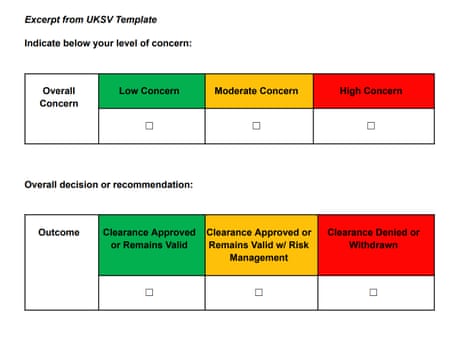
The No 10 briefing implied that UKSV ticked the red boxes.
Whittingdale said that a red box tick did not sound like a borderline judgment.
Robbins said, before he had seen the No 10 document, he had never seen a form like that.
He went on:
I certainly do not recall the way in which the UKSC findings were presented to me as being that definitive. As I say, it was briefed to me that they were leaning against. I think it’s the phrase I remember.
Robbins said UKSV had also considered if the risks could be managed.
After they took a view on that, they came to him with a decision, he said. He said there were only two people in that meeting – him and the UKSV director of security.
Analysis on Robbins' revelation about the Cabinet Office saying security vetting not needed

Henry Dyer
Henry Dyer is a Guardian investigative correspondent.
Olly Robbins has given remarkable evidence so far. He has spoken about the pressure the Foreign Office faced from Downing Street – weeks before he took the top job – about ensuring Peter Mandelson made it to Washington as ambassador. That included, Robbins claims, a discussion between the Cabinet Office and the Foreign Office as to whether or not Mandelson even needed to go through the vetting process.
Robbins said his predecessor had to be “very firm in person” about the necessity of Mandelson to face vetting in the days leading up to Christmas, in the face of arguments from the Cabinet Office that there was no need for Mandelson to face vetting, given he was a member of the House of Lords and a member of the privy council.
Given nearly all staff – including junior civil servants – in the Foreign Office require DV clearance, it would have been astonishing for the man in the top British diplomatic posting to not have received the same security clearance.
Robbins refuses to say if Mandelson's security vetting threw up concerns not 'already in public domain'
Thornberry asked if the vetting process threw up anything “that wasn’t already in the public realm”.
Robbins said he would not answer that because the whole process relies on confidentiality. People comply because they know that they say will not be disclosed.
Thornberry said she was not asking what the new information might have been.
Robbins said, if he said new information came out, people would ask what it was.
Thornberry said she would not do that.
Robbins replied:
I trust you. I’m not sure that the whole of the rest of the world will hold off from wanting to know.
Robbins says Mandelson's vetting decision 'borderline'
Robbins confirmed that the decision about Mandelson’s developed vetting was “borderline”. (See 8.57am.)
I was told that UKSV [UK Security Vetting] were leaning towards recommending against, but accepted it was a borderline case.
He said that, although reporting suggests this is process you pass or fail, that is now how the system works.
Robbins says he does not know if Morgan McSweeney was behind No 10 trying to rush Mandelson appointment
Thornberry asked Robbins if Morgan McSweeney, the PM’s chief of staff, was the person putting pressure on the Foreign Office to push through the Mandelson appointment. She said:
We do know that Morgan McSweeney was a protege of Peter Mandelson, and we know that he was very keen on Peter Mandelson getting the job, and we know that he resigned, saying that it was all his fault and that he had advised the prime minister to appoint Peter Mandelson and took it on the chin.
Robbins said, when he said he didn’t know who the individuals were, he meant it.
Cabinet Office suggested Mandelson did not even need security vetting, Robbins tells MPs
In his letter to the committee, Robbins says the Cabinet Office suggested that Mandelson would not have to go through security vetting. He says:
After the announcement, I believe the Cabinet Office (CO) raised whether Developed Vetitng (DV) was actually necessary. I understand the FCDO insisted that DV was a requirement before Mandelson took up his post in Washington.
Thornberry asks about Robbins’ phone.
Robbins says he has had to hand in his official phone. But the messages were downloaded, he says.
Thornberry asks if there was a record of all the calls for No 10.
Robbins says if civil servants minuted every call they took, they would never get anything done.
Robbins says Foreign Office was under 'constant pressure' from No 10 to push through Mandelson appointment
Robbins says the Foreign Office insisted developed vetting would have to go ahead.
Thornberry is asking where the pressure for the appointment to go through very quicky was coming from. (See 9.14am.)
Robbins says that in January 2025 his office, and the foreign secretary [David Lammy’s] office were “under constant pressure”.
“There was an atmosphere of constant chasing,” he says.
Asked who this was coming from, Robbins says it was “private office to private office”.
Thornberry asks for the names of those putting pressure on the Foreign Office to expedite the appointment and the vetting process.
Robbins says he does not want to give names.
I didn’t come here today to put scapegoats other civil servants. I came here to make sure the committee understood the circumstances.
Robbins says, when he started as permament secretary, it was not even clear that Peter Mandelson would have to go through the developed vetting process.
Robbins says No 10 wanted Mandelson in US 'as quickly as humanly possible' before security vetting started
Robbins starts by saying that when he started as permanent secretary, the Mandelson appointment was well under way. He says:
I wasn’t walking into a vacuum. I arrived to a situation in which a due diligence report had been undertaken into Mandelson by the Cabinet Office, assessing the reputational risks and his fitness for office.
The prime minister had then presumably taken advice on his fitness for office.
The name had been submitted to the king as ministers’ recommendation.
The prime minister had made an announcement that Mandelson was his nominee without caveats.
The British government had sought agreement, the formal diplomatic process for a host government accepting a nominee from the US government, and that had been obtained before I arrived in post.
He’d been given access to the building. You’ve been given access to low classification [information]. And, from time to time for case specific issues, he was being given access to higher classification briefing.
So I’m afraid I walked into a situation in which, there was already a very, very strong expectation [that the appointment would go through].
Robbins also said that “coming from No 10” there was an expectation that “he needed to be in post and in America as quickly as humanly possible”.