3 months ago
136
3 months ago
136
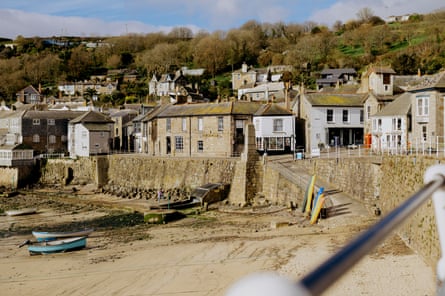
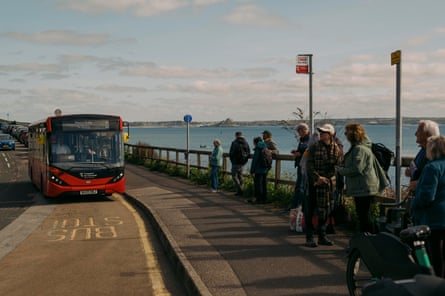
It’s early April and the sun is shining over Mousehole, Cornwall, as an older couple trudge up the hill to their nearest bus stop before sinking into two of the plastic chairs that have been lined up on the side of the road. Until recently, buses would come right to the centre of the fishing village, the couple are soon explaining to a pair of Australian tourists also waiting for the bus. But when the bus route was taken over by the Go-Ahead transport group in February, the small, ice-cream-van-like buses that had been used by the previous bus company, First Bus, were swapped for full-size buses – some of them double deckers – that wouldn’t be safe to drive through Mousehole’s narrow streets. So the route, which has been taking passengers down to the harbour since the 1920s, was cut short, and now ends at the edge of the village.
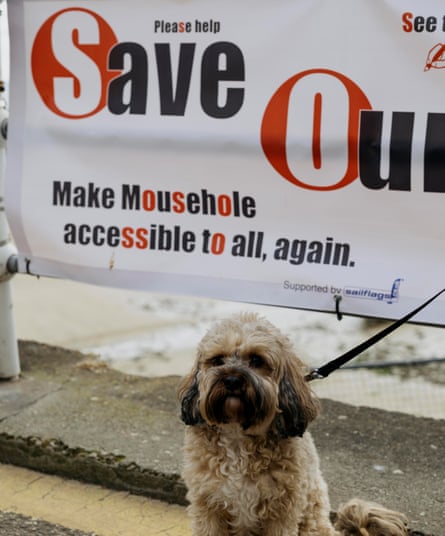
You don’t have to spend long in Mousehole, described as “the loveliest village in England” by the Welsh poet Dylan Thomas, to learn of residents’ dismay over this change. “Save Our Stop” flyers have been stuck in the windows of houses and businesses, while a banner adorns the railing next to where the old stop used to be, inviting passersby to sign the petition to have it reinstated and “make Mousehole accessible to all again” – a petition that now has more than 5,000 signatures.
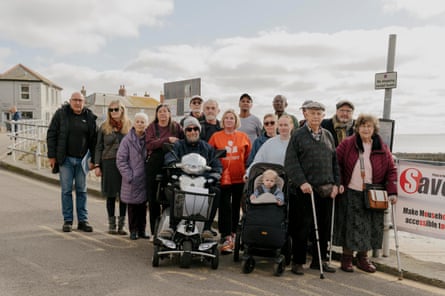
For now, residents are trying to make the best of the situation, and have tied garden chairs to the railings near the new stop with rope (to stop them from being swept away by a gust of coastal wind). “We call it the oxygen station,” 83-year-old Judy O’Shea tells me, since the village’s elderly residents, who make up approximately 40% of Mousehole’s population, often need to catch their breath after walking from the centre or the west side of the village. It’s not a long walk, but it’s uphill, and there aren’t pavements.
“For me, it’s out of the question,” says O’Shea, who has lived in Mousehole for the last 54 years – she’s got arthritis and uses a stick to walk. Since she doesn’t currently have a car, she had been using the small bus at least three times a week, “so it’s a big loss”. When a friend picked up her and her husband to take them to a hospital appointment earlier in the week, “we were really excited” just to get out of the house, she says.
Another Mousehole resident, Hannah Devenney, tells a similar story. The 50-year-old’s whole family has been affected: from her children, who used to catch the bus on their own but whom she doesn’t want walking up a road with no pavements, to her disabled mother and her stepfather who has emphysema. Devenney’s own health issues – she has spinal arthritis – have meant that she has gone from catching the bus “most days” to almost never. “I’ve probably used it twice since it’s moved,” she says. “It’s getting quite hard for me to walk,” so she has switched from shopping in person to online orders, she explains. “It’s made me feel more isolated.”
Mousehole might seem like a lovely place to be isolated, with its tiny harbour lined with stone cottages – but, as Devenney explains, “There’s no cash machine in the village.” Nor is there a pharmacy, or a food shop other than a high-end deli. A round trip to nearby Penzance in a taxi costs approximately £35, she says.
The loss of the bus stop is “another example of hollowing out Mousehole”, says Tim Pullen, 67, who also lives in the area. “Another thing that makes it more difficult for people to live here full-time. It’s becoming a sort of shell holiday village.” When he first moved to Cornwall in 1998, Mousehole had its own butcher, post office and general store. “That’s all gone now,” he says. He and his neighbours “have accepted” the cut in the service from three buses an hour down to two. “Obviously, it’s very seasonal here,” he says, so he understands why compromises have to be made. But the harbour bus stop is worth fighting for, he thinks: “It’s a lifeline for people in the village.”
Buses aren’t a statutory entitlement, but, as the Mousehole case illustrates, cuts to services can incite strong public feeling. Bus stops are “a shop window for public transport”, says Michael Solomon Williams, head of external affairs at the Campaign for Better Transport. That means that when a stop is taken away, or the frequency is reduced – or even if the stop itself isn’t well maintained and fails to provide up-to-date information – people develop a negative opinion of the public transport system, and stop using it, exacerbating the problem further.
The current system clearly isn’t working well enough: almost a fifth of England’s rural bus services were cut in the past five years, it was revealed in June, and even London has lost 40 bus routes in the last two years.
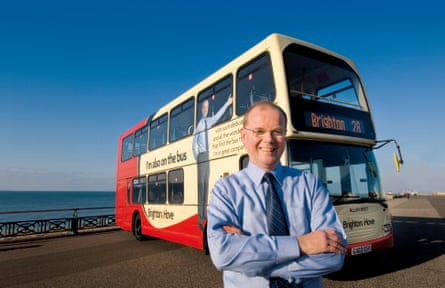
“Money within the bus industry is getting shorter and shorter,” says Richard Stevens, managing director for Go South West, who made the decision to change the Mousehole route. Patronage “hasn’t recovered to pre-Covid levels”, he adds, “but also the way buses are funded has changed. When the government introduced the £2 flat fare, they capped the amount of revenue that a bus operator can charge. It’s now gone up to £3, but even that change from £2 to £3 triggered further passenger decline nationally.”
Operating costs for bus companies have gone up, as have living costs for passengers. “It’s not a healthy place to be,” Stevens says. “I’ve been arguing that funding needs to be weighted to rural areas for social inclusion. But at the moment, the way the reimbursement is calculated tends to favour high-density urban areas and longer routes.” With fuel prices increasing due to the war in Iran, it is becoming increasingly difficult for bus companies to make any money while ticket prices are capped as they are, he says. “It’s really, really challenging.”
The decision to change the Mousehole route, which also stops at the fishing port Newlyn, “was not done through ignorance”, says Stevens. He’s a former bus driver himself and the Mousehole route was one of the first he ever drove. But though he cares about keeping Cornwall accessible, the previous provider, First Bus, “landed themselves in a loss-making situation”, he says. Cornwall council subsidises approximately half of the bus services in the county, but the Mousehole route falls into the other half – the more well-used half that, pre-Covid at least, was deemed profitable enough to be run as a commercial service. “No bus company’s getting rich these days with current funding models, so while I am a stable company, I couldn’t afford to take on the kind of losses that they were incurring,” Stevens says.
“There isn’t a bus that is small enough to navigate Mousehole, that’s big enough to be commercially sustainable for the whole route, and that’s the conundrum,” he says. After attending a meeting with more than 100 residents to discuss the issue, Stevens says he committed to looking into the possibility of a medium-sized bus that could be driven safely through Mousehole’s streets but also fit enough passengers on board to turn a profit. “I’ll have a look at it, but I’m not hopeful we can do that,” he says.
With the very small buses, “people were being left behind” as buses filled up too quickly, he adds. While the Save Our Stop campaigners dispute this – none of them had ever seen people being left waiting at bus stops – local Liberal Democrat councillor Thalia Marrington says constituents had mentioned to her that they hadn’t been able to board the bus. And Roger French, who writes about public transport on his blog BusAndTrainUser, says when he rode on the old bus last summer, it was “full up when we left Penzance”. Though passengers were squeezed on along the route, they were standing right up to the front of the bus, which “wasn’t particularly safe in my judgment”, French says.
The blogger also questions the safety of the new large buses, which still have to navigate narrow coastal roads, despite not travelling all the way down to the harbour. “I personally have some concerns at the reversing arrangement that the poor drivers have to do to turn the bus round,” he says. Before the minibus-sized buses, the route was serviced by a bus “that was a bit bigger than a minibus, but not quite as big as a single deck”, French says – a size that might be a good option for this route to return to, he thinks.
For now though, while it’s “so sad” to see the end of the “absolutely idyllic” bus stop in the harbour, he thinks it’s “worth persevering with the new arrangement … and seeing how the residents feel after a while”.
“There’s never enough money for the best possible rural bus network that you could ever hope to have,” French says. His view is that Cornwall council has done relatively well in terms of government funding: between 2022 and 2025, it has been awarded £13.3m to improve bus services.
Nationwide, the £3bn investment in buses promised by Boris Johnson’s Bus Back Better plan shrank to £1.4bn in 2022. A total of £2.1bn in bus service improvement plan money from successive governments was eventually allotted, and Labour promised its own £3bn boost to buses at the end of last year. Funding alone is not enough, though – it must also be allocated carefully, French says. As someone who spends his “whole life travelling around the country on buses” and generally comes away “very positive”, sometimes he sees a “waste of public funding going into services that don’t stand any chance of success”.
Marrington, who represents Mousehole, Newlyn and St Buryan, says she “would like government ministers to come and see for themselves what rural transport actually looks like and the challenges we face here”. Many services “cost more to run across large, sparsely populated areas like Cornwall” – yet current funding doesn’t reflect that, she feels. “Our communities deserve a decent, reliable public transport system, and I will continue to stand up for that,” she says – although she notes that she doesn’t have “a lot of power” to influence the Mousehole bus stop issue in particular, since the route is not one of the council-subsidised ones. That hasn’t stopped some of the campaigners directing blame her way, though – and it has become “quite personal at times”, the councillor, who lives in Mousehole, says.
She hopes the residents will be receptive to alternative solutions to bridge the gap for those who have difficulty getting to the new bus stop. “I’ve been looking at community-based ideas, like car-sharing schemes, which the council is promoting in this area, and looking at areas where they have sorted out their own community volunteer-based transport solutions,” she says. But is it fair for buses to be replaced by community-run services? Solomon Williams of the Campaign for Better Transport does give some credit to central government because, when it comes to buses, “the direction of travel is generally good”, he thinks – Labour has changed the service funding from a competitive bidding model to allocation based on need.
More needs to be done to improve bus services across the UK, because “transport connectivity creates opportunity”, he says. “It connects people to jobs and opportunities and economic growth. So the more bus or train connectivity you have, the wealthier a community is going to be, the better it will be for quality of life and economic chances for people living in those areas.”
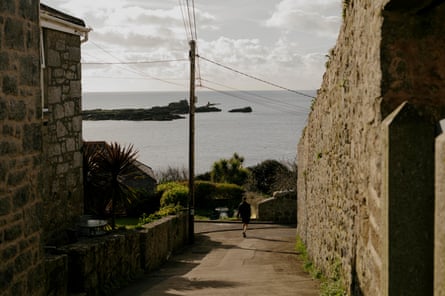
The Campaign for Better Transport’s 2021 report on “left behind” neighbourhoods found that in many areas where car ownership is lowest, public transport provision is also low. “So it’s kind of a vicious cycle. And therefore, they’re more isolated,” Solomon Williams says. “It exacerbates economic inequality. What we need to see is a balancing out of that.”
He is encouraged by the Mousehole residents’ action, though he also appreciates the difficult decision-making faced by bus companies and local authorities. “It’s fantastic to see how much people care about their bus stops,” he says. “When the response is so clear from the community, they need to look again at what’s possible.”