7 hours ago
14
7 hours ago
14
With glasses of champagne sipped among the peonies, Chelsea flower show is generally a friendly and genteel occasion. But this year, the secateurs have been drawn as gardeners clash over the use of AI in designing the exhibits.
Matt Keightley, an award-winning designer who has created gardens for figures including Prince Harry, is using artificial intelligence to design his garden for the prestigious show, held at the Royal Hospital gardens in Chelsea, London, next week.
He is launching a new app, Spacelift, which reportedly can replicate the work of garden designers and create spaces from scratch.
Keightley said: “We’re used to using technology to design every part of our homes – except our gardens. Spacelift changes that. It gives people a starting point, a plan, and the confidence to actually create something – not just imagine it.”
Horticulturalists have expressed alarm that their work could be automated in this way.
Andrew Duff, the chair of the Society of Garden and Landscape Designers, said: “Successful garden design is an art form. It is rooted in creativity, collaboration, experience and human connection.
“While technology may offer useful tools, it cannot replicate the insight, empathy and personal engagement that comes from working with a skilled garden designer to create a living, evolving natural space within the home.”
Yvonne Price, a garden designer who has exhibited at RHS Hampton Court, said Chelsea should not be giving the AI garden a platform: “That it’s being shown at Chelsea – which is the world-leading show for garden design – feels like a betrayal.”
Nadine Mansfield, an award-winning designer, asked: “What time does the job centre open?”
Some gardens already make use of AI to tell people when they should water plants, or to map which species of flower might be appropriate as the climate changes.
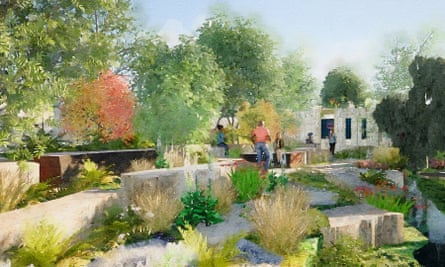
The Chelsea gold medallist Tom Massey has worked with AI before, but never to design his gardens. At last year’s Chelsea he created a garden where visitors could “listen” to urban trees, with sensors monitoring growth, sap flow, soil conditions, air quality, and weather patterns. AI was used to track this data and spot patterns and problems.
However, Massey said, that was completely different from “robot designers”. “I don’t think we will see robot designers going out there doing surveys and designing gardens. I don’t think many people would like the idea of that. I am worried about it, I am worried what it will do to the industry. You could give an AI all my designs and it could produce something very similar to that,” he said.
He added that a garden designed by AI would be inferior because “it doesn’t have that physical body and interaction with a natural space that I think you need”.
The AI app is exhibiting three full-sized gardens at Chelsea, which will be designed entirely by using the platform. They include a rural-inspired scheme using reclaimed materials, a compact urban balcony garden, and a woodland-themed wellbeing space incorporating a sauna and cold shower.
Spacelift disagrees that garden designers would be out of a job because of the app. Alexandra Davison, the head of PR and partnerships at Spacelift, said: “The platform is designed to serve the vast majority of UK homeowners who are currently priced out of professional garden design entirely. It doesn’t compete with designers, it expands the market. Spacelift users who go on to invest in their gardens are better informed, arrive with clearer briefs and more realistic expectations, which benefits the entire profession.”
Duff said his guild would be campaigning to show the value of human work in garden design: “AI may become a useful tool for inspiration, visualisation and concept exploration, much as CAD evolved to support the design process, but it cannot replace the human understanding, creativity, accountability and experience that sit at the heart of successful garden and landscape design.
“As chair of the SGLD, I see this as an opportunity to communicate more clearly than ever the value professional designers bring – creating gardens that are thoughtful, functional, sustainable and deeply connected to both people and place.”