5 hours ago
10
5 hours ago
10
On Wednesday evening, millions of Europeans will experience a celestial treat: a solar eclipse. A wide band of north and central Spain, plus a sliver of Portugal and parts of Greenland and Iceland will experience a rare total eclipse. The light of the setting sun will be virtually blocked out across much of western Europe, including the UK, France, Belgium, Switzerland and northern Italy.
Here’s what you need to know:
What is a solar eclipse?
A solar eclipse occurs when the moon passes directly between the Earth and the sun, resulting in the moon casting a shadow on the Earth.
Viewers see a total solar eclipse when the sun’s light is fully blocked by the moon – meaning they are in the umbra of the moon’s shadow – and a partial solar eclipse when only part of the light is blocked, meaning they are in the penumbra of the moon’s shadow.
“The moon and sun have to line up precisely for the moon to fully cover the sun and for you to see a total eclipse,” said Dr Megan Argo, a reader in astrophysics at the University of Lancashire and the vice-president of the Society for Popular Astronomy. “Because the orbit of the moon is slightly tilted, it doesn’t appear to cross the disc of the sun from our perspective each time it orbits the Earth.”
Whether viewers see a total or partial eclipse – or no eclipse at all – depends upon their location on the Earth’s surface. “You have to be right in the middle of the shadow to see a total eclipse, and that is quite a narrow track on the Earth’s surface,” said Argo.
How rare is Wednesday’s event?
This total eclipse will be the first in mainland Europe in two decades. The last event of this kind visible from the UK occurred in 1999, when parts of Devon and Cornwall were in the path of totality. The next total solar eclipse visible in the UK is not due to occur until 2090.
While the country will only experience a partial solar eclipse on Wednesday, experts are enthusiastic, noting the next comparable event visible in the UK will be in 2081. “This is the best [solar] eclipse that we’ve had in the UK since 1999. There have been a few other partial eclipses, but not one that’s this deep, which has this percentage of the sun eclipsed by the moon,” said Argo.
When will it take place?
For those watching in Spain under the path of the total eclipse, it will peak between 20.26 and 20.33 local time, depending on location, shortly before sunset.
In the UK, the Royal Observatory Greenwich calculates that the partial eclipse will begin for viewers in London at 18.17 BST, before reaching its maximum at 19.13 BST and ending at 20.06 BST. Dr Carys Herbert, an astronomer at Royal Observatory Greenwich, said people in Cornwall would experience about 96% coverage, while people in the west of Scotland would experience 93% coverage and people in London would see about 92% coverage.
“It will be low on the horizon,” said Herbert. “So anyone who is wanting to go and see it should probably find a spot with a nice view to the western horizon without any buildings or trees in the way. Everyone in the UK is going to have a very good eclipse.”
How can I view the eclipse safely?
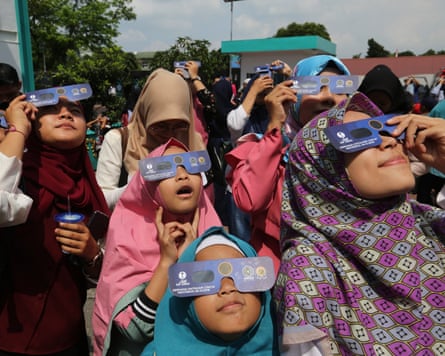
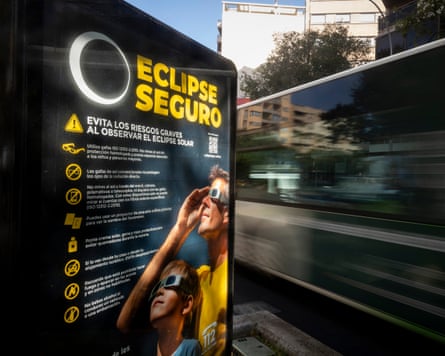
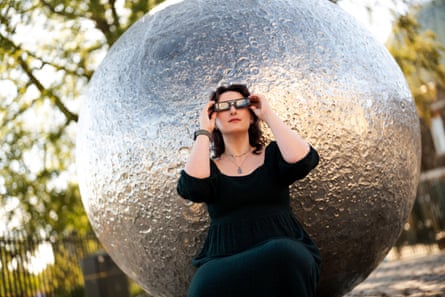
Experts have stressed it is crucial not to look at the sun with the naked eye, or to rely on sunglasses, noting it can cause permanent eye damage. Instead, they recommend buying special eclipse glasses.
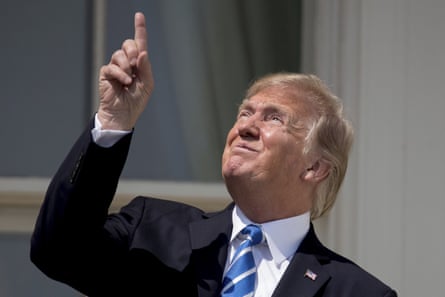
During a 2017 eclipse, Donald Trump was widely mocked for looking up and pointing at the sky during the solar eclipse without glasses, despite repeated warnings that doing so can lead to permanent eye damage. He later donned eclipse glasses.
“If you don’t have eclipse glasses, you can use a colander or something to create a pinhole projector,” said Herbert. This is a way to see the eclipse indirectly – do not look at the sun through the colander but project the light on to card or paper.
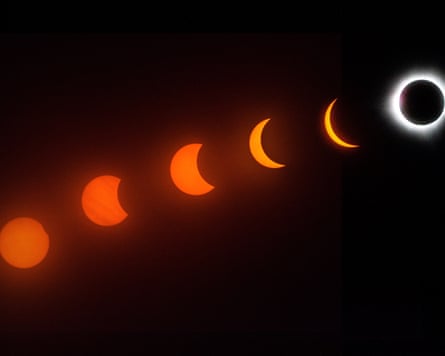
Assuming that clouds don’t block the view, the spectacle will resemble a growing bite being taken out of the sun’s disc as the moon moves in front of it, until only a slim crescent is visible. As the moon moves away, the sun will gradually return in its full glory.
Why are scientists excited?
“There are scientific things that we can do during eclipses,” said Argo, as it offers one way to study the sun’s outer atmosphere – or solar corona. “It can tell us a lot about the chemistry of the sun’s atmosphere, [and] how the atmosphere varies depending on the sunspot cycle and the solar activity cycle, which goes through an 11-year cycle,” she said.
There have been other important experiments.
“Back in the 1919 solar eclipse, there were expeditions to go and measure the position of the planets and stars close to the sun during the eclipse to basically confirm Einstein’s theory of general relativity,” said Argo.
Herbert added that a solar eclipse meant the sun, moon and Earth were in the same plane. As a result, lunar eclipses – where the Earth sits directly between the sun and the moon – occur a couple of weeks before or after solar eclipses. In this case, a partial lunar eclipse will be visible in the UK just after 5.00am BST on 28 August.
“What happens is, the light sort of bends around the Earth a bit and actually it’s what people call a blood moon. It really sends the moon red,” Herbert said. “It should be quite impressive.”
The Perseid meteor shower is expected to reach its peak overnight on the 12-13 August – so it may be worth staying out after the eclipse to catch a glimpse.