3 hours ago
13
3 hours ago
13
In the boot of her car, Pratelle carries the corpse of her mother and a giant sledgehammer. Her mission is simple: take the hammer to her home town. As you enter shops and homes through the door and leave them through the opposite wall, it becomes clear that the robots who either attack you or flee are all digital versions of your old neighbours.
Pratelle, with her close-cropped hair and dungarees, read to me as a queer woman, but interestingly, testers of the game often mistook her as a man. The team at developer Deconstructeam and longtime collaborator Selkie Harbour didn’t anticipate this confusion but found it fits the character perfectly, especially in this setting based on a small Spanish town like those in which the developers grew up.
“These towns are culturally living a couple of decades behind, especially regarding subjects such as queerness,” says game director, writer and Deconstructeam CEO Jordi de Paco. “Maybe these communities aren’t ready to acknowledge that they have other identities within them – and Pratelle is exactly that. She is someone who doesn’t fit the community, but her very existence makes the community ask questions about identity, even if it’s through confusion and anger.”
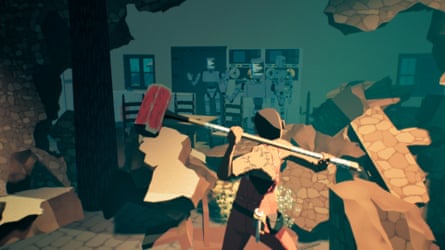
Many of the robot villagers react to Pratelle with vitriol, but some flee or beg for their lives, which feels harrowing despite their identical bodies. The villagers remember what it was like to have a body, a plot point the full game will explore in detail.
The most important part, however, is Pratelle’s story, which you uncover by hitting glass statues around town that contain fragments of memory. It seems as if Pratelle’s own sister turned everyone into robots, which is one of the reasons she rebels with what she calls “20 pounds of physical media”. But Virtue isn’t meant to be read as a critique of our increasingly digitised lives. Instead De Paco created a family story of a “sometimes embarrassing teenager” to contrast with the otherwise futuristic themes of the game.
“Back in 2024 we designed a prototype with a pretty stereotypical story about transhumanism,” he says. “We had some friends play it and got the feedback that the themes were stale, so we decided to use the setting as more of a metaphor and came up with the feeling of not belonging. Suddenly the aesthetics and themes felt really powerful in contrast with the destruction of buildings and facing robots.”
A game about straightforward destruction seems to fit oddly with Deconstructeam’s prior body of work, such as the thought-provoking narrative experiences The Red Strings Club and Many Nights a Whisper. “We’re constantly joking about this being our first actual game because you’re not making a proper game unless you destroy something,” laughs De Paco, who even tried to take a sledgehammer to a real ruin for research.
“In Virtue, you’re being made to destroy the place you grew up in. Despite the combat, the game is a narrative experience. It’s not meant to be challenging; it’s more of an aesthetic choice. We think of Virtue like a walking simulator: you go through a space and solve the narrative, and the game isn’t designed around combat. We want everyone who plays this game to reach the end.”
-
Virtue and a Sledgehammer is in development for PC. Release is planned for later in 2026