2 months ago
197
2 months ago
197
When Liberal Democrat MP Tom Gordon spoke earlier this month in the commons of the “militarisation of children”, he wasn’t warning of a generation suddenly taking arms. He was talking about a cartoon bear. Gordon, along with a cross-party group of more than 50 MPs, had written a parliamentary letter urging that an animated children’s show be banned on the basis it is Russian propaganda.
The accused animation is Masha and the Bear, a Russian programme aimed at preschoolers. The show is one of the most popular series on YouTube, and is available in the UK on ITVX and Netflix. The programme follows the adventures of the young, pink-hooded Masha and her brown bear companion in a remote woodland. But MPs – as well as Ukraine’s Center for Countering Disinformation and Estonia’s minister for foreign affairs – see Masha’s use of Soviet-era military costumes as a flex of Russian “soft power”.
Cartoons as propaganda have a century-long history. The earliest examples can be traced back to the first world war, according to David Welch, emeritus professor of modern history at the University of Kent. “All belligerents employed them,” he says. One of the most prominent British animators in 1914 was Lancelot Speed, whose “lightning sketches” featured him drawing ridiculous caricatures of Kaiser Wilhelm II haunted by ghosts, wearing dresses and being turned into a sausage. “These proved hugely popular with cinema audiences,” Welch adds.
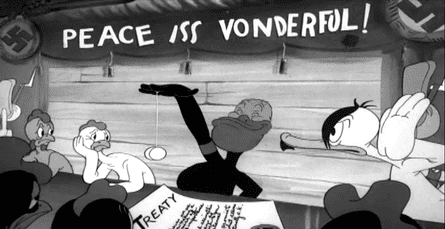
But the use of propaganda cartoons exploded in the second world war. According to Welch, the stretchy and slapstick cartoon characters in the slowly maturing animation industry were perfect for the humour-led propaganda films of the early 1940s. “The boom was also because of the technological advances in animated film production and the rise of specific global – mainly USA – companies devoted to such productions,” he says.
Some of the biggest animation studios at the time had a hand in hand-drawn agitprop: Warner Brothers produced The Ducktators, in which Hitler, Mussolini and Tojo are depicted as maladjusted mallards who end up stuffed above a mantelpiece; in Daffy – The Commando (1943), a rotoscoped Adolf Hitler gives a speech before Daffy Duck promptly whacks him on the head with a mallet.
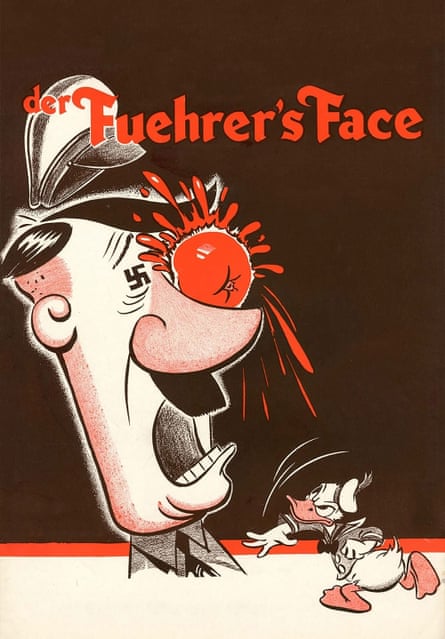
Disney also proved to be a muscular cartoon arm of the US war effort, producing several cartoon propaganda films for the government. The most famous was the Oscar-winning Der Fuehrer’s Face, in which Donald Duck has a nightmare that he lives in Nazi Germany. In one section, Donald reaches the point of exhaustion after repeatedly Sieg Heiling dozens of portraits of Hitler. After waking from his dream, he kisses a figurine Statue of Liberty and proclaims: “Am I glad to be a citizen of the United States of America!”
Many of these US wartime films featured racist caricatures and insults. Bugs Bunny featured in a now-banned Warner Brothers cartoon titled Bugs Bunny Nips the Nips, where the iconic rabbit used multiple racial slurs.
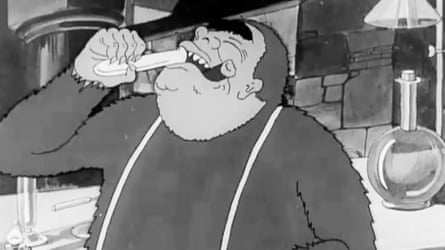
The Axis powers also produced films for their own audiences . Fascist Italy released 1941’s Il Dottor Churkill, where a hairy, sharp-toothed Winston Churchill is depicted as a Jekyll and Hyde monster who plunders gold from people at home and abroad. In 1943, under the orders of Nazi Germany, Nimbus Libéré was released in Vichy France to portray a potential allied invasion as dangerous. In the film, an antisemitic caricature in London orders Mickey Mouse, Felix the Cat, Popeye and other cartoon icons to bomb a family to smithereens.
As capitalism and communism butted heads during the cold war, propaganda shifted to differences in ideology rather than sheer military might. Britain’s first animated feature film – 1954’s Animal Farm – was also marred by political influence, albeit more covertly. Decades after its release, it was discovered that the adaptation of George Orwell’s tale was funded by the CIA. The film famously diverted from the novel’s original ending, preferring to have the farm animals successfully revolt against the pigs – a broad hint of support for the overthrow of communist governments.
Although there have been some heavy-handed outliers – such as the environmentally conscious Captain Planet and the Planeteers – cartoons with overt messaging had taken a break by the end of the 20th century. But as digital animation software became more readily available in the 2000s, individuals began to produce their own propagandistic ’toons without the use of state-subsidised studios.
In the aftermath of 9/11, the internet was awash with support for US intervention in the Middle East in the form of crude animations of Osama bin Laden made in Adobe Flash. Many featured 2D versions of the al-Qaida founder being shot, tortured and generally mocked. In one widely shared animation released a month after the attacks, a pixelated Colin Powell sings a parody of Harry Belafonte’s song Banana Boat where he pleads: “Come Mr Taliban, hand over Bin Laden”. Meanwhile, George W Bush plays the bongos as the Saudi-born militant dodges a barrage of missiles.
Both sides came to use cartoons at one point or another. While better known for publishing graphic recordings of beheadings, the Islamic State briefly took to producing child-friendly animations disseminated over YouTube and Telegram.
This lowering financial barrier to animated propaganda eventually began to blend with the explosion of online meme culture.
Murdoch Murdoch, a far-right cartoon series that began in 2015, revels in open racism, misogyny and Nazi ideology – and was created using pre-existing internet memes on forums such as 4chan. In one episode, the SS-uniformed protagonists travel back in time to redpill the Beatles.
The last 15 years have seen an uptick in war cartoons. Kristián Földes, a lecturer and academic researcher at Charles University, Prague, studied animated propaganda made during the ongoing Russo-Ukrainian war, and found that both sides were reacting to one another through cartoon counter-propaganda. “They anthropomorphise states into children, they both use victim-perpetrator or hero-villain narrative arcs, and they also combine the fictional story of the cartoon with real-life events,” he says.
Recently, the cost of cartoon warfare has plummeted. After the start of the US-Israel war on Iran, the Iranian digital media company Explosive Media used generative AI to create Lego Movie-style animations in support of Iran. One video sees plastic versions of Donald Trump and Benjamin Netanyahu paired with the devil, and in another a toy Iranian commander raps insults to the US; both were shared widely on social media. “Distribution through these platforms is easy, effective, and, most importantly, algorithmic,” Földes says. “This fits perfectly with cartoons because visual material, especially videos, spreads much more easily in this environment than mere text.”
The pro-Iran videos fall neatly into a fledgling category of propaganda – “slopaganda” – defined by its use of generative AI. Michał Klincewicz, an assistant professor of computational cognitive science at Tilburg University in the Netherlands, was the first to use the term in an academic paper. Though he reckons most slopaganda is text-based, Klincewicz points out that cartoons excel at communicating emotions, rather than facts. “[The] videos would not have worked so well if they were realistic depictions.” Földes agrees: “Our current infrastructure is designed to verify or falsify factual claims, not narratives and stories.”
Földes says he can’t be sure if Masha and her bear are propagandists without further study. “There are obvious symbolic elements throughout the series,” he notes. “The bear, for example, quite clearly symbolises Russia. However, compared to the Russian cartoon that we analysed – which was specifically produced as a piece of propaganda – Masha and the Bear exhibits these propagandistic elements only episodically.”
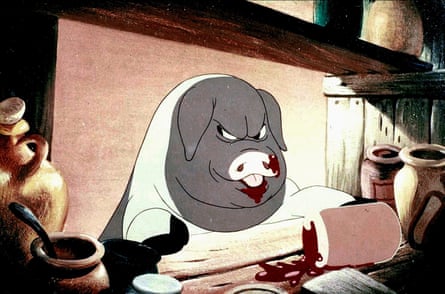
Whether Masha and the Bear will stay on screens is yet to be decided. And while propagandists will probably stay unquashed online, it begs the question: will the eraser finally come for their cartoons? Klincewicz doesn’t think so. “The idea is to deliver a message in a form that is more familiar, less threatening, or that elicits affective responses,” he says. “So if we see a cartoon of a death camp kapo as a pig, as opposed to a realistic human being, we get a particular association. I don’t see that changing any time soon.”