3 months ago
102
3 months ago
102
Early on in his documentary, Changing the Game for Young Men, in that relaxed introductory section where the famous host is at home, fondling mementoes and chatting about their life, Gareth Southgate reveals he was unsure what to do next when he stopped being England football manager. Many of his admirers wish he would enter politics: they dream of him being a witty, kind presence in Westminster, a compassionate antidote to liars and clowns.
Southgate has so far demurred, and here we glimpse what he may do instead. Changing the Game, an assessment of how Britain is failing a generation of demotivated young males, is politics with a politely lower-case “p”. Every problem it identifies is the result of a big political choice, which Southgate ignores before offering a small-scale solution. It’s certainly well-meant, but its limitations are frustrating.
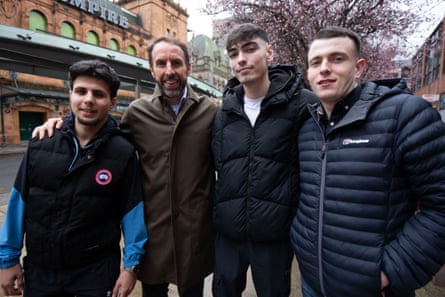
After a visit to a thinktank seminar setting out the basic issues, Southgate’s first field trip returns him to his old stomping ground of Middlesbrough, where as a player and manager he witnessed the decline of the town post-deindustrialisation. He has a heartbreaking chat with three men aged 19 and 20 who cannot find regular employment: with hundreds of applicants for each vacancy, they rarely even get feedback on why they weren’t suitable. They’re just ignored. One says he’s had to snap himself out of suicidal thoughts. All three are remarkably resolute.
“You’re doing really well to keep yourselves on track,” Southgate assures them. “You’ve got to give yourselves the best possible chance.” He tries to use the setbacks he overcame in his sporting career as inspiration for a message of hope, a theme he reprises later on when he gives a talk in a prison. “What’s gone you can’t do anything about,” he tells a group of prisoners, many of whom came from similar circumstances as the Middlesbrough lads and succumbed to the lure of crime. “But what your future is, you can do something about. I ended up managing England!”
Southgate is aware of his privilege, and coming from him these homilies don’t feel as patronising as they would from virtually anyone else. It’s heartfelt advice, given in a spirit of comradeship that is all you have if you’re not discussing how the industries that used to keep places such as Middlesbrough afloat were deliberately not replaced, leaving whole communities to rot as economic stimulus was stigmatised as “spending”. What would happen if, say, a government scheme to insulate every home in Britain offered those Middlesbrough boys a job? They’d soon repay the investment, but we are operating in a world where ever-declining opportunities are a fact of life.
When Southgate looks at British schools, he observes that boys who struggle in an academic environment can be too quickly dismissed as troublemakers; that it would be good to have more vocational training on top of the regular curriculum; that boys not growing up with a dad in the house cry out for male mentors, so it would be beneficial for more schools to run a scheme like the (fascinating) one he sits in on, where male teachers put on an extracurricular class that allows boys to discuss their emotions and ambitions.
Gareth! The core issue there is underfunding, caused by austerity politics! Teachers might have scope to give male students what they need if they had smaller class sizes, if there were still a teaching assistant in the classroom, if the school could afford better facilities! This isn’t mentioned; a conversation with a “policy adviser” about the challenges schoolboys face is pure waffle.
The closing segment of the film demands a win of some kind, which Southgate finds by arranging for one of his three Middlesbrough pals to volunteer with a community environmental project. A day of wellies, wheelbarrows and interacting with other adults beats staying at home, alone and overlooked. Meanwhile, on match day down at Hitchin Town FC, Southgate roams the terraces, challenging blokes to give up an hour a week to help a local hero, Dan Gaze, whose after-school schemes keep boys out of mischief.
This tinkering at grassroots level does have value: on an average day, an individual citizen can’t smash that many macro political paradigms, so community organising is the best available option, even if you ideally wouldn’t forget why such work is necessary. One informs the other. Southgate’s role in that may well include television, since he shows himself here to be excellent at every skill required, from narration and pieces to camera to engaging productively with interviewees.
A second career as an ambassador for social cohesion, somewhere between Freddie Flintoff and Gareth Malone? That may be as far, politically, as Gareth Southgate is willing to go.
Gareth Southgate: Changing the Game for Young Men aired on BBC One and is on iPlayer
In the UK and Ireland, Samaritans can be contacted on freephone 116 123. In the US, you can call or text the National Suicide Prevention Lifeline on 988, chat on 988lifeline.org, or text HOME to 741741 to connect with a crisis counselor. In Australia, the crisis support service Lifeline is 13 11 14. Other international helplines can be found at befrienders.org