3 months ago
192
3 months ago
192
“Before every tournament there are always concerns,” Kelly Cates says as she approaches her fifth World Cup as a television and radio presenter. “There’s always something everybody’s worried about. This time I worry about the humidity and the altitude for the players and there are political concerns, obviously.
“But there are also concerns that it’s not going to feel like a World Cup. In the US, they probably see that as a good thing. They probably see it as: ‘We’re going to make it better.’ Whereas we’re looking at it from a more traditional point of view, thinking: ‘Why are you going to change something that’s so amazing in the first place?’”
Cates, who will present World Cup games on BBC television and Radio 5 Live, worked in Russia in 2018 and Qatar four years later, and she does not try to sidestep that we are about to be immersed in a tournament that takes place mostly in Donald Trump’s America. It starts in Mexico City on Thursday, and features 13 games each in Mexico and Canada, but the bulk of it will be played in the US.
There is widespread antipathy towards America in Mexico, Canada and Europe and the tournament will unfold against the US’s war in Iran as well as the absurd double act of Trump and Fifa’s grovelling president, Gianni Infantino, who has allowed obscene ticket and travel prices to soar.
“We do try to talk about it all, especially in the buildup,” says Cates who, as always, combines natural warmth with a refreshing willingness to discuss difficult issues. “Once the football gets under way we have this great distraction and that’s the point, isn’t it? But there’s a difficult line between taking the World Cup to countries where it wouldn’t traditionally be, and that can be a genuine force for good, and taking it to countries where it can be hijacked for someone’s political promotion or personal gain.

“But I’m not sure the idea of sportswashing works that well in a World Cup, because I don’t think people really pay too much attention to where it’s being staged. They watch the football and really don’t have that sense of place. I don’t think people watched the Qatar World Cup and thought: ‘I really want to go to Doha.’ I don’t think people watched the 2018 World Cup, even with England reaching the semi-final, and thought: ‘I really must book a flight to Russia.’”
Cates smiles diplomatically when asked how she feels about a World Cup that won’t be able to escape Trump. “I assume, because of his PR nous and skill for self-promotion, he will want to be front and centre. But I’m not sure that has the knock-on effect he will hope for. It might domestically. But he’s the kind of person that anything he does just consolidates what people already think of him now. I don’t think anybody’s changing their minds about him.”
More pressingly, the World Cup will be prohibitively expensive and logistically problematic for fans. “The American sporting experience means they don’t understand why you wouldn’t pay premium prices, ridiculous prices, for huge occasions,” Cates says. “I don’t think there’s an understanding of how that works in a World Cup and that you don’t get the full experience unless the fans can afford to get there. It isn’t an entertainment show like the Super Bowl.”
The 50-year-old then laughs at herself. “But I’m giddy about the fact they’ve decided to put Madonna on at half-time [of the final on 19 July]. I’m very sniffy about half-time shows, but now that Madonna’s going to be there [along with Shakira and the K-pop stars BTS], it has made it a much better idea.”
Cates soon becomes more serious. “But you don’t get the full World Cup experience unless the fans are there, unless you have fans being able to travel in the first place. Not everybody’s going to be able to, either financially or logistically or because of travel bans. So that’s another issue and I think they’re missing out on what makes a World Cup special. They’re hoping they will be able to put razzmatazz around it and bring the American showbiz factor that’s going to make up for [the missing fans]. But it won’t feel like a traditional World Cup.”
Cates is a football fan as much as a media pro. “I’m really wary of saying all these caveats and concerns will spoil the World Cup because when it gets under way you feel the buzz, don’t you? Even for us working in it.”
She draws hope from the way football sustained her in Qatar. “It was quite stressful going over there. We’d had lots of conversations and there was a lot of anxiety about how we would cover it. I was really worried about getting the tone right. I was also concerned with how sanitised the games were going to be.
“There was a coldness at times, but I went to Argentina v Mexico and the stand directly across from us had a peak in the middle and so it felt incredibly high and incredibly far away. It was slightly fuzzy and looked a little bit like old footage of Argentina 1978. It had that vintage feel to it and their fans were incredible.
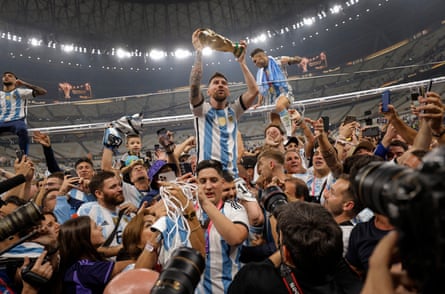
“Bar the Saudi Arabia game, which I’m not too worried about having missed, I went to every Argentina game in Qatar, whether it was to work on or just to watch. I ended up getting so involved, I felt Argentinian by the end of it. There are all these links between Argentina and Scotland so I was like: ‘Right, these are my people.’ So when they won it I was beside myself. That final? What a genuine privilege. And what a privilege to see Messi at close quarters.”
Cates shakes her head in wonder. “We talked about it on 5 Live with Tim Vickery [the South America football expert] and it was like watching an alligator. They sit below the surface and look like a rock and nobody notices them and then they snap. It was so incredible to watch this all-time great in action. Me and my friend, Simon, who was a producer on many of the games, saw a lot of Argentina together. Every now and again we still send each other a text that says: ‘Have you ever seen Messi win the World Cup?’”
Enthusiasm pours out with her laughter and Cates sounds even more excited when we remember how some of the World Cup qualifying matches, especially as Scotland beat Denmark 4-2 in November, were the equal of almost anything else this season.
“I was working for BBC Scotland at Hampden and it was incredible,” she says. “They did a commentary-cam, with a camera on all the pundits, and I ended up sitting in the middle of them. I don’t know how it slipped through the net on social media because what you can see, and a few of my friends noticed, is that when Scotland went ahead with that amazing Scott McTominay goal I’m in the middle going: ‘What a fucking goal.’
“My friends were texting me going: ‘How has that slipped through? We can all lip read.’ It was also so cold and I’ve got really big, heavy gloves on so I looked like someone who’d never clapped in their life. I was so overexcited.
“I did a show with Pat Nevin on the radio last month about moments of the season. Pat said it might be the greatest feeling he’s had, watching or playing, in any game of football. Genuinely, it was so special.
“We’ve had so many years of glorious failure so we all went in steeled for that. After the first goal that euphoria was quickly tempered by a feeling of: ‘Well, we scored too early.’ But there were three more sensational goals and my phone was beeping constantly till four in the morning because nobody could sleep. Everybody was wired.”
Does Cates have some sadness the BBC decided she, her fellow presenters, Gabby Logan and Mark Chapman, and their pundits, will be working in a studio in Salford until the later stages of the tournament? “At first I was a little bit disappointed. But I’m now very much on the positive side and thinking: ‘Do you know what? It would be impossible to get to enough games to cover them.’”
Cates says “we’ll still have a presence. For the Scotland matches, Eilidh Barbour’s going to be there and we’ll have people in the stadium. But when I think about the first Scotland game [against Haiti], I like the idea it’s going to be two in the morning. We won’t be in quite the same headspace as everybody who’s watching it in the pub, but we’re going to be in that slightly unreal, middle-of-the-night, mad World Cup kick-off time zone.
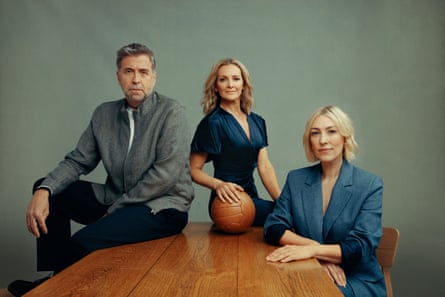
“I’m going to get in Irn-Bru and Tunnocks Caramel Wafers and Teacakes and make it a bit of a party atmosphere in the studio so we’re in the same headspace as people watching at home. There’s something nice in being mentally and emotionally in the same place as the viewers.”
She will do “a mix of TV and radio and then I’m heading out to the US for 5 Live for the semi-finals and final”. On television, Cates, Logan and Chapman will guide a panel of pundits including Alan Shearer, Wayne Rooney, Thomas Frank and Olivier Giroud, but will she keep a close eye on the BBC’s rivals at ITV?
“Very much so and much more than in a normal tournament. I’m going to be able to watch everything and that’s nice because I know a lot of the ITV pundits. I’ve worked with them week in, week out. There’s a rivalry at a corporate level where they’re looking at numbers, but not for us. We just want to watch the games and watch our mates.”
For Cates, “there is a sense of responsibility in having that many viewers trusting you to bring the coverage. You don’t want to let people down. World Cups are such a big part of people’s lives, and we’re covering it for kids who will have their first World Cup memories in this one and we’re also covering it for people for whom it’s a huge part of their lives every four years.
“But, mostly, they remember the games. Then they’ll remember the pundits, but we presenters are way down the list. Nobody’s really going: ‘There was that amazing World Cup moment with a presenter.’ Unless it’s Des Lynam, of course.”
Cates laughs again and, as always happens in the World Cup, the pre-tournament concerns fade. She will also host Scotland v Brazil in their final group game and Cates can’t stop smiling. “Just the thought of Scotland being in the World Cup is amazing. If your own country isn’t there, it’s not the same. I know we’ve been in it before in my lifetime, but this feels different. This feels more emotional.”