2 months ago
101
2 months ago
101
Israel’s war in Gaza has led to a 41% fall in births in the territory, and high numbers of maternal deaths, miscarriages, newborn mortality and premature births, two reports into the impact of the conflict on pregnant women, babies and maternity care reveal.
Two reports by Physicians for Human Rights, in collaboration with the Global Human Rights Clinic at the University of Chicago Law School, and Physicians for Human Rights–Israel document how the war has led to high figures for maternal and neonatal mortality and forced births in dangerous conditions and systematically dismantled health services – consequences of “a deliberate intention of preventing births among Palestinians, meeting the legal criteria of the Genocide Convention,” researchers said.
Building on PHRI’s earlier findings, the reports place women’s testimonies alongside health data and field reports, documenting “2,600 miscarriages, 220 pregnancy-related deaths, 1,460 premature births, over 1,700 underweight newborns, and over 2,500 infants requiring neonatal intensive care,” between January and June 2025.
Lama Bakri, from Physicians for Human Rights Israel (PHRI), said: “These figures represent a shocking deterioration from pre-war ‘normalcy’, and are the direct result of war trauma, starvation, displacement, and the collapse of maternal healthcare.”
Gaza’s health system has been systematically dismantled since October 2023. Israeli military operations have repeatedly struck hospitals, ambulances and medical staff, while siege conditions. Sustained bombardment have cut supply lines and restricted movement between facilities, accelerating the wider collapse of public health in the territory.
Israel maintains that Hamas has used hospitals to shelter its fighters, but such claims have not been supported by clear evidence.
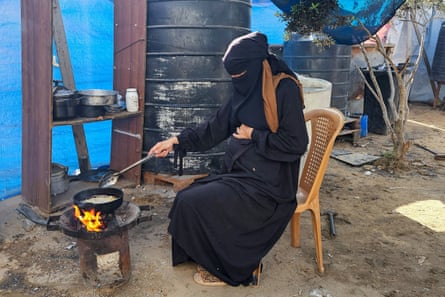
As a result, mothers in Gaza are forced into unthinkable choices, routinely compromising their own health and survival to meet their children’s most basic needs. With maternal and newborn care dismantled by fuel shortages, blocked medical supplies, mass displacement and relentless bombardment, life in overcrowded tent encampments has become the only remaining option.

“These conditions endanger both mothers and their unborn babies, newborns, and breastfed infants, and will have consequences for generations, permanently altering families,” writes Bakri, a psychologist and project manager at Physicians for Human Rights Israel.
UN Women estimates that over 6,000 mothers were killed in the first six months of the war – an average of two every hour, with the number continuing to rise, while according to the UN Office for the Coordination of Humanitarian Affairs (OCHA), an estimated 150,000 pregnant women and nursing mothers have been forcibly displaced, while according to Palestinian Ministry of Health (MOH) data, 391 women have undergone upper or lower limb amputation since 7 October, out of 4,500 total cases. The first months of 2025 saw just 17,000 recorded births, a 41% drop from the same period in 2022.
“Beyond the numbers, what emerges in this report are the women themselves, their voices, choices, and lived realities, confronting impossible dilemmas that statistics alone cannot fully capture,” writes Bakri.
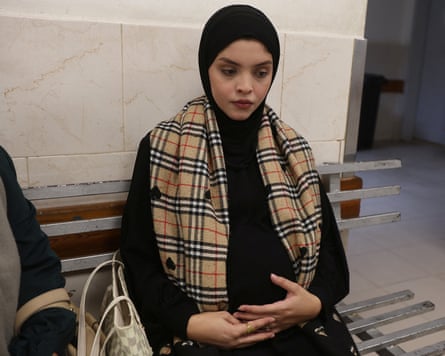
“I was shocked when I found out I was pregnant,” says Masara Khamis al-Sakahfi, 32, from Rafah. “During the pregnancy, I suffered greatly; I spent more time in hospitals than in the camp. I experienced severe pain and infections, and there was a shortage of vitamins and food … I suffered a lot; contractions would start and then suddenly stop due to fear of the airstrikes. I would freeze, and the contractions would stop.”
Sarah al-Daour, a 26-year-old mother of three, from Jabalia, has a heart condition. She was at al-Shifa hospital on 7 October 2023, where she was admitted after giving birth while suffering from an infection. Her newborn daughter was placed in the neonatal unit.
After being discharged, al-Daour returned to her parents’ home on the outskirts of Beit Lahia, where relatives had to carry her into the house because she was unable to walk. Her condition later worsened and she was taken back to hospital, where she underwent further surgery.
She was subsequently evacuated under gunfire and shelling to her late sister-in-law’s home in al-Fakhoura. Her sister-in-law, Aya Naif al-Mashrafi, a nurse at Al-Awda Hospital who had cared for her, was killed along with her children and 35 other members of the family.
“It was very difficult,” al-Daour said. “I suffered greatly each time we were forced to relocate because of my medical condition.”
The report sheds light not only on the killing of women and newborns, but on what it describes as an alleged intent to erode the Palestinian people demographically, through attacks aimed at dismantling their ability to reproduce as a community.
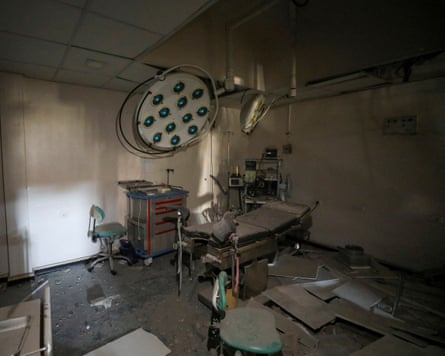
In particular, researchers examine Israel’s December 2023 strike on the Al-Basma IVF clinic, Gaza’s largest fertility centre, which destroyed an estimated 5,000 reproductive specimens and brought to a halt between 70 and 100 IVF procedures each month.
The Independent International Commission of Inquiry concluded that the attack was deliberate and that it directly targeted Palestinians’ reproductive potential, marking what the report characterises as a grave violation of international law.
A UN commission has cited the impact on the right to reproductive health as one of the reasons for declaring Israel’s actions a genocide.
“Reproductive violence constitutes a violation under international law; when carried out systematically and with them intent to destroy, it falls within the definition of genocide of the Genocide Convention,” reads the reports.
“The destruction of maternal care in Gaza reflects the deliberate infliction of conditions of life calculated to bring about the destruction of the Palestinian people, in whole or in part.”
The Israeli military did not respond to a request for comment by the time of publication.
Meanwhile in Gaza, despite the ceasefire that came into force last October, children continue to die.
Unicef spokesperson, James Elder, said that more than 100 children have been killed in the enclave since the ceasefire.
“We’ve now gone to six children who died of hypothermia just this winter,” Elder said.
Life in Gaza remains precarious. While airstrikes and gunfire have slowed, they have not ceased. At the same time, recent storms have compounded the crisis, causing deaths and flooding in displacement camps already stretched beyond their limits.
Strong winter winds collapsed walls onto flimsy tents for Palestinians displaced on Tuesday, killing at least four people.
The dead include two women, a girl and a man, officials at al-Shifa hospital, Gaza City’s largest, which received the bodies, said, while the enclave’s health ministry said on Tuesday that a one-year-old boy died of hypothermia overnight.