2 months ago
103
2 months ago
103
On 26 June 2015, the US supreme court finally declared gay marriage legal nationwide. Two days later, singer-songwriter and former Disney Channel alum Hayley Kiyoko effectively came out to the world with her debut single, Girls Like Girls. “Girls like girls like boys do, nothing new,” she sang with triumphant bluntness. Its accompanying music video, featuring a Sapphic teen romance, spread fast and wild across Tumblr, a website defined by its intensely nostalgic aesthetics, where style and identity formation merged for many queer teens. Today, the music video has 163m views on YouTube.
Kiyoko, now engaged to former The Bachelor contestant Becca Tilley, has since been hailed the “lesbian Jesus” by fans. Queer expressions in pop music, from King Princess to Chappell Roan to Reneé Rapp, have become far more common in the decade since the music video was released, but Kiyoko still seems to inspire one of the most dedicated, and specifically Sapphic, audience in queer pop music today.
Unlike her more sardonic peers, Kiyoko carries forward the neoliberal optimism of the Obama years. Kiyoko’s 2023 novel adaptation of the Girls Like Girls music video, which became a New York Times No 1 bestseller, continued that same spirit, and it persists in her directorial debut of the same name.
Kiyoko’s vision for Girls Like Girls, the movie, is guided by the Obamacore mantra that representation matters. Her stated reason for making this film was that “we need more queer stories”, buying into the liberal belief that visibility for historically underrepresented groups like the LGBTQ+ community constitutes political progress in itself. But in Kiyoko’s film, representation is all that matters. The film assumes that depiction alone is meaningful enough to excuse other glaring deficiencies in its film-making.
Set in small-town Oregon in the summer of 2006, the film follows Coley (Maya Da Costa), a quiet and sullen teenager newly relocated to live with her estranged father – Zach Braff jumpscare – following the death of her mother, a textbook lesbian backstory. Biking through suburban back roads in flannel shirts and low-rise jeans, with a nascent butchy earthiness, she encounters Sonya (Myra Molloy), the ideal American girl: pretty, charismatic, but unhappily tethered to her boyfriend, Trenton.
The two strike up an instant connection that is ambiguously romantic, pushing at the limits of female friendship as they twist their legs together and whisper “Olive Juice” to one another, a phrase that resembles “I love you” on the mouth. Throughout the girls’ tryst, Coley becomes the watcher and Sonya the watched, gazing longingly at her crush’s legs and ass.
As in Kiyoko’s music videos, color overwhelms the film. It’s washed in a burnt orange, digitally re-creating analogue warmth with the nostalgia of an Instagram memory. Nothing in the film is left implicit, the film’s ache for a bygone time as heavy-handed as the romance at its center.
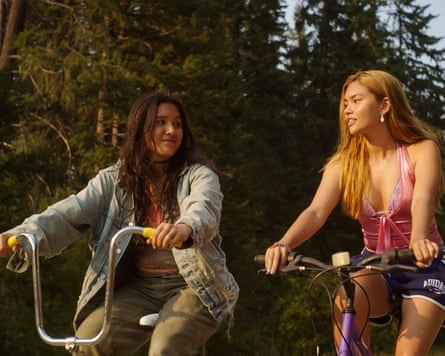
In the opening seconds, the film unsubtly tells us we are in 2006, as Coley cycles past a banner celebrating that year’s graduates. She picks up her iPod Classic (2006), wears her shoddy over-the-ear headphones (2006), plays Tegan and Sara (lesbian) and logs into AIM (where she curiously has only seven contacts).
Stylistically, Girls Like Girls strains desperately for a kind of cinéma vérité, with its overlapping dialogue and over-the-shoulder shots. But there is no vérité to be found; the script is far too rote to pull off any sense of realism. “I’m tired of running,” says Sonya, putting her head on Coley’s shoulder. “So don’t,” Coley replies, with the faux-profundity of bad YA fiction.
Molloy and Da Costa’s performances exceed the script. Their lingering pre-kiss glances invoke the same stomach-dropping fear and excitement that comes with a first smooch. When their lips finally lock, it feels like relief: ravenous and real. There is curiously little sex for an R-rated film; just a lot of PG-13 neck kissing. But these moments are clumsily stitched together by a rambling storyboard, Kiyoko crafting cute vignettes without a sufficient narrative backbone, like a horror director constructing a plot merely to connect scenes of gore.
Kiyoko’s adolescent fantasy is perhaps even too faithful. Like a teenager’s view of the world, it is thoroughly depoliticized. Towards the end of the film, Sonya says her relationship with Coley is “wrong”, but there’s no indication as to why it’s wrong or to whom. Nothing in Girls Like Girls exists beyond individual feeling, and there are no larger institutions to speak of, not even a school.
It all leaves the film stranded in an unsatisfying place: intensely personal yet emotionally unearned, politically gestural yet totally vacant of politics. Kiyoko has made a film obsessed with being seen. It never once learns how to look.
-
Girls Like Girls is out in US cinemas and on VOD in Australia on 19 June, with a UK release date to be announced