2 months ago
86
2 months ago
86
Selling vegetables was Dieudonné Bakarani’s first job. He had a little stall at Kinshasa Central Market in the Democratic Republic of the Congo. Decades later, the 57-year-old entrepreneur is redeveloping the historic marketplace that gave him his start in business to be an award-winning city landmark.
Bakarani hopes to see the market, known as Zando, flourish again and reopen in February after a five-year hiatus. The design has already been recognised internationally; in December, the architects responsible for it won a Holcim Foundation award for sustainable design.
“I started out getting vegetables from Goma and selling them in this market. I never expected to be the one rebuilding it decades later,” says Bakarani.
“We have built a market with local people, especially our mothers and sisters, in mind. We have kept the concept of the old one but have enlarged it, and it is more functional.”
Inaugurated in January 1944 under Belgian colonial rule, Zando was demolished and rebuilt in 1968, with space for 3,500 traders. By the time it was closed in January 2021, it was attracting about a million shoppers a day and there were issues around safety, overcrowding, sanitation and waste disposal.
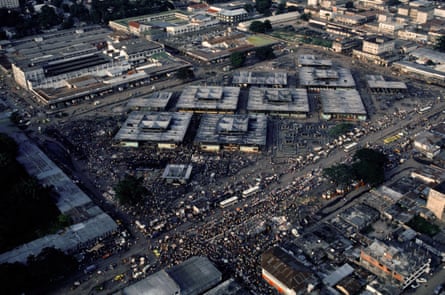
The closure affected approximately 20,000 vendors, who were relocated to surrounding markets, sparking protests in front of city hall.
“It was in a very bad state,” says Bakarani. “It wasn’t clean; it was overcrowded. There were nine toilets for the whole market.”
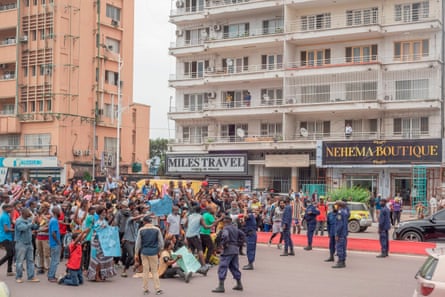
The market produced up to nine tonnes of waste a day, often amid searing temperatures.
“It was a nightmare working there during the day,” says Bakarani. “It was extremely hot. You can only imagine what it was like for our mothers or sisters selling there, exposed to the sun from morning till evening.”
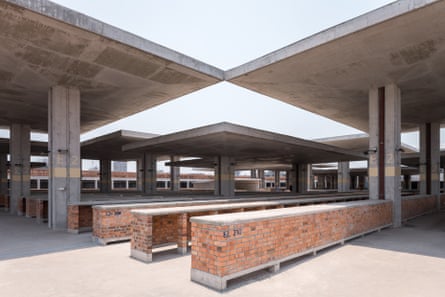
The new market feels like it has air conditioning, he says, as it was built with perforated brick facades to ensure ventilation and shade.
“We really wanted to keep the quality and characteristics of the African market,” says Marine de la Guerrande, part of the team from Think Tank Architecture Paysage Urbanisme, the Paris-based practice behind the market’s redesign. “The market has been built with concrete and locally produced terracotta bricks, supporting regional craftsmanship and economies.”
Spread across 92,000 sq metres (23 acres), the new market will house 10,000 stalls, 630 shops, 40 cold rooms, 272 toilets and 22 units for banks. There are two food courts, a fire station, CCTV, high-speed wifi and TV screens for advertising.
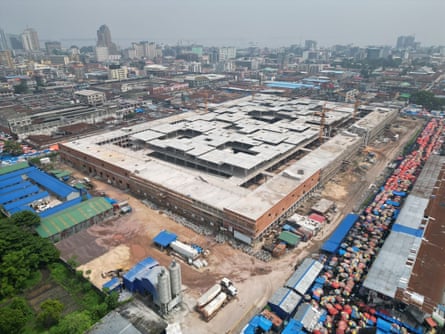
The building will be accessible, while rainwater harvesting and landscaped courtyards with trees aim to boost biodiversity, improve fire safety and promote cleanliness.
Tosin Oshinowo, a Nigerian architect and judge for the Holcim Foundation awards, says the design is fascinating because it has recreated a traditional African market, and the way of life that goes with it, but modernised it.
“So many solutions we get on the continent are always western imports because our education also tells us that this is the only way things can be done,” she says.
Markets are vital across the continent, she says. “Most people in Africa today will still go to the market because it’s cheaper but it’s also [interwoven into culture],” says Oshinowo. “What you have across the continent is a very specific way of trading … So these markets – economically, socially and politically – are very sustainable.”
The project has been made possible by a public-private partnership between city authorities and Bakarani’s company, Sogema (Société de gestion des marchés Africains). With French architects, construction was outsourced to the Chinese company SZTC, overseen by the French engineering firm Egis.
The development has cost about £56m and was financed by a loan from SofiBanque, based in the DRC. The operating contract grants Sogema control of the market for 25 years, after which the government will take over.
Bakarani says he faced accusations of corruption, and criticism, when people feared the design would be like a western shopping centre and not in keeping with local culture.
In May 2024, a report by two DRC anti-corruption organisations, the Public Expenditure Observatory (Odep) and the Congolese League Against Corruption (Licoco), said there were inconsistencies in the contract that “stem, on the one hand, from the incompetence of public authorities … and on the other hand, from a lack of transparency justified by the culture of corruption and easy enrichment that has taken root in the mindset of the Congolese political class”. Provincial authorities have defended the deal.
“I’m not saying there won’t be problems in the future. But at least the infrastructure is there,” says Bakarani, who denies the allegations of corruption.
Bakarani hopes the market will be a blueprint for similar projects across the continent. “It has been built [to the highest standards], recognised internationally,” he says. “We’ve respected the environment and improved what was there.”
He also hopes the new market will help change the country’s image. Referring to long-running armed conflicts with rebels, especially the Rwandan-backed M23, which have displaced huge numbers of people and fuelled human rights abuses, he says: “I hope we can attract international partners to come and see that in DRC, regardless of the situation in the east, which I am not underestimating in any way, there are opportunities that can be explored.
“People are still dreaming here and as entrepreneurs, we are driven. It’s not that we are not sensitive to what is happening, but it’s our country. It’s our duty to build it.”