5 hours ago
8
5 hours ago
8
Wars are usually measured in the number of people killed, homes destroyed and towns erased. Far less attention is paid to what happens beneath the rubble. Across southern Lebanon, repeated large-scale detonations are not only causing human tragedy by demolishing villages, they are also destroying the ancient limestone habitats that have sheltered colonies of rock hyrax for centuries.
As founder and president of Green Southerners, an environmental organisation documenting the ecological effects of war in southern Lebanon, I have been helping colleagues to record the damage inflicted on forests, wildlife and fragile ecosystems across the border region.
The Syrian rock hyrax (Procavia capensis syriaca), locally known as tabsoun, depends almost entirely on the fissures and cavities of karstic limestone for shelter and on sparse coastal vegetation for food. We have monitored colonies of the species for years, but over the past few months, our team has watched many of their familiar habitats disappear beneath bombings and demolitions.
For example, on 30 April, social media accounts associated with the Israeli army published footage showing a massive detonation targeting a neighbourhood in Bayada, along Lebanon’s southern coast. Similar demolitions have become increasingly common across the villages invaded by Israeli troops, erasing and reshaping not only urban areas but also the surrounding karst. The April explosions in Bayada and nearby Naqoura were reportedly powerful enough to be seen and heard in the coastal city of Tyre, more than six miles to the north, and appeared to directly affect an area known to host at least one colony.
Likewise, Green Southerners had previously documented rock hyrax colonies in the landscape surrounding Majdal Zoun. Satellite imagery after large-scale detonations on 26 June shows extensive alteration of these habitats. While the status of the colonies requires field verification, the fragmentation of their habitat raises serious ecological concerns. The same is also true for Qantara, where large-scale destruction has been inflicted on the surrounding landscape.
Studies on blasting and karst environments have shown that powerful explosions can destabilise these fragile formations through shock waves and intense ground vibration, causing fractures, collapses and the obstruction of subterranean refuge systems.
Added to this, large-scale demolition operations can have two major environmental consequences. First, repeated blasting generates post-blast gases, including carbon monoxide and nitrogen oxide, rock dust, particulate matter and, depending on the explosive formulation and detonation efficiency, residual explosive compounds that may affect surrounding soils, air and water. In karst landscapes, these contaminants may spread rapidly through interconnected fractures, caves and groundwater systems because of the high permeability of the limestone.
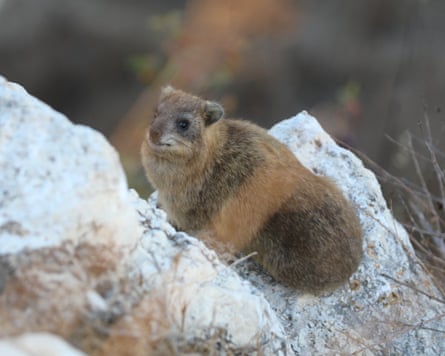
Second, blast waves and structural collapse can alter cave humidity, airflow and temperature regimes, while damaging habitats relied upon by cave-dwelling and rock-dependent fauna. Such changes may have severe implications for species adapted to these environments, including the rock hyrax, which depends on stable rocky shelters for thermoregulation, reproduction and avoiding predators.
Across the areas we have monitored, many of which remain under Israeli occupation, these and other habitats are now under unprecedented pressure.
Repeated bombardment, fires, large-scale detonations, the burning of vegetation and other ongoing military activity have transformed landscapes that once supported human communities and wildlife. Hills have been fractured, valleys burned and rocky escarpments destabilised, while burned areas, craters and rubble have fragmented the habitats of species across the region.
The consequences extend beyond the destruction of a single breeding ground or shelter network. Habitat fragmentation can become a serious threat to survival. The destruction of shelter networks may isolate colonies and weaken connectivity across already fragile environments. Recent assessments of wartime environmental damage in southern Lebanon have similarly identified habitat fragmentation and the creation of ecological barriers that disrupt wildlife movement patterns for many species, including the rock hyrax.
The damage inflicted on the vegetation that sustains these colonies is another overlooked factor. Rock hyraxes rely on surrounding low shrubs and sparse coastal plants for food. Heavy bombardment, detonations and fires not only destroy vegetation, but may also leave behind residues and contaminants capable of altering soil quality and further degrading these fragile habitats. In addition, white phosphorus is present in some forms of smoke-screening shells used by the military. It is feared burning fragments or residues may enter or become lodged within the fissures and crevices used by rock hyraxes and other fauna as refuges, in addition to the chemical’s potential effects on soil and soil biota.
Taken together, these impacts raise broader questions about the long-term environmental consequences of the weapons and demolition methods used during the conflict.
Assessing the direct and indirect damage inflicted on rock hyrax colonies remains difficult without access to the affected areas and comprehensive field surveys. This uncertainty extends to colonies our team documented in Naqoura and Bayada before the war, along with others on the slopes surrounding Beaufort Castle, as well as Wadi Majdal Zoun and Wadi Zebqine, all which were subjected to heavy bombing.
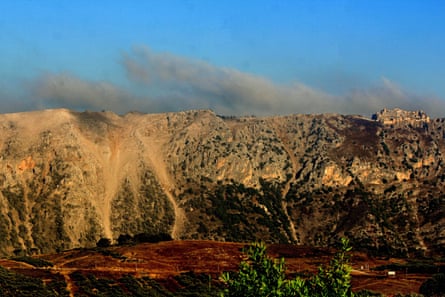
While the International Union for Conservation of Nature has previously described the regional subspecies as relatively stable, no official nationwide assessment of rock hyrax populations exists in Lebanon. The absence of recent field surveys also makes it difficult to evaluate population trends with confidence.
In any case, the ecological consequences may extend far beyond the loss of a single species. A recent report on postwar recovery from Lebanon’s National Council for Scientific Research notes that biodiversity loss can occur through wildlife mortality, species displacement and the breakdown of ecological interactions such as pollination and seed dispersal. In this context, the disappearance of local hyrax colonies would signal not only the decline of a single mammal, but the deterioration of whole ecological systems.The full ecological cost of the conflict cannot yet be measured. When the war eventually ends, homes can be rebuilt. Reconstructing geological systems and ecological communities that evolved over thousands of years will prove far more difficult.
When contacted by the Guardian for comment on the ecological impact of its military activity, the Israel Defence Forces (IDF) said: “Similar to many western militaries, the IDF possesses smoke-screening shells containing white phosphorus, which are lawful under international law. These shells are used by the IDF to create smoke screens and not to strike targets or cause fires, and are not classified under international law as incendiary weapons.
“The IDF is aware of the potential environmental impacts of its activities in the area and takes measures to minimise harm to the environment. The IDF does not target wildlife and does not carry out strikes against wildlife. Operational activity is directed solely against military targets and is conducted with consideration for the surrounding environment. The IDF operates to protect the citizens of Israel and ensure the security and safety of the surrounding areas, while taking precautions to minimise harm to civilians and the environment.”