3 months ago
142
3 months ago
142
When 200,000 protesters gathered to meet the G8 summit in Genoa, 25 years ago, their point (our point, in fact; I went on a coach, it took two and a half days) was that eight rich nations shouldn’t dictate the rules to the rest of the world. If you accept that power concedes nothing without a demand, this demand probably sounds a bit broad, boiling down to “abnegate your power”. But it was part of a wider anti-globalisation movement, in which many of the precise mechanisms by which the developed world exploited the developing had been nailed down.
Many of the protest tactics and networks had been honed at the battle for Seattle in 1999, outside the World Trade Organization summit, along with an agenda that was capacious and versatile. Unfortunately, the authorities had also learned a thing or two, and both the elaborate security of the G8’s red zone and the police brutality outside it were met with some astonishment from the world’s (liberal) media, but not from anyone with a memory exceeding two years.
Genoa also became a no-fly zone, citing concerns about terrorism. Since this was before 9/11, it made the world’s establishment look rattled and paranoid. The profile of the demonstrators was pretty well-understood – they (we) looked like anti-capitalists, but did not look like people who could get anything dangerous into the air.
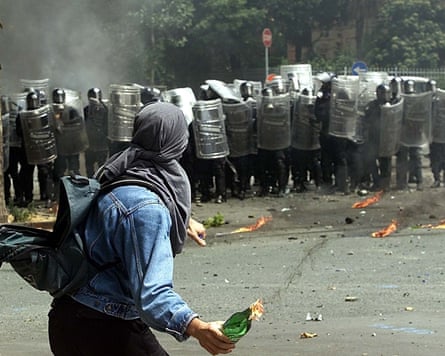
Was anyone rattled? Did the subsequent anti-poverty initiatives of the G8 in the next few years come from any of that activism, any of that messaging? It was certainly hard to miss what was called the inside/outside coherence, where street activists and NGOs syncopated their messages to insist that a rules-based order had to be pro-social or its moral authority would be empty and disorder would ensue. The G8 would never admit it if they had, and the protesters would say the anti-poverty crusade was just an interim phase in a broader neoliberalist unfolding that was very much pro-poverty.
Nevertheless, it’s interesting to consider these heritage moves of dissent and rebellion from the vantage point of the G7 just gone: there were protests, smaller in number at 20,000, met by police with kettling overnight, which is just a mass arrest without the facilities.
The target was simpler than ever – grotesque and unsustainable wealth inequality – and one of the opening moves from protesters was to set fire to a Tesla. There’s nothing new about burning a car, but there is something stark about this particular car. Since Elon Musk became the world’s first trillionaire last Friday, his wealth has already gone up to $1.4tn. The person with £1 in the world is as close to the second-richest man on Earth as that man is to Musk.
National governments, even the ones that still say “social democracy” on the tin, seem paralysed by his power, sometimes domestically bemoaning his calls for civil foment, but where it counts, devoting a whole agenda item to banning social media for the under-16s.
There is no doubt that social media, Musk’s and beyond, misrepresents truth to people (not just children) for profit, to the detriment of democracy and society. Answering that with a call for society to better police its children is the clearest possible signal that governments will unite to do anything, as publicly as possible, to delay the moment when they have to take on the forces of concentrated private capital. It makes perfect sense for protesters to torch a Tesla, but it also throws into painful relief the weakness of state powers that once seemed so omnipotent.
Germany’s Friedrich Merz, meanwhile, declared it a success that the summit had “found common language” in its support for Ukraine. But the wild card in that commonality has always been Donald Trump, whose relations with Vladimir Putin are opaque, whose support for Volodymyr Zelenskyy looks more like coercive control and who hasn’t committed to any military aid for the country since he took office.
Whether that’s all strategic, or whether US foreign policy is now decided from day to day by an unsteady mood is secondary (though it’s not that mysterious, in the light of Trump’s pronouncements: “I am the boss,” he said of the summit; “If they don’t behave, we will go right back to dropping bombs right smack in the middle of their heads,” he said about Iran). These G7 nations are no longer unified; it doesn’t matter whether or not most of them are, you cannot watch a rules-based order in its pomp where only most participants are playing by the rules. It’s like watching a game of football with a horse on the pitch.
The leaders, meanwhile, look personally insecure in a way with which one can deeply sympathise while, at the same time, lose patience. Emmanuel Macron reportedly spent the week worrying about Trump leaving early (as he did last year). Keir Starmer was caught on a news feed asking whether the rest of the leaders were in a meeting he hadn’t been invited to. For every trenchant statement of success, there is an image of power unravelling. The only sense in which all these leaders are united is in their determination to pretend that their unity has held.
None of which is to say that protest is misplaced, nor that it is unsure of its aims. But it is fighting a different entity: rather than being strong and sure of themselves, heads of state are insecure and in denial. But perhaps the protesters’ crucial target in this meeting of rich nations wasn’t a nation at all, but the richest man in the world.
-
Zoe Williams is a Guardian columnist