2 months ago
125
2 months ago
125
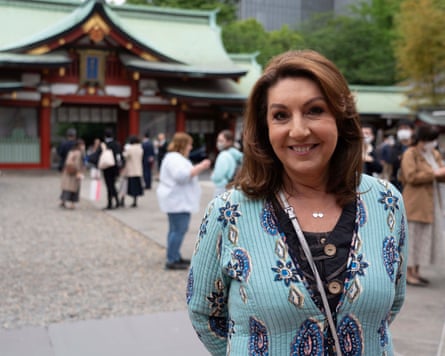
Whatever else has changed for Jane McDonald, between the working mens’ clubs the cruise ships and the arenas she is increasingly packing out, one thing has remained. It’s there on TV, where she remains the only Bafta-winning broadcaster liable to go full Cilla and break into song: she plays to the women. “Never acknowledge the men,” she advises cheerfully. There are a lot of husbands. “And they’re like, ‘Oh God …’” She pulls a face. “‘Jane McDonald.’” Increasingly, however, her audiences may not contain many straight men: her social media-led renaissance as an icon of northern high camp means she will perform at London queer festival Mighty Hoopla this summer.
I meet McDonald at her members’ club in Mayfair on the morning she releases her 12th album, Living the Dream. At the age of 62, she’s gone country. Recorded at the elite Blackbird Studios in Nashville – Coldplay and Taylor Swift have recorded there – she is dealing in unabashedly big country flavours. Less Cilla, more Shania.
She was wary of agreeing to a chat with no conditions. For more than two decades, McDonald has been her own manager – and she’s protective of her client. She attracts, she says, “a lot of fake news”, meaning the junk online news items that follow any podcast or TV appearance. She doesn’t go on social media and turns down “about 96%” of what she is offered unless it passes her “Hell yeah!” test. McDonald is dressed in a crimson suit, her blowout arching like a question mark above her face. A pink wristwatch ticks down our allocated hour.
Recently, she was comforting a friend ground down by her serially cheating husband. “All those wasted years,” says McDonald, in the lush near-whisper she sustains throughout our interview, leaning in close. “Everything she’s had to put up with.” That became the bar-room blues of Ain’t Gonna Beg. She brought a Channel 5 crew to Nashville – her travel programmes won the channel its first Bafta in 2018. The documentary airs next month.
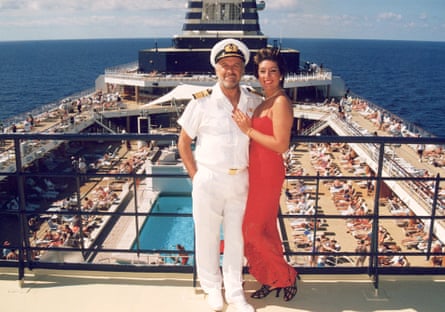
But none of this – the album, Nashville – was meant to happen. McDonald had planned to retire with the love of her life, fiance Eddie Rothe. They had dated in clubland in the 1980s – he was a drummer for Liquid Gold and later the Searchers – and reunited in 2008. He died of lung cancer in 2021, aged 67. “Everybody was waiting for that Ed song,” she says. But nothing came. So for the first time, she decided to work with professional songwriters. One asked her about Rothe, “and my face lit up”. It does again now.
Out of this came How Do I Move On. Torch song piano, gospel backing vocals and keening cello accompany McDonald’s stately, intimate vocal about wearing Rothe’s jumper and listening to his voicemails. Then there is the track Beautiful Soul, so titled “because he was. And is. I still talk about him in the present. To me, he’s still around in every way.”
This morning, McDonald woke at 5am to appear on Radio 2, singing Olivia Dean on Scott Mills in front of fellow guest Claire Foy (a McDonald stan, it turns out). Later she will sign CDs for fans on Oxford Street, and more tomorrow in Wakefield, the Yorkshire city where she has lived all her life. The fan events are rarities. Stage door signings began taking longer than the shows. Then there was a credible threat to her life. “At first I were a bit, ‘Oh, it’s just a death threat.’ But you start to think.” I tell her it’s horrible how this just comes with being a female artist. Well, she says, “Would a man stand and talk to the fans like me? And say, ‘How’s your mother?’” She asks about her fans’ children, their divorces, their jobs. “I write for them, really.”
On Oxford Street, the slowly moving queues snake out of HMV and down side streets. One fan – Rowenna, 56 – calls McDonald “courageous”. Sam, 26, was reared on McDonald by his mother. “Jane’s almost a drag queen,” he says, “which is a high compliment.” Some of them are going on this year’s Jane McDonald fan cruise, an October sojourn across Europe with the singer performing on board. Julie, 53, has followed McDonald since the 1990s and says we are watching “the height of her career” right now, since surely she “can’t peak any more than she has”?
McDonald was born in 1963 to a coal miner father and shop-worker mother. “We were really working class,” she says. The youngest of three, she has only lovely memories of the cigarette and coal smoke of her home. Music originally came from the radio – her first word was Downtown, as in Petula Clarke – and then came the golden age of light entertainment on television. She remembers “how excited we all were to sit down on a Saturday night” for Cilla or Tonight at the London Palladium. “It was so light,” she says. “It lifted everybody.” She gestures upwards with a hand, as if floating above the troubles and disappointments of life. “I wanted to make people feel how I felt watching it.”
The club circuit around Yorkshire was creatively ambitious. Her local was Wakefield Theatre Club, which showcased modern jazz and touring Americans. It was at the age of 12, while watching Birmingham beat group the Fortunes and enjoying the intoxicating smell of “stale beer and fried food”, that she realised she wanted to be a singer.
But this was not the generally done thing. “In my age, everybody was either a secretary or a nurse.” She began as a “turn” in her teens, with clubland providing an education in everything from ballroom dancing to standup comedy. In her 2019 memoir, she briefly mentions the awful effects of the 1984-85 miners’ strike. Her father and her brother Tony went out on strike. “That were hard work,” she says. “Terrible.” It wasn’t just about miners. “It was every industry: the mills, the steelworks. The whole north just collapsed.” She raises her hand and brings it crashing down. “Music was the one thing that everybody wanted to listen to, but it was horrendous. I can’t lie.”
A rare pause. She begins speaking more softly. “I’ve always had mixed feelings about that time. When you see the whole of your community fall, it stays with you. The clubs weren’t full any more. When the working man had money, he’d spend it.” And this was what funded the glamour of clubland. “We lost that because everything stopped. Every. Thing. Stopped.”
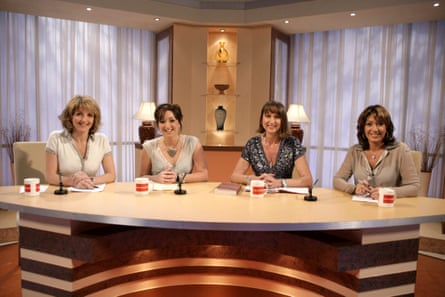
Even now, she finds nostalgia for the era painful. “A lot of people say celebrate the 80s, especially down here,” she says, surveying the London luxury around us. When Margaret Thatcher died, McDonald was booked to appear on Loose Women, where she was a panelist for 10 years. “All the Londoners on the panel were devastated. And I went, ‘My thoughts are with all the miners that she …’” Her whispers get even quieter. “‘That actually died.’ A lot of people couldn’t stand it. They couldn’t look after their families.”
She received more letters after that TV appearance than any other. “Saying, ‘Thank you for standing up for the north.’” This goes back to why she plays for the women. She saw what they were capable of during the strike.
Yorkshire clubland never recovered, so McDonald moved with the times: three shows a night in Manchester. Her father ploughed his redundancy money into her stage show, becoming her roadie. McDonald remembers taking on the promoters who paid male turns more. “And it wasn’t just a little bit of money. Massive. I was told, ‘They’ve got a wife and kids to look after.’” She threatened to walk – and won her equal fee. “I can’t lie,” she says. “It’s been a man’s world.”
Her sets included disco, ballads, standup. She knew a lot of psychics, so she understood early that her future involved sea and success, but she had to work at it. “I was lucky that Whitney Houston was massive when I was doing the clubs.” She serves me the opening bars of I Will Always Love You in a luxurious whisper. That’s how you belt it out: by not doing. She learned that in Skegness. Today, on social media, the camp value of that same approach to contemporary pop hits – Rosé and Bruno Mars’s APT or DNCE’s Cake by the Ocean – has brought her viral renown.
When her father died suddenly in 1993, his GP revealed that he had been terminally ill for a long time, meaning he had chosen to spend his final years working with his beloved daughter. “That’s when I ran away to sea,” she sighs. “I couldn’t face the clubs without him.”
This is how she ended up becoming one of the UK’s first reality TV stars. BBC One’s The Cruise aired in 1998 (it is back up on iPlayer). Its first episode followed McDonald preparing for a headline cruise set with all of the warmth and excitement that has become her trademark. It was watched by 13 million people. “Suddenly, you’ve got a fanbase.”
Her self-titled 1998 debut album topped the charts – “but everybody wants to change who you are”. That included her first husband, Henrik Brixen, who became her manager, siding with an industry that said she couldn’t be that Wakefield woman any more. “They cut my hair. I hated it. I was laughed at and shunned and underdogged.” She feels that the industry mocked her cruise and club origins. “But I was proud of where I came from. The public liked me because I was real.”
This is when her songwriting began: she escaped to the piano as her career fell around her in the early 2000s. “Henrik had left,” she says. “I got dropped from the BBC. My record company dropped me. And I just thought, ‘Well, carry on. But do it yourself. How hard can it be?’” She read music industry guidebooks, learning how to be “a lawyer, a promoter, a manager”. Even today, filling arenas, she has only just stopped paying every invoice herself. “I didn’t save the money, like normal people,” she says. She would invest it in the next album or show, often using her house as collateral.
When Covid hit, McDonald was exhausted from three non-stop years filming her cruising programmes for Channel 5. Her mother Jean had died in 2018. On long lockdown walks with Rothe, exploring the Yorkshire countryside without deadlines or camera crew, he pointed out that she could have this life all the time. He had quit music a few years earlier. Then, what had been a persistent cough led to him being diagnosed with lung cancer. McDonald became his full-time carer until his death. In her 2024 self-help book Let the Light In, she writes that she was diagnosed with PTSD, and has since moved out of the Wakefield bungalow they shared.
“If I could bring back Ed, I would give everything up and have him back.” But she can’t. “My life has just gone: boom! That is a gift from him. So why wouldn’t I celebrate him? And not be sad. I don’t want to be sad about Ed. He was a wonderful, beautiful soul.” She considers herself blessed to have had the years they did. “I feel like he’s with me all the time. And now, with the songs, he will be.”
As with the country divas with whom she is communing on her new album, it is McDonald’s survivor attitude – overcoming loss with Yorkshire grit and an insistence on living her dream – that has afforded her icon status. “I quite like being the underdog,” she says. “I don’t mind it.” Whenever people underestimated or overlooked her in the clubs, she knew what to do. “I used to think, ‘Go on. Watch this. I’m going to blow you away.’”