2 months ago
82
2 months ago
82
A few weekends ago, I went to the flea market in Bomonti, a neighbourhood on the European side of Istanbul. I go there regularly, and over the years I’ve accumulated a small collection of things: embroidered napkins, records, old issues of House & Garden, earrings, candle holders. It is usually on the days when you are not looking for anything in particular that you find the most interesting things – or, as the Turkish writer Sabahattin Ali once wrote, “some things we never know we need until we find them”.
That particular Sunday, strolling through the stalls, I came across a book from 1965 titled Türkler için Almanca – Deutsch für Türken (German for Turks). It was among the first language textbooks of its kind, widely distributed to the so-called Gastarbeiter – “guest workers” – who came to West Germany in the 1960s and 70s. The economic boom of the 1950s had created an acute labour shortage, prompting the recruitment of workers from abroad. A bilateral agreement with Turkey, signed in 1961, facilitated the arrival of hundreds of thousands of Turkish men and women to come and work in German factories. Officially, their stay was meant to be temporary. Workers came alone; families stayed behind. A copy of the language book I found 60 years later at a flea market in Istanbul would have been in the suitcases of many of these workers.
Learning a new language as an adult is hard. I am struggling, as a German speaker, to learn Turkish myself. There are few similarities between the two languages. Turkish suffixes, for example, add meaning to the ends of words. Where German – like English – needs four words to say “I am at home”, Turkish needs just one: evdeyim. There is no grammatical gender in Turkish. In German, everything has one. Even sentence structure is reversed. In German, we say: “Iris drinks coffee.” In Turkish: “Iris coffee drinks.”
I own a Turkish grammar book that explains these differences from a German linguistic perspective. The authors of Türkler için Almanca promised in their foreword that they could teach Turkish speakers “to master sentence structures and speak fluently in the shortest time”. But when you read the book, it becomes clear that it is not really about helping others learn German.
Instead, it reads like a compilation of lessons by someone less interested in exchange than in display – keen to demonstrate a dull sense of superiority rather than to share knowledge. In that sense, the book becomes a revealing portrait of how Germans wanted to be seen – and how little they wanted to know about the people it addressed. Who the learner is does not matter. What they bring with them does not matter. What it means to move from Turkish into German does not matter. The student is not a person, but a subject.
That the Turkish men and women who came to West Germany were called guest workers already says a great deal about the nature of the agreement that brought them. They were treated as temporary labour, not as future citizens, and considered strangers – people who had little to do with Germany and likely never would.
What is often forgotten and rarely mentioned is that the relationship between Turkey and Germany did not begin with guest workers. It is a much older story. Ottoman sultans had German advisers; Meissen porcelain found its way to Topkapi Palace. By the late 19th century, the Ottoman and German empires were closely intertwined – economically and militarily – and even allied during the first world war.
History later reversed direction. After the Nazis seized power in 1933, Turkey became a refuge for Germans. Hundreds of Jewish and antifascist academics and political dissidents fled there – among them Ernst Reuter, later mayor of postwar Berlin – and joined Mustafa Kemal Atatürk’s project to secularise and modernise the country, helping to rebuild universities and public institutions. Many arrived with passports stamped heimatlos – stateless – a word that entered Turkish as haymatloz.
This shared history existed. And yet when Turkish workers arrived in Germany in the 1960s, it vanished from view. It did not fit the image of the underprivileged “guest worker” – nor the cliched view of Turkey. In many ways, that remains true today.
I was born in the GDR and grew up in Leipzig. In my childhood there were no Turkish classmates, no visible Turkish communities. There were, however, children with Vietnamese backgrounds. The GDR had its own agreements with so-called brother states, formed around the same time as West Germany’s labour recruitment programmes. The terminology was slightly different; the structure was not.
For a long time, neither west nor east (including myself as a part of those societies) acknowledged how hard the situation was for those who arrived from abroad, how much racism they faced and how their treatment shaped the next generations. We simply didn’t talk about it.
My first encounter with the West German-Turkish history happened after I moved to Berlin. My first boyfriend at university had a German mother and a Turkish father. He did not tell me immediately; I learned it weeks later. His father, who had come to Germany in the early 1980s, had raised his sons with one guiding principle: nicht auffallen – do not stand out. My boyfriend did not know Turkish. His first name did not mark him as “other”. The Turkish part of his heritage had been muted out of fear of being stigmatised.
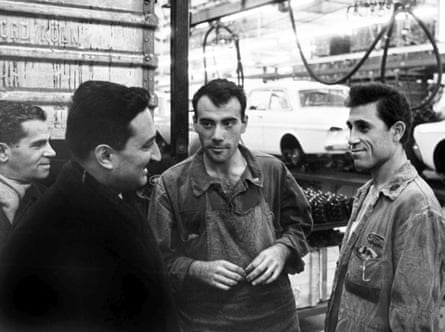
Shedding proper light on these realities is a relatively recent thing and has come largely through the voices of the grandchildren of the first generation – journalists, writers, film-makers and artists who have turned family memory into articles, books, films and art. One example is the 2022 documentary Aşk, Mark ve Ölüm (Love, Deutschmarks and Death) by Cem Kaya. I remember watching it with awe and shame at how much I had not known. The film looks at the difficult lives of Turkish workers in Germany through the music they produced. One widely popular song, sung by Yüksel Özkasap, included the lines: “Germany, everything about you is a lie. You have stolen my life and taken my love.”
Türkler için Almanca – Deutsch für Türken, which also briefly appears in the documentary, did little to help ease that pain and utter disappointment. In the book’s first lesson, students learn the names of family members – in other words, the names of people who are no longer with them. It is a harsh beginning. They also learn yes and no and adjectives such as sick, diligent and lazy. In the following sections, sentences revolve around teachers, workers and factory directors, and are paired with instructions such as “Always be diligent” and “I have no time to lose”. In the short practice texts that introduce each lesson, one word appears again and again: tired. The word happy does not appear at all – nor any way of answering the question, “How are you?”
Yes, the book is an artefact. But it is also a reminder. The present German government once again speaks of recruiting “skilled labour”, carefully specifying qualifications, language levels and economic usefulness – as if migration were primarily a transaction rather than a human relationship. It is an old temptation, hard to erase from the German mindset: to want labour, but not lives; productivity, but not people with complex histories, needs and claims.
At the back of Deutsch für Türken are reading samples from Johann Wolfgang von Goethe, Heinrich Heine and Theodor Fontane. It does not get more canonically German than that. Yet looking at this canon today, it becomes apparent how much richness entered German culture after the 1960s. Without those who were once kept at a distance by being called “guests”, Germany would sound different, taste different, move differently. It has changed for the better – it is less narrow, less self-contained and more capable of speaking to the world.
-
Carolin Würfel is a writer, screenwriter and journalist who lives in Berlin and Istanbul. She is the author of Three Women Dreamed of Socialism