4 hours ago
9
4 hours ago
9
Israel is working towards the systematic “elimination” of the conditions that sustain Palestinian collective life in the occupied West Bank, according to a major report published by the human rights group B’Tselem.
The Israeli organisation’s hard-hitting report, shared with the Guardian in advance of publication, says Israel is “dramatically intensifying its attacks on every aspect of Palestinian life in the West Bank”, including “the ability to get to work, take children to school or university, receive medical treatment or municipal services, meet family and friends, cultivate land or go on vacation … routine activities that make up human life”.
According to B’Tselem, the assault on Palestinians is “governed by a coherent organising logic” and comprises five “interwoven domains of action”: violence and intimidation, movement restrictions, economic strangulation, social and political destruction, and ethnic cleansing and territorial takeover.
The publication of the Elimination Project, B’Tselem’s most comprehensive piece of work on the West Bank since its launch in 1989, comes less than a week after the British foreign secretary, Ed Miliband, accused settler terrorists, supported by Benjamin Netanyahu’s government, of committing ethnic cleansing in the West Bank, in the UK’s starkest condemnation of Israel since the foundation of the state.
1,107
Number of Palestinians killed by Israel in the West Bank since October 2023
By looking more broadly at the conditions required for Palestinians’ collective existence, however, the B’Tselem report goes further still. It says various arms of the Israeli state – led by Bezalel Smotrich, the far-right finance minister with broad powers over civilian matters in the West Bank – are seeking to “create a reality in which millions of Palestinians live in constant fear of Israeli military and civilian violence”.
“Palestinian communities are being pushed out in an accelerating process of ethnic cleansing, while an ever-expanding Israeli presence is being established in their place in the form of settlements, outposts, farms and Jewish-only civilian infrastructure,” the report says. “Elimination in this context means sustained harm to the conditions that enable Palestinians to exist as a people with land, institutions, language, culture, social ties, leadership, shared memory and history, and a social and political horizon.
“It is an ongoing political project that seeks to re-organise space and the conditions of life so that Jewish presence becomes contiguous, institutionalised and permanent, while Palestinian existence becomes fragmented, vulnerable and dependent.”
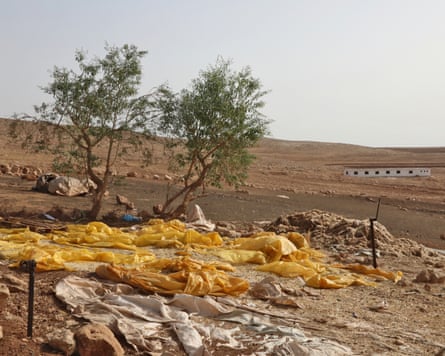
One of the most obvious aspects of this fragmentation is the closure of roads and villages to Palestinian passage, and the abandonment of Palestinian homes under relentless pressure.
On a recent afternoon outside the village of Sair, Haytham Adnan Murad, 49, was returning from a hospital appointment in Hebron with his 12-year-old daughter, Balqis, who is unable to walk because of recent surgery. A gate to the road accessing his village, open in the morning, had been closed by the Israeli army, forcing Murad to get out of the taxi he was travelling in with his daughter and carry her around the roadblock.
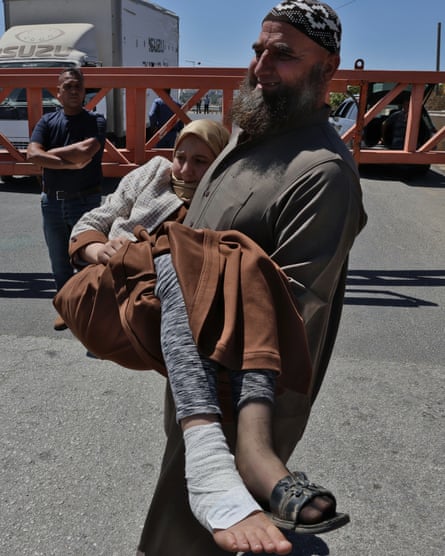
“When we left, the gate was open. Now it’s closed, but this is daily life,” he said. “In the morning, things are different from the afternoon. There’s no dignity in this.”
The authors of the report link the acceleration of the Israeli assault on life in the West Bank to the period after the Hamas attack on southern Israeli communities on 7 October 2023. However, they argue that the underlying motivating ideology predates this period.
In particular they point to a document known as the Decisive Plan, published by Smotrich in 2017, before he became a minister, which they describe as the “key document for understanding Israeli action in the West Bank.”
64
Number of entire communities forcibly displaced in the West Bank since October 2023
B’Tselem says the plan gave Palestinians three options: “Live under Jewish supremacy while relinquishing their national claims, leave the territory, or face violent suppression by the Israeli military if they resist”. It has been translated, the report adds, “into policy, budgets, powers and practices exercised by different arms of the state” with “unprecedented speed and openness”.
As such, the report goes on, settler violence is no longer “operating only as private violence or a breach of public order” but as part of a “broader system of control”.
“It is sometimes carried out alongside soldiers, with the backing of security forces, using weapons, equipment and infrastructure supplied by the state, and with almost complete impunity.”
Beyond the already well-documented incidents of escalating settler violence, the report highlights other corrosive aspects of the tightening Israeli grip on the West Bank, including devastating economic restrictions, and impacts on education and culture.
31.3%
Unemployment rate in the West Bank in 2024, up from 13.1% in 2022
Israel, it says, has enacted a systematic policy of “full economic strangulation” since 2023, which has denied livelihood opportunities, destroyed civilian and agricultural infrastructure, tightened control over resources and the banking system, and undermined the ability of public institutions to provide basic services.
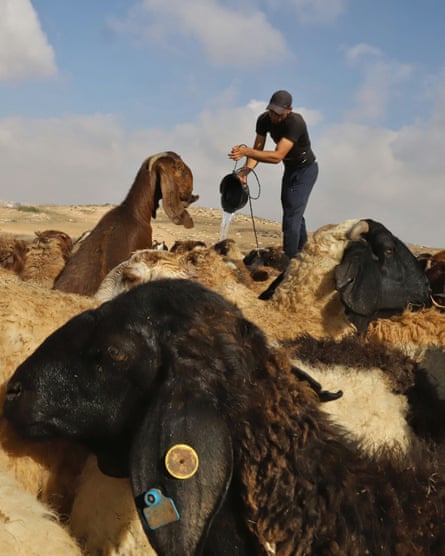
Smotrich said in September 2025 he would employ every means possible “to prevent the danger of a Palestinian state, including bringing about the collapse of the Palestinian Authority … through economic strangulation”.
Mass work permit revocations have left workers and their families without a stable income. This is reflected in data from the West Bank cited in the report. The unemployment rate, for instance, rose from 13.1% in 2022 to 31.3% in 2024, and in 2025, nearly half of all young people were neither employed nor enrolled in education or vocational training.
The UN has estimated that in 2024, 700,000 Palestinians in the West Bank needed assistance to buy food, a 17% increase from the previous year.
Since October 2023, Israel has also intensified attacks on various Palestinian organisations and associations in the West Bank. Grassroots and community groups, as well as organisations that protect workers, people in need and children, have faced frequent raids on their offices, forced closure, systematic harassment and the arrest of employees, volunteers and activists without cause.
Cogat, the Israeli military unit responsible for overseeing civilian policy in the West Bank and Gaza, has been approached for comment.
8 to 20%
Proportion of West Bank schools closed in the 2023-24 academic year
In an interview conducted to coincide with the report’s publication, Kareem Jubran, the head of B’Tselem’s field research on the West Bank, said: “What we uncovered is that these are not separate incidents. All the disparate elements have one character, one goal. When you look at the picture from above, it leads to one conclusion: that the main goal is to eliminate Palestinians as a collective.”
Yuli Novak, the executive director of B’Tselem, said: “What we are saying in the report is that this is ongoing. The project was there before, but now we are in a new phase.
“It started at the end of 2022, with the change of the government [to a right-far right coalition], and we saw another marked escalation after October 2023. What we are talking about is an attack on Palestinian life in the West Bank that changed in scale. It’s as much a quantitative element that has changed, making the West Bank more and more unlivable for many Palestinians.”
Novak described Smotrich’s plan from 2017 as the “blueprint”. “It shows the ideological and the operational way to get to what we are calling an elimination,” he said. “And he calls it victory by settlement. To win in a very final way so that nothing [such as a Palestinian state] can happen afterwards.”
All data and figures provided by B’Tselem