3 months ago
127
3 months ago
127
A misty, rainy day in the uplands of Somerset and the mud was thick and sticky. In some patches, just putting one foot in front of the other without plunging into the mire felt like a win.
But Jon Barrett, a community engagement officer for the Quantock Hills national landscape, had a broad grin on his face as he negotiated the ooze.
“I know for some, mud may be their nemesis at this time of year but we’re trying to celebrate it, get people to embrace it,” Barrett said.
Barrett and his colleagues are running a Month of Mud festival in February, inspired by the Anglo Saxon name for this time of year – Solmōnaþ, sometimes translated as “mud month” (a second possible translation is month of cakes).
The landscape team is holding events ranging from squelchy hikes to art sessions in which participants are shown how to make mix the red-hued mud with honey to make paint. There will also be story-telling sessions focusing on earthy legends. “We’re keen to reconnect people with mud,” Barrett said.
“Children love splashing through muddy puddles but I think adults can forget that joy. We want people to remember that feeling of freedom when you splash and stamp through muddy puddles.”
February has turned out to be extremely muddy due to the repeated pulses of rain that have hit the English West Country hard. Scores of people have been affected after their homes and businesses were flooded.
There were around 88 warnings and 223 alerts in England on mostly in the south-west and Midlands on Sunday, the Met Office said adding that it rained alomost every day in the south-west so far in 2026.
But in the Quantocks they are determined to find the bright side.
While accompanying Barrett on a hike around Cothelstone Hill, near Taunton, where (in the summer) pied flycatchers and dark green fritillary butterflies flit about, it was clear this time of year was mostly about the mud.
Trail runners enjoy the slippy paths here and tyre tracks show that mountain bikers make good use of the bridleways. “But we want to encourage more people to get out and walk,” Barrett said.
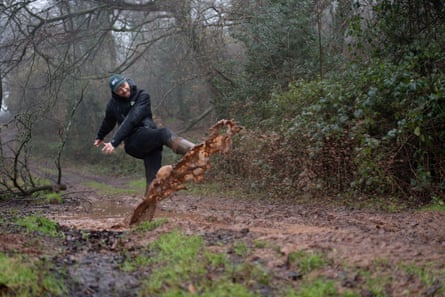
He also likes people to get up close and personal with the mud. “I don’t mind getting it on my face and hands.” He happily smeared some across his cheeks, though he does not have any scientific evidence that the Quantocks mud has any particular skincare benefits.
He extolled the aesthetics of this mud, in particular. “The soil is a lovely rich red. If you fall in the mud here, people can tell where you’ve been and at the end of the day your boots are covered in this red soil.”
Barrett was sporting a natty pair of fleece-lined wellies made by the French bootmaker Aigle – though he pointed out they were a charity shop find.
Barrett said he did not want to exclude anyone who did not have waterproof footwear. He hopes to attract not just hardened walkers but people who would not venture out in inclement weather.
“We work with people who may only have one pair of shoes,” said Barrett. So some of the walks have a “five welly rating” – extremely muddy – while others a “one welly” – contact with mud optional.
Andy Stevenson, a Quantock Hills ranger, said mud was a valuable habitat for some flora and fauna, from the brittle stars – echinoderms closely related to starfish – on the Somerset coast to the earthworm.
He said: “Mud created by people or grazing animals can also be beneficial for invertebrates such as bees and wasps to burrow into and drink from the shallow pools, or use as hunting grounds for their prey.
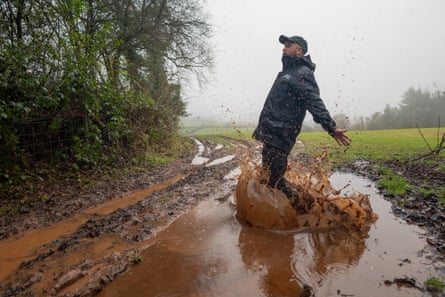
“Once dry, the muddy patches or bare soil provide a bed for new plants. Wildflowers such as bluebells and primroses in woodlands may have been covered over but once the ground receives sunlight, water and warmth the plants will grow.”
Extreme rainfall is becoming more common and more intense in many parts of the world because of climate breakdown.
The Quantock team has noticed adders emerging from hibernation much earlier than usual, possibly driven out of their burrows by flooding. Patrols have reported palmate newts, toads and frogs in greater numbers than usual.
Dan Broadbent, a West Country storyteller, said mud provided a fertile topic for writers and poets.
The Romantic poet Samuel Taylor Coleridge, who lived in Somerset in the late 18th century, wrote about being “stuck in the mire” and searching for “mud-lost sandals” in his poem, Devonshire Roads.
Broadbent said there were many stories from around the world in which humans were created from mud or earth.
He likes the Anglo-Saxon idea of “mud month” and prefers to see it as a positive, hopeful thing. “Mud appears as the hard ground becomes softer and ready for ploughing and sowing after winter.
“Mud therefore, becomes something almost sacred, to do with regeneration and renewal. Mud can have a transformative power.”