3 months ago
170
3 months ago
170
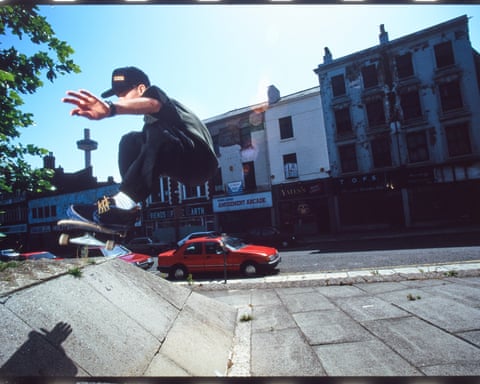
Flying from roofs or grinding on car spoilers, the skaters at the spectacular birth of a UK subculture are captured in Neil Macdonald’s book Elsewhere
Life on the edge … Geoff Rowley, Liverpool, 1992 Photograph: Wig WorlandThu 21 May 2026 10.00 CESTLast modified on Thu 21 May 2026 11.18 CEST
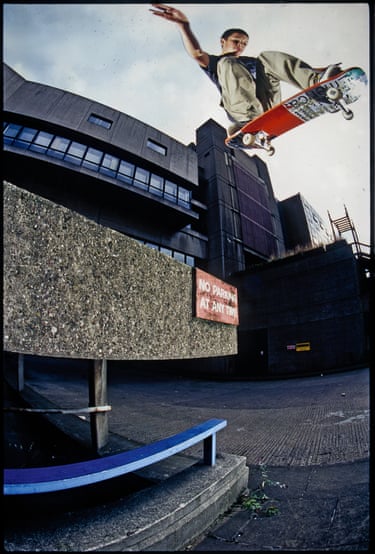
James Woodley, Birmingham, 1999
Elsewhere tells the story of skateboarding in the UK during the pivotal era of 1987 to 2002, when the British iteration of the sport developed its own unique identity. The book is the product of a lifetime of collecting, researching and interviewing the biggest names in UK skateboarding history. Many early cottage industries inspired by British skateboarders are now multimillion-pound brands that influence mainstream culture. Elsewhere: The Story of UK Skateboarding 1987–2002 by Neil Macdonald is available 28 May from Batsford BooksPhotograph: Leo Sharp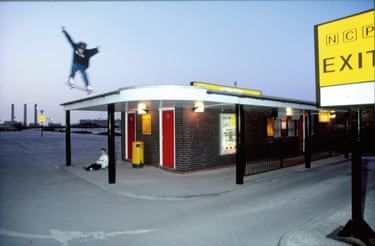
Brian Sumner, Liverpool, 1993
Neil Macdonald: ‘There are so many great photos from Liverpool. There’s always been an incredible scene. Usually people who do all the technical flip tricks don’t jump off roofs, but Brian was doing everything. He ended up being a big deal in the US. But everything about this is so British, the light at sunset in the summer, the industrial background and the NCP signage. NCP car parks meant so much in UK skateboarding, especially the undercover ones, which kept us going through long, dark, wet winters’Photograph: Kevin Banks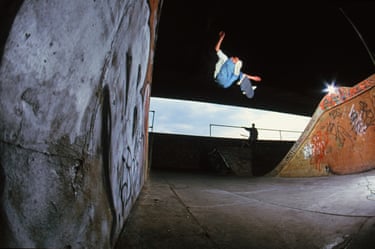
Carl Shipman, Meanwhile 2, 1993
‘Carl’s from Worksop and Skin’s from Swansea. Neither of them spent much time in London, but they shot some photos there for Carl’s pro spotlight interview in the US magazine Transworld. Carl was the first person to kickflip this gap. It’s at Royal Oak [skatepark in west London] and it’s called Meanwhile 2 – two halfpipes made of the modular sections designed by a guy called Lorne Edwards for his Radical Banking company. Carl and Skin both moved to the states, Carl to skate professionally for Stereo Skateboards, and Skin to work as editor-in-chief at Transworld’Photograph: Skin Phillips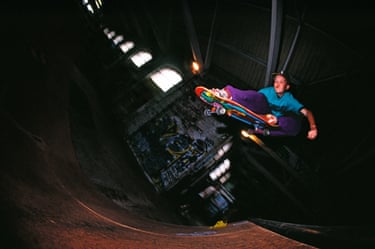
Chris Atherton, Barrow-in-Furness, 1990
‘This is a great example of a northern indoor skate park at the turn of the decade. With the deindustrialisation of the north, these huge Victorian brick warehouses were being taken over by skateboarders and used as homes for indoor skateparks. These were places where crews of skateboarders from around the country would really start to get to know each other, in an era long before social media made finding your people easy’ Photograph: Sean Keef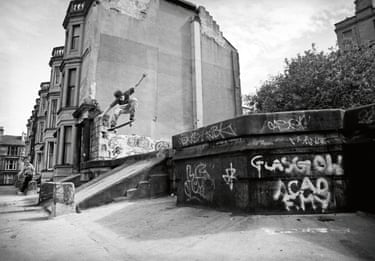
Colin Kennedy, Glasgow, 1998
‘Colin ollieing into the Mississippi chicken bank, named for its location above the Great Western Road fast-food outlet. This is from the first issue of Document magazine. The rawness of this shot really reflects those early Document years. Colin rode for Panic and then Blueprint, and Blueprint was the first British skateboard company that made it so that you didn’t have to move to the US to earn a living as a professional skateboarder’ Photograph: Andy Shaw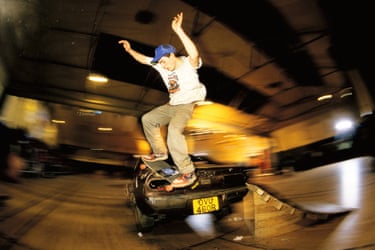
Jimmy Boyes, Wigan, 1989
‘This is from a televised skateboard competition, on a Channel 4 “yoof” sports programme. Skateboarding was growing and growing by 1989, but it was still so rare to see it on the TV. I recorded it with my parents’ VCR and rewatched it relentlessly. US skate VHSs were £30 at the time, but taping this contest provided a generation with instant-access skateboard footage they could watch again and again. Jimmy Boyes is one of the most important figures in skateboarding too. He’s in this book from beginning to end’Photograph: Tim Leighton-Boyce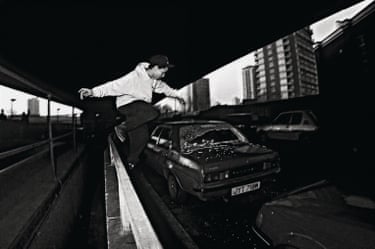
Curtis McCann, Meanwhile 2, 1991
‘It was really important to me that there wasn’t a skate photo on the cover. The gritty griminess emphasises the difference between American skateboarding and what things were like in the UK. This is at Meanwhile 2, or Royal Oak, skatepark. Curtis was skating the gap one day when his board shot out and through the window of that abandoned Cavalier. James Hudson knew to shoot this moment. Curtis was one of the best and most stylish skateboarders in the world, even though he had to dip out quite early because of an ankle injury’Photograph: James Hudson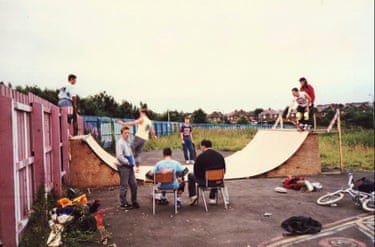
Longbenton miniramp, 1988
‘Paul “Rocker” Robson who shot this wasn’t a photographer; he was a professional skateboarder. There are a lot of photos like this in the book, “snaps” that wouldn’t have meant much at the time, would have been unremarkable, but now have extraordinary value as glimpses into the reality of skateboarding in the UK, beyond what the magazines were showing us’Photograph: Paul Robson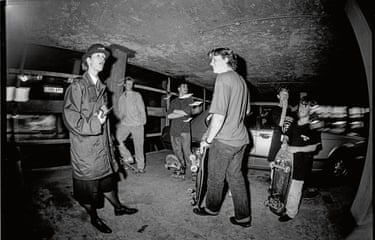
Car park ejection, 1991
‘A daily occurrence back then, and still a regular problem. Indoor NCPs were a refuge from the elements, and even though they were dirty, greasy, almost as wet as it was outside, and had the wind blowing straight through them, they were where you’d go when it rained. The book is called Elsewhere because that’s where security guards would tell you to go. This photo sums up that familiar exchange’Photograph: James Hudson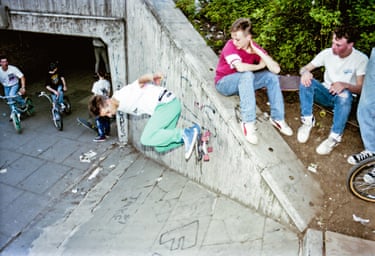
Martin Bernstein, London Road, Sheffield, 1987
‘This image perfectly illustrates the transition from BMX to skateboarding in teenage culture. BMX was huge after the release of ET in 1982, but when Back to the Future hit the cinemas, more and more people started skateboarding. Plenty of BMXers stuck at it, of course, but skateboarding was new and exciting. Skateboards were cheaper, you could take them on the bus, and they had cool graphics you could draw on your schoolbooks, so it was a no-brainer for a lot of people’Photograph: James Hudson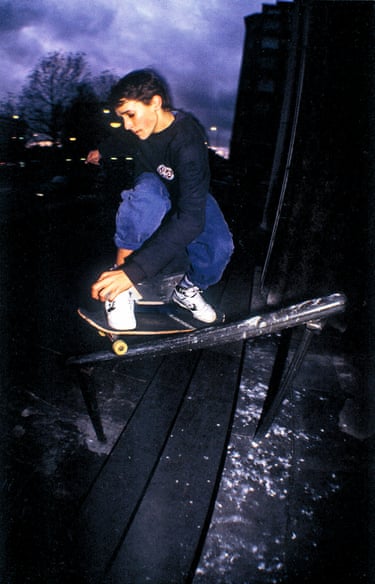
Ben Wheeler, South Bank, 1990
‘Corin, his brother Simon, and Ben here made The South Bank Video, which is on YouTube and probably the best documentation of what the scene there was like at that time. A lot of people (including me) think South Bank [in central London] looked better when it was grey, and you can see in the background here the centre have painted over some graffiti. It was around this time that Southbank Centre’s hostility towards skateboarders was really turned up. They installed bars to make the banks unskatable, kept the lights off at night and poured gravel over the surface’Photograph: Corin Casey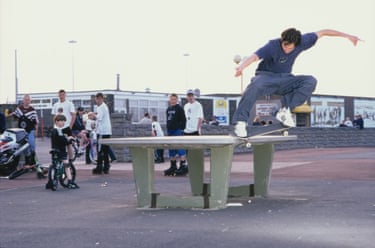
Gordon Skrezka, South Shields, 1997
‘Gordon is one of the most underrated British skateboarders ever. Like all the best people, he didn’t really care about getting coverage because he just wanted to skate for himself. But when you’re not getting coverage, you aren’t getting free product and it gets expensive when you’re breaking a lot of boards. Gordon got free stuff here and there, but he was all about just skating. There’s always been such a solid scene in the north east. It’s like Liverpool in ways, with generations of incredible skateboarders’Photograph: Wig Worland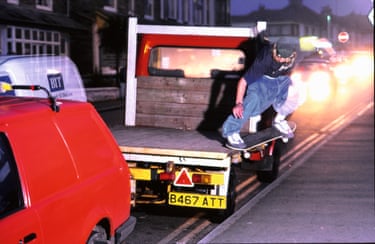
Mark Baines, Newquay, 1997
‘There are no bad photos of Mark Baines. Skate photos now are planned out, where the skateboarder will have an idea of a trick they want to do at a certain spot, and they’ll figure out how it should look with the photographer. Maybe they’ll have to go back a few times before it gets landed, or to make sure the light’s just right, or to avoid pedestrians or security, and this is the complete opposite of that. Spontaneous improvisation, seeing something that could be done, doing it and getting the photo done’Photograph: Andy Horsley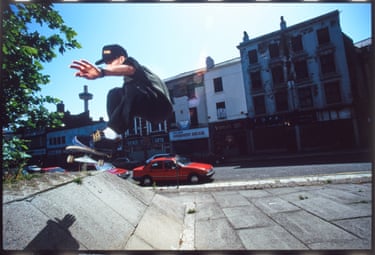
Geoff Rowley, Liverpool, 1992
Geoff convinced Vans, at the end of the 90s, to make vulcanised canvas shoes again. He’s wearing Vans Chukkas here, which not many people did in 1992, following Simon Evans’s discovery and accidental reintroduction of former terrace favourite the Adidas Gazelle into skateboarding, and eventually mainstream culture. Geoff has been Thrasher magazine’s skater of the year, had multiple magazine covers and put out several seminal video parts. He’s lived in the US for a long time now, but he’s Liverpool through and through.’ All captions by Neil Macdonald Photograph: Wig WorlandExplore more on these topics