3 months ago
141
3 months ago
141
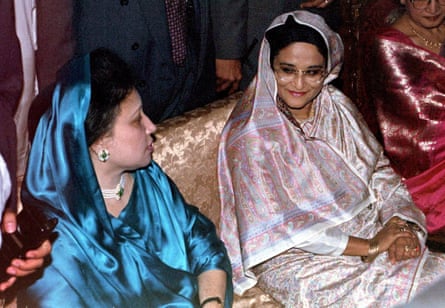
Khaleda Zia, who has died aged 80 – although her age was disputed – was the first female prime minister of Bangladesh, and was credited with an increase in female education and empowerment during her two terms in office, in the 1990s and early 2000s. The defining feature of her public life, however, was one of the world’s longest-running and most bitter political feuds.
For more than three decades Zia and her rival, Sheikh Hasina – now exiled in India following her resignation after a violent uprising in mid-2024 – contested the leadership of the south Asian nation, and sought to eclipse the other when in office.
Both women inherited their positions through assassinations of people close to them, Hasina from her father, Mujibur Rahman, the founder of the nation after the 1971 split from Pakistan, and Zia from her husband, Ziaur Rahman, the country’s first military ruler. It is a pattern familiar in south Asia’s dynastic politics: Benazir Bhutto in Pakistan, the first female leader of a Muslim nation; Sirimavo Bandaranaike in Sri Lanka, the first woman elected prime minister anywhere; and Indira Gandhi in India. All assumed leadership of movements founded by male family members.
Nowhere else, however, saw anything like Bangladesh’s “battle of the begums” – a term often applied to high-ranking Muslim women. The two initially united to demand an end to the military dictatorship of Gen Hussain Muhammad Ershad, who seized power soon after the assassination of Zia’s husband in 1981. But the alliance ruptured once Ershad stood down: an election was held in 1991 and Zia became prime minister.
The pattern for ensuing decades was set. During each woman’s term in office – Hasina first won in 1996 and served until 2001 – there were accusations of vote-rigging and corruption, strikes, street protests, and parliamentary boycotts by the opposition, punctuated by caretaker governments and military interventions. Zia won the 2001 election, but political turmoil remained constant. When her term ended in 2006, another interim government tried vainly to achieve consensus before elections in 2008. The military stepped in and detained both women, but on their release it became clear that nothing had changed.
When she first contested an election as the head of the Bangladesh Nationalist party (BNP), founded by her husband, Zia had to seek the support of the minority Jamaat-e-Islami to gain power. The alliance persisted, despite hostility from the country’s dominant neighbour, India, which considered the party a tool of Pakistan. In office Zia sought to cultivate relations with Pakistan and China rather than New Delhi, while Hasina’s Awami League favoured India.
The mystery, among such changes of direction and political dysfunction, is how Bangladesh, one of the world’s poorest countries at independence, has managed to reach lower-middle-income status, according to the World Bank. While much of the growth has come from exports of garments and people – hundreds of thousands of Bangladeshis have to find contract work abroad, mainly in the Middle East, and their remittances improve rural incomes – the Bank also points to women’s empowerment, an initiative of Zia.
That she would ever be in a position to implement such policies would have come as a surprise to those who first encountered her as a “shy housewife” who had married an army officer in her teens, and was devoted to the upbringing of her two sons.
She was born Khaleda Khanam in Jalpaiguri, in what was then British-ruled Bengal, now in India. The date of birth, she claimed, was 15 August 1945, matching the day and month that her rival’s father was assassinated. However, opponents alleged in a long-running court case that none of her official documents reflected this (all gave different dates).
Known as “Putul” (doll) in her family, Khaleda was the daughter of Iskandar Majumder, a tea merchant, and his wife, Taiyaba. They moved soon after her birth to Dinajpur, which became part of East Pakistan (now Bangladesh) in the 1947 partition of India. She went to school there and was enrolled at college when she married Ziaur Rahman in 1960, and took his first name as her last name. An army commander in the 1971 independence war, he became president in 1977 after a spate of coups. He in turn was assassinated in an abortive military coup in 1981.
Zia was not even a member of her husband’s party when he was killed. She joined the BNP in 1982, and by 1984 had become the national chair. Some might have expected her to be a figurehead, but she demonstrated unwonted steel during several periods of house arrest under Ershad’s regime. In 1986, when he announced an election without suspending martial law, she refused to allow the BNP to take part, though the Awami League did. It made her party appear more principled during the 1991 election, which was free from military interference.
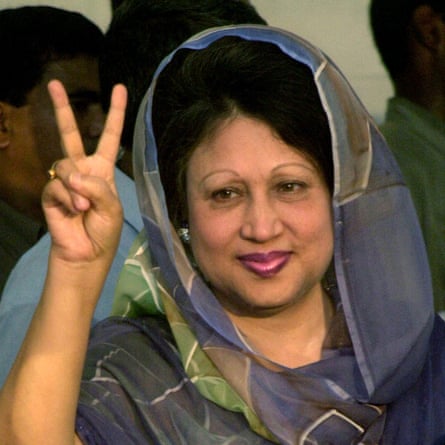
In office, Zia continued her husband’s liberalised economic policies, and relaxed controls on the media. She promoted girls’ education, helping to make Bangladesh one of the first developing countries to achieve parity between the sexes in school enrolment. The country’s rate of growth accelerated, but this did not prevent her defeat in 1996. Another of her husband’s policies, Islamisation, had damaging effects during her second period of government after 2001, when growing Islamist radicalism and accusations that her elder son, Tarique Rahman, was running a parallel administration, contributed to unrest.
Zia probably did not anticipate that she would never return to power after 2006, but after losing the 2008 election she boycotted the poll held in 2014, arguing that it would not be fair. In 2018 she was convicted of corruption, a case her supporters said was political, reflecting Hasina’s growing authoritarianism. Zia was sentenced to five years in prison, later raised to 10, disqualifying her from standing for election, but she refused to go into exile.
Her deteriorating health allowed her to leave prison for house arrest in 2020, but it was not until Hasina’s fall in 2024, after 15 continuous years in power, that all restrictions on Zia were lifted. Under the interim government of Muhammad Yunus, she was acquitted of all charges, and was nominated for the elections next month, though the BNP will now be led by Tarique. For the first time since 1991, Bangladesh faces an election with neither of the begums.
Her younger son, Arafat, died in 2015. Tarique survives her.