2 months ago
115
2 months ago
115
How do you turn a classic Hollywood western into West End musical fare? Add songs, many of Bruce Springsteen’s in this case, along with a few rounds of line dancing and a sizzling star in Billy Crudup. Still, it’s an odd experience initially as Thea Sharrock’s production switches from one brief filmic scene to the next, and the endeavour seems as wooden as the clapboard saloon-bar slats that comprise the handsome set.
As a piece of theatre, it finds its flow. As a debate play, though, it gathers a locomotive energy as it travels towards the showdown between Frank Miller (James Doherty), who is returning to this “dirty little village in the middle of nowhere”, and the marshal Will Kane (Crudup) who put him behind bars. That is mostly because of the uncanny and urgent relevance of this 1952 film about a community working out (or rather, squirming out of) its civic responsibilities around institutional wrongdoing.
Originally an allegory of McCarthyism (its screenwriter, Carl Foreman, was blacklisted), the story sets the cowardice of the many against the courage of the few – in this case, the lone, heroic Kane, who mobilises his defence against Miller and his henchmen after being let down by the townsfolk. The film was blasted by John Wayne as un-American for its critical portrait of the community; the production comes to life in its arguments on collective in/action and seems to speak directly about the dilemmas facing the cowboy country of Trump’s America (the shooting in Minneapolis just the latest example). Eric Roth’s script uses many lines from Foreman’s screenplay but fleshes out the debates on the ethical stance of a community in the face of wrongdoing and misguided American myths around immigration.
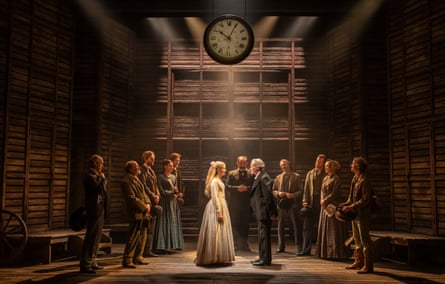
There is also the joint talent of Crudup and the ever agile Denise Gough who play the central couple on their wedding day. She is Amy Fowler, a Quaker who abhors the actions of violent men; he is the marshal who has just given up his “tin star” to start over as a shopkeeper. That is, until news reaches town that Miller is arriving on the noon train.
Gary Cooper made the role entirely his own, his integrity comparable only to Gregory Peck’s Atticus in To Kill a Mockingbird. So Crudup has his long shadow to evade. He manages to hold up the part on stage as an upstanding, earnest and increasingly desperate man. Gough makes her part grittier and more modern than that of her film counterpart, Grace Kelly. The pair are convincing as a couple although their narrow characterisation hems in the full scale of their abilities.
Several other characters seem too flimsy, from Billy Howle’s deputy marshal, Harvey Pell, to Rosa Salazar’s Mexican businesswoman, Helen, although the affinity between her and Amy is refreshing, and Roth gives more voice and texture to these women as a whole.
Several of Springsteen’s songs bring their own American politics (from the frontier optimism of Land of Hope and Dreams to The Rising, written in response to 9/11). Some are sung a cappella, mostly by Gough, who is a strong singer, her voice emanating desolation, but she reprises I’m on Fire one too many times.
It seems like a reluctant musical at times, the songs short and thin but the percussive music and sound design are always arresting, as is the lighting, designed by Neil Austin, which brings emotional clarity and intrigue. A clock is central to Tim Hatley’s set design, counting down to the train’s thrilling arrival and the subsequent showdown, which manages to contain tension and drama, despite the difficulty of staging a cross-town shootout.
For all its early stiffness, it builds in momentum and there are moving moments. Ultimately, the political message speaks loudest, harnessing the McCarthyist fear of then and the Trumpian terror of today.
-
At the Harold Pinter theatre, London, until 6 March