2 months ago
82
2 months ago
82
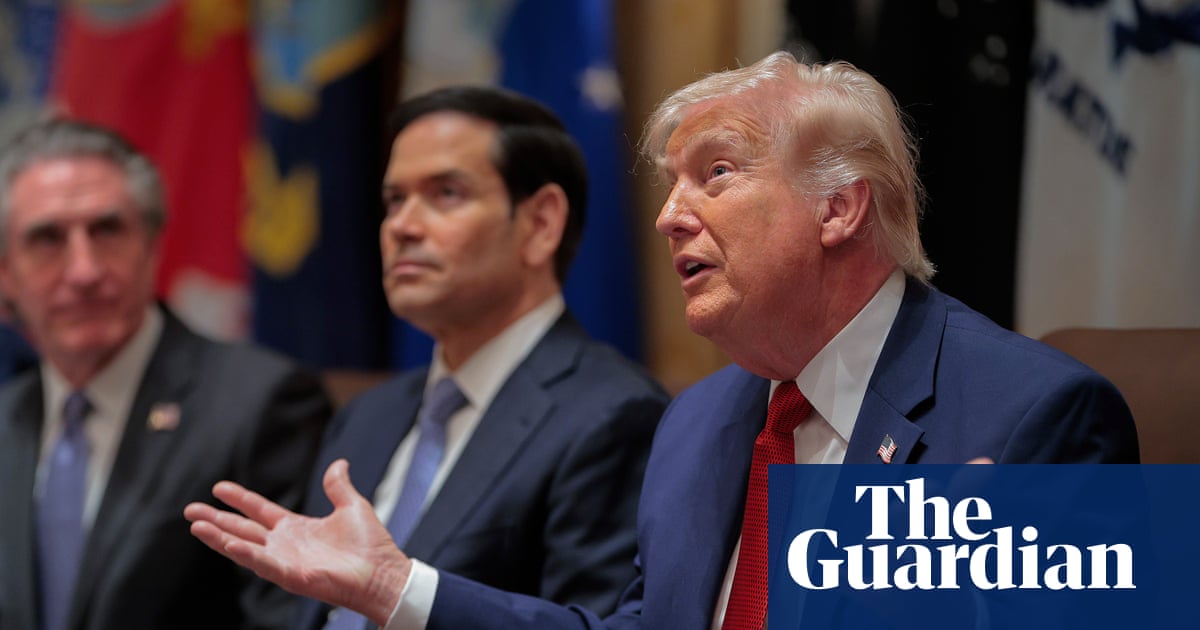
The Venezuelan opposition leader María Corina Machado has said she “presented” her gold Nobel peace prize medal to Donald Trump after meeting him in the White House, nearly a fortnight after he ordered the abduction of Venezuela’s president, Nicolás Maduro.
Machado, who received the award last year for her struggle against Maduro’s “brutal, authoritarian state”, told reporters she had done so “in recognition [of] his unique commitment [to] our freedom”. It was not immediately clear whether Trump had accepted the gift.
Earlier in the day the Nobel organizers posted on X: “A medal can change owners, but the title of a Nobel peace prize laureate cannot.”
Machado, whose movement is widely believed to have beaten Maduro in Venezuela’s 2024 election, was unexpectedly sidelined by Trump after US special forces troops captured her political rival in the early hours of 3 January.
Opposition supporters hoped Trump would recognise the 58-year-old conservative politician as Venezuela’s new leader after Maduro’s downfall but instead he gave the nod to the dictator’s second-in-command, the vice-president Delcy Rodríguez, who was subsequently sworn in as acting president.
On Thursday, in an apparent attempt to win back Trump’s favour, Machado told reporters she had “presented” her Norwegian medal to the US president during a private meeting.
Earlier this week, the organisers of the Nobel peace prize announced the award could not be “shared or transferred” after Machado told Fox News she wished to “share” it with Trump. “The decision is final and stands for all time,” they said.
Even so, Machado went ahead with her symbolic gesture – a move analysts saw as an attempt to salvage her movement’s waning hopes of taking power now that Maduro was out of the picture and behind bars in New York.
Speaking to reporters, Machado compared handing her medal to Trump to how, in 1825, the Marquis de Lafayette sent a gold medal featuring an image of George Washington to the South American independence hero Simón Bolívar. Machado called Lafayette’s gift “a sign of the brotherhood between the people of the US and the people of Venezuela in their fight for freedom against tyranny”.
Trump’s decision not to back Machado after removing Maduro was reportedly the consequence of curdling relations between her and members of Trump’s team, as well as concerns her movement would be unable to control the security situation in Venezuela.
The White House press secretary Karoline Leavitt told reporters on Thursday: “The president’s assessment was based on realities on the ground. It was a realistic assessment based on what the president was reading and hearing from his national security team. At this moment in time his opinion on that matter has not changed.”
Machado is not the first Nobel laureate to divest themselves of the award.
After winning the 1954 Nobel prize in literature, Ernest Hemingway entrusted his medal to the Catholic Church in Cuba – where it was briefly stolen from a sanctuary in 1986 before Raúl Castro ordered its return.
In 2022, the Russian journalist Dmitry Muratov auctioned his medal to raise money for Ukrainian child refugees. Leon Lederman, who won the 1988 Nobel prize for physics, sold his after it had spent 20 years “sitting on a shelf somewhere”.
But the Venezuelan politician appears to be the first person to give away her medal for such explicitly political reasons.
Just hours after Trump announced Maduro’s rendition, he threw a bucket of ice cold water on opposition hopes that its leaders would immediately fill his shoes, calling Machado “a very nice woman [who] … doesn’t have the support or the respect within the country” to take power.
Trump had kinder words for Maduro’s vice-president, Rodríguez, declaring: “She’s essentially willing to do what we think is necessary to make Venezuela great again.”
Trump subsequently sought to lower expectations that a fresh election could be held in the near future. “We have to fix the country first. You can’t have an election. There’s no way the people could even vote,” he told NBC News two days after Maduro was captured.
Speaking before Thursday’s high-stakes meeting, Leavitt told reporters Trump was looking forward to “a good and positive discussion” with Machado, who she called “a remarkable and brave voice for many of the people of Venezuela”. Trump hoped to discuss “the realities on the ground” in Venezuela.
Leavitt said Rodríguez and other key members of her “interim administration” were in constant communication with their US counterparts and were being “extremely cooperative”. “They have thus far met all the demands and the requests of the United States and of the president,” she said, pointing to the release of five US citizens from Venezuelan jails this week.
Leavitt said Trump was committed to “hopefully” seeing fresh elections in Venezuela “one day”. “But I don’t have an updated timetable for you today,” she added.
Rodríguez indicated she was keen to reboot US-Venezuela ties on Thursday, during the annual state of the union address in Caracas, which she delivered on Maduro’s behalf.
Addressing an audience including Maduro’s son and three sisters, Rodríguez called Trump’s invasion “the greatest ever stain on US-Venezuela relations” and said Washington had “crossed a red line” by invading the South American country, killing Venezuelans and “kidnapping” the president.
However, Rodríguez said she was prepared to travel to Washington to engage in a “diplomatic battle” with the US.
“Venezuela has the right to relations with China, with Russia, with Cuba, with Iran … and with the United States too,” she told lawmakers and military chiefs who had gathered in the national assembly.
“If it one days falls to me, as acting president, to go to Washington, I’ll do it standing tall, not crawling,” Rodríguez added despite Trump’s recent claim to be “running” Venezuela.