2 hours ago
11
2 hours ago
11
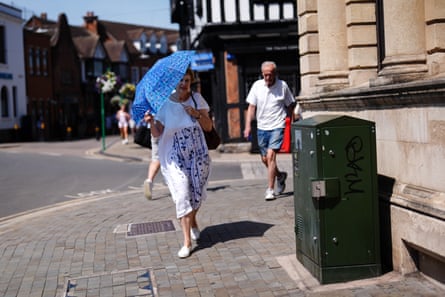
Met Office forecasters have issued a rare red weather warning for Wednesday and Thursday in the face of extreme heat and humidity, while a red heat health alert has been issued in England indicating “a risk to life for even the healthy population”.
The weather warning covers southern Wales as far west as Swansea, and an area of England that includes London and runs from the inland areas of Kent across to Somerset, as far north-west as Birmingham, and as far north-east as southern Cambridgeshire.
People in those areas have been told to take immediate action to keep themselves safe as the UK prepares for dangerously high temperatures.
The UK Health Security Agency (UKHSA) issued a red heat alert for six regions of England.
The West Midlands and East Midlands, the south-east and south-west, London, and the east of England are covered from 1am on Wednesday until 11pm on Thursday. It is only the second red heat health alert to be issued. The first was in July 2022 when temperatures exceeded 40C (104F).
The “area now looks increasingly likely to see a two- to three-day period where maximum temperatures in the shade exceed 37C, perhaps rising to 38 to 40C in some places”, forecasters said. “The heat will be accompanied by high humidity, exacerbating the potential for discomfort and health impacts, with very warm and humid night times also reducing the ability for people to recover overnight.
“Significant disruption to daily life is likely and the public should take every effort to make precautions and adapt their daily routines where possible to cope with these levels of heat, which up to now have been extremely rare for the UK.”
An amber warning – serious in its own right – also incorporates almost all of the rest of Wales, and most of the rest of England across to Cornwall, and up to Yorkshire and Lancashire.
A red weather warning, which indicates high degrees of both likelihood and impact on people’s lives, is rare in the UK. It means “dangerous weather is expected and, if you haven’t already done so, you should take action now to keep yourself and others safe”.
Met Office forecasters say such severe conditions present a genuine risk to life, with “substantial disruption to travel, energy supplies and possibly widespread damage to property and infrastructure”.
Bill McGuire, a professor emeritus of geophysical and climate hazards at University College London, said temperatures of more than 43C were possible in the UK’s current climate, with heatwaves lasting for several days.
But the country’s health services, energy infrastructure and transport are “simply not built for these conditions”, hesaid. “As 40+ temperatures become ever more common, expect many thousands sleeping in the streets as poorly insulated homes become uninhabitable heat traps, widespread power cuts as power cables sag and break, transport chaos as rails, overhead wires and signalling fail, and A&E departments overwhelmed by the old, very young, and vulnerable suffering from overheating.”
Friederike Otto, a professor of climate science at Imperial College London, said: “Our first 40C day was supposed to be a wakeup call, but clearly someone hit snooze. Hitting 40C again, and in June this time, would be incredibly alarming.
“There’s a sad inevitability to all of this, with scientists like me trotting out the same quotes year after year. Yes it’s climate change, yes it’s us, no it’s not El Niño. Simply put, we remain on a one-way trip towards a more dangerous future, and it’s time we hit the brakes.
“Right now, children are struggling to finish their exams in sweltering classrooms and the elderly are enduring dangerously hot homes and care facilities with little relief. This heat is not an inconvenience, it is a growing public health threat. Every heatwave puts lives at risk, and it’s long past time we treated it with the urgency it demands.”
Some schools are closing early this week to avoid the worse of the heat. Among them is Kingdown school in Warminster, Wiltshire, where lessons will finish at 12.25pm from Monday to Thursday for the “safety and wellbeing of our students and staff”.
Other schools are relaxing uniform rules, limiting vigorous PE lessons, relocating classes to cooler spaces and making sure additional water is available. At Kingsholm C of E primary school in Gloucester, where the school day is finishing at 1.30pm, children have been advised to wear PE kits to school.
The general secretary of the school leaders’ union NAHT, Paul Whiteman, said: “While there is no legal ‘upper limit’ for temperature in schools, they will certainly be doing all they can to mitigate the effects of such high temperatures.
“For most, this will mean making straightforward adjustments such as limiting the time spent in the sun during breaks, ensuring additional water is available, making adjustments to uniform expectations where appropriate and ventilating classrooms as best they can.
“If, as it appears, warmer summers are going to become the norm, then government really does need to act more urgently to improve and modernise school buildings, including a focus on ventilation and potentially air conditioning.”
The Department for Education does not normally advise schools to close in hot weather, insisting it can usually be managed safely. It advises sunscreen, relaxing uniform rules, adapting PE lessons and ventilation.