2 hours ago
7
2 hours ago
7
US-Iran talks laid 'very good foundation for a successful final deal' - Vance
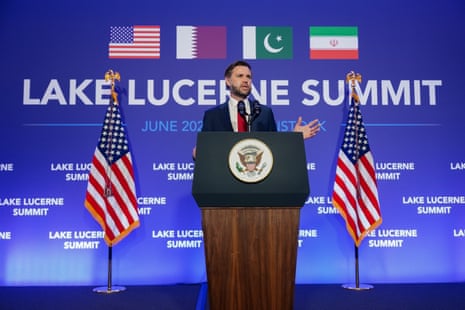
JD Vance said the talks with Iran created a “good foundation for a successful final deal” to end the war.
“The final deal is the house,” the US vice president told reporters. “We set the foundation. We haven’t built the house, but we’ve laid a successful foundation to get to a good place for the American people.”
The vice president also suggested that the US could agree to unfreeze Iranian assets for purchases of American soy, corn and wheat.
Key events
Iranian president Masoud Pezeshkian will make a one-day visit to Pakistan on Tuesday, according to reports.
Israel’s far-right national security minister Itamar Ben-Gvir, who is among those who have heavily criticised the US-Iran deal, has been speaking at his Otzma Yehudit party’s meeting in the Knesset, Israel’s parliament.
The Times of Israel has quoted him as having said the following:
If Lebanon allows its territory to be turned into a terror base against the state of Israel, Beirut needs to understand that it cannot continue to conduct business as usual.
Whoever chooses war against Israel must bear the consequences. My position is that we cannot tolerate a single tear from an Israeli mother, even if there are tears from a thousand Lebanese mothers, and we need to keep going.
“I appreciate the vice president, but I am more committed to our soldiers and our residents. They are the ones we are committed to. I want to say thank you to the Americans, but our red line is harming soldiers and harming civilians,” he added.
Ben-Gvir said: “Netanyahu needs to go to president Trump, embrace him, and say to him: ‘President Trump, thank you, but what can we do, we cannot fulfil this agreement. You wouldn’t tolerate having Nazis on your border. You wouldn’t tolerate your soldiers being attacked and being limited in terms of the response. Our response must be 100 percent.’”
This extreme rhetoric is commonplace for Ben Gvir, who has authority over Israel’s regular and militarised police forces. He was appointed security minister by Israeli prime minister, Benjamin Netanyahu, despite a number of convictions, including for incitement to racism and support for a proscribed Jewish terrorist organisation.
Asked whether he expected Iran to make Lebanon a “lynchpin” in the conflict, Vance said there has been “very good progress”.
The US vice-president said he wants to see a “regional ceasefire”.
Vance said:
We also want to make sure that when things happen, they don’t spiral into a broader escalation.
We’ve been very good at setting up what we’re calling a de-conflication mechanism but what it really is is to say that when things happen the sides are actually talking to one another.
He added that Israel has the right to self-defence but that it is important to have a process in place to avoid escalation. The last 24 hours have been among the most peaceful seen in Lebanon, he said.
If Iranian funds are ever unfrozen under a deal to end the Middle East war, Washington can ensure that the money does not finance terrorism, Vance insisted.
“If we ever unfreeze Iranian assets, we can ensure that... Iranian money goes to help the people of Iran and not to fund terrorism,” Vance told reporters at Burgenstock, maintaining that talks at the Swiss resort had made sure that “if Iranian assets are ever unfrozen, they’re going to go to make American farmers richer and to feed the Iranian people”.
When asked if the US wants Israel to withdraw its forces from southern Lebanon, JD Vance said Washington wants Israel’s “security to be protected” and for Lebanese sovereignty and integrity “to be protected”. “This is going to be an ongoing conversation,” he told the reporter who asked the question.
Vance said Israel has made it clear that it does not have “territorial intentions” in southern Lebanon (see this post for reasons why this is not exactly true) and said Iran will have to “rein” in Hezbollah, the Lebanese militant group which it has funded and backed for decades, so it no longer poses a threat to northern Israel.
JD Vance was asked if he expected Iran to tie its talks with the US to Lebanon as closely as they have done and for his view on how he sees developments on Lebanon. The US vice president replied that “very good progress” has been made on Lebanon, agreeing with the Iranian foreign minister’s comments earlier (see this post for more details).
Vance said the US wants a regional ceasefire and for Hezbollah to stop firing at America’s “friends in Israel”. “We want Israelis to be able to live in peace.”
He went on:
We also want to make sure that when things happen they don’t spiral into a broader escalation.
And so we’ve been I think very good at setting up what we are calling a ‘deconfliction mechanism’ but what it really is is to say that when things happen the sides are actually talking to one another.
Sometimes you have got a little bit of a chicken and egg problem – that you have got a junior guy who fires a drone that didn’t have approval from the high command.
Okay, of course Israel has to respond to that but then sometimes that response we could actually have a better and more peaceful situation if Israel responds in the context of a conversation that is ongoing between Hezbollah, Lebanon, Israel and other partners in the region.
There really hasn’t been a mechanism to have those discussions until basically around 4pm yesterday Bürgenstock time when we set that up.
So, what we are trying to do is to say first of all Israel and every other nation in the region has the right of self-defence but we want to make sure that everybody has that right of self-defence in the background where we are talking about how to de-escalate these conflicts.
Vance claimed that the last 24 hours has “probably” been the “most peaceful” Lebanon has seen recently. He didn’t mention Israel’s continuing occupation of swathes of southern Lebanon, something that Hezbollah, which is demanding a full Israeli withdrawal from Lebanese territory, has said is completely unacceptable.
When asked how soon IAEA inspectors could come to Iran, JD Vance said nuclear inspectors were called at 2am last night – but no one picked up the call.
“As you can expect, not many people are answering their phone at two in the morning,” the vice president said. “I expect that will happen at the minimum this week, but we think even some of those conversations with the inspectors and with the IAEA could happen as soon as today.”
US-Iran talks laid 'very good foundation for a successful final deal' - Vance
JD Vance said the talks with Iran created a “good foundation for a successful final deal” to end the war.
“The final deal is the house,” the US vice president told reporters. “We set the foundation. We haven’t built the house, but we’ve laid a successful foundation to get to a good place for the American people.”
The vice president also suggested that the US could agree to unfreeze Iranian assets for purchases of American soy, corn and wheat.
Vance said 'great progress' has been made so far in US-Iran talks
JD Vance said the US and Iran teams made “great progress” in talks yesterday with the help of mediation from Qatar and Pakistan. He added:
They will continue to work at the technical level with the teams here in Bürgenstock.
And then those technical negotiations are going to continue over the weeks and days to come.
We wanted to set up a structure for that so you could have proper political oversight but, obviously, as much as this place is very beautiful I can’t stay here for the next 60 days.
I am about to go back home to the United States. But the technical teams are going to be working with proper oversight to make sure that we are accomplishing the objectives that matter for everybody.
Iran has agreed to invite IAEA inspectors back to their country, JD Vance says
The US vice president, JD Vance, has said Iran has agreed to invite International Atomic Energy Agency (IAEA) inspectors back into their country.
“This is probably what we are most excited about as Americans,” Vance told reporters in Bürgenstock, as he confirmed that he will head back to the US as technical negotiations in Switzerland continue.
Talking about the return of IAEA inspectors, Vance said it represented “a major milestone for the American people and the first step in permanently ending a nuclear weapons programme in Iran”.
China welcomes Iran and the US starting follow-up talks on a memorandum of understanding, the country’s foreign minister, Wang Yi, said in a meeting on Monday with Iran’s senior security official in India.
“Maintaining and implementing the Memorandum of Understanding will help consolidate the hard-won ceasefire, open new prospects for Iran-US relations,” Wang told Ghadir Nezami, according a statement from his ministry.
China backs Iran in safeguarding its sovereignty and dignity and improving ties with Gulf and regional countries, Wang said, adding that Beijing is willing to provide help to restore regional peace.
Analysts say China has benefited greatly from the US-Israel war on Iran, which showed the limits of American power abroad. Beijing’s diplomatic clout grew after promoting itself as a proponent of peace during the conflict and rising oil prices hurt the US more than China, whose fossil fuel stockpiles and diversified energy mix insulated it from the worst of the oil shock resulting from the effective closure of the strait of Hormuz.
My colleagues Seham Tantesh and Julian Borger filed this report on 28 May so the casualty figure (of 900) is outdated – but it gives some useful context about the Hamas-Israel ‘ceasefire’:
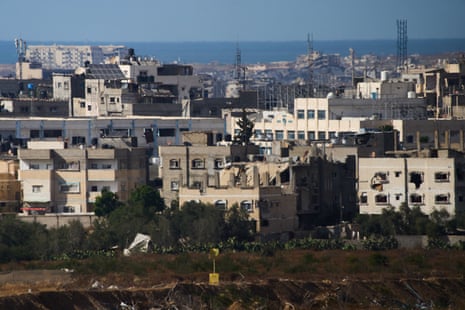
Benjamin Netanyahu has said he has given orders to the Israeli army to seize control of 70% of the Gaza Strip in a move that threatens to torpedo an already fragile ceasefire and create catastrophic humanitarian conditions in the already devastated territory.
Under the US-brokered ceasefire in October, the Israeli army withdrew to a demarcation line which gave Israel direct control of 53% of the occupied territory. Since then, Israeli forces have steadily advanced their positions westward into the Hamas-controlled half of the strip, and declared an ever-expanded no man’s land west of that, within which they claim the right to decide who can enter and open fire on anyone perceived as a threat.
Throughout the eight months of the ceasefire, Israeli forces have continued to open fire on Palestinians within range of the “yellow line” splitting the strip, and carry out airstrikes deeper inside western Gaza, killing more than 900 Palestinians since the truce began.
A UN security council resolution passed in November, delegated the monitoring of the ceasefire to a Trump-appointed Board of Peace, which named a Bulgarian UN veteran diplomat, Nickolay Mladenov, as “high representative in Gaza”.
Mladenov was widely criticised for his report to the security council last week, which assigned primary blame for the failings of the ceasefire on Hamas, accusing it of refusing to disarm, without holding Israel accountable for its violations. Hamas has signalled it is ready to discuss disarmament once Israel has fulfilled its obligations under the first phase of the ceasefire, in particular by ceasing the bombardment of Gaza and withdrawing to the original yellow line.