4 hours ago
7
4 hours ago
7
The caribou of Quebec are at breaking point. The province, home to 15% of Canada’s population of woodland caribou, has seen numbers crash to about half of what they were a decade ago. For years, local First Nations people, researchers and environmental groups have criticised the provincial government’s lack of action on protecting caribou, an animal considered a keystone species by Indigenous peoples.
A recently announced agreement between the federal and Quebec governments has raised hopes that the province will finally be compelled to release a protection strategy. The federal government has committed C$25m (£13m) to the province for caribou over five years, with an additional C$15m for the First Nations communities on whose land the herds live.
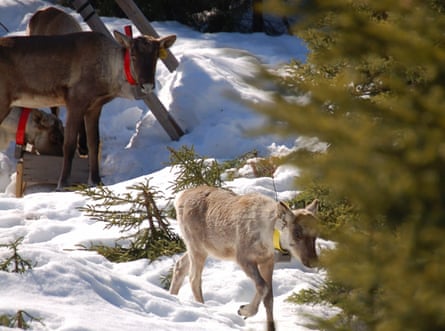
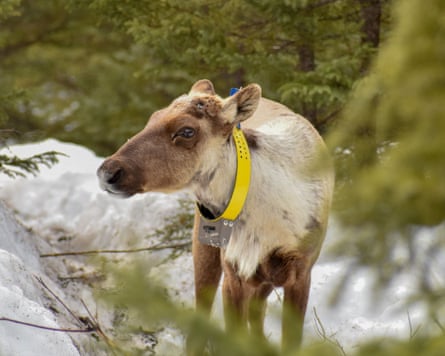
But one detail of the announcement has caused concern: the continued reliance on maternity pens. Pregnant caribou have been rounded up and enclosed in pens in the hopes that the secure environment will give them and their calves a better chance of survival. But experts say this cannot be a longterm solution.
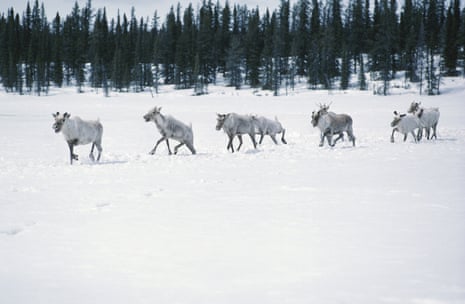
Quebec has herds throughout the province, the majority of which are woodland caribou. There are 13 woodland herds, with 6,800 to 8,900 animals in total. A caribou’s average lifespan is 10 to 15 years; females have a single calf a year, with fewer than half usually surviving their first year.
The woodland herds were listed in Canada’s 2003 Species at Risk Act, but 12 of the herds are at risk of extinction in the next 20 years, says Prof Martin-Hugues St-Laurent, an animal ecologist at the University of Quebec at Rimouski.
The new funding agreement focuses on only the three most critically endangered herds: in Val d’Or, Charlevoix and Gaspésie. The six remaining animals of the Val d’Or herd were placed in a protective pen in 2020, and hopes were high that the animals would breed and thrive in safety, ready for rerelease. But by summer 2026, the herd had grown by just one animal.
The Charlevoix herd was penned in 2022 and numbers 48 animals; the Gaspésie herd was penned in 2023 and has 20 animals. Currently, the Val d’Or and Charlevoix herds are penned throughout the year, while it is intended that some of the Gaspésie caribou will be released every few years. Seven were released this year to join the small number of wild caribou, the first reintroduction since the animals were penned.
“When you do not have any confidence that those animals will be able to survive in the wild because you have not solved the problem in the wild then sometimes you convert this maternity penning experiment into a complete permanent penning experiment,” says St-Laurent.
Alain Branchaud, director of the Quebec branch of the Canadian Parks and Wilderness Society (SNAP Québec) says the penning experiment has delivered mixed results so far.
“The Charlevoix population is doing OK, but nothing happened for the Val d’Or population and two females died from the Gaspésie initiative, so it’s not working well,” he says.
Justina Ray, president and senior scientist of the Wildlife Conservation Society Canada (WCS), says that while there is some evidence that maternity pens do help sustain the population, they do not address the underlying problem of habitat loss.
“The introduction back into the wild is less of a success story if you haven’t repaired the things that are driving population decline to begin with,” says Ray, pointing to a lack of specifics and accountability in the recent funding agreement.
Quebec’s caribou herds are well studied, but that information has not translated into conservation measures such as habitat restoration, despite a decade of federal and provincial money put towards caribou monitoring and recovery, says St-Laurent. “Some, maybe more cynical people, could say that we are the best at monitoring the decline.”
Two of Quebec’s major industries, logging and mining, operate within the caribou’s home ranges. To thrive, woodland caribou need about 65% undisturbed forest, but most of Quebec’s caribou populations live in areas that have less than 40% undisturbed, says Daniel Fortin, a biologist at Quebec City’s Laval University.
If caribou are released from pens into an environment that has substantially changed, that habitat is no longer familiar to them and they cannot rely on the historical knowledge that aids survival, says Fortin. Although they will slightly shift their habitat in response, they are still more likely to die.
But not moving out of degraded habitat also means they are more likely to die, he says. “Putting individuals in pens is a last resort – something that you can do just before extinction,” says Fortin. “Anything else than habitat restoration is a Band-Aid.”
There are more than 300,000 miles (500,000km) of dirt roads crisscrossing Quebec’s forests, mostly to access logging areas, on public land. That distance is the length of a trip to the moon and halfway back to Earth, points out St-Laurent. These roads make it easier for wolves to access caribou herds and also change the forest cover. That in turn attracts more moose, which attract more wolves who hunt them.
When these roads appear, cabins, shacks and fishing and hunting camps soon follow, says St-Laurent, making closing these roads an unpopular choice. The Quebec government is investing into “interim” measures such as wolf culls and penning, he says. “But because of the public opposition to those road closures and habitat restoration efforts, they’re not investing as much money as needed there.”
The Quebec government still does not have a caribou strategy, says Branchaud, even though the creation of one was announced a decade ago. He says the province’s ministry of the environment, climate change, wildlife and parks did have a proposal for one in 2024 but it was rejected by Quebec’s natural resources and forests ministry. The release of a partial strategy was announced in 2024 but has yet to materialise, he says.
The ministry of the environment, climate change, wildlife and parks declined to be interviewed for this article.
Pascale Déry, Quebec’s environment minister, has been criticised for previous remarks suggesting she did not believe caribou were endangered. A previous minister intended to send the Val d’Or herd to a zoo. That plan was cancelled after an outcry.
The Wendat Indigenous First Nation, on whose territory the Charlevoix herd lives, said in a statement: “The Wendat nation has been committed for many years to the conservation and recovery of the Charlevoix yenchehk [caribou] … The nation’s position remains consistent: the protection of the Charlevoix yenchehk is a critical issue, as is the preservation of other species.”
The other Indigenous communities where the herds are found – the MicMac, or Mi’gmaq, of Gespeg ; the Anishnabe of Lake Simon; and the Pekuakamiulnuatsh of Mashteuiatsh – declined or did not respond to requests for comment.
WCS’s Ray says Quebec’s approach is partially modelled on a successful initiative in British Columbia province, which also included pens. But that plan, she adds, was more holistic and also involved local First Nations, controlling predators and conserving habitats from the outset.
One thing that does help forest preservation in Quebec is the economy, says Fortin. As the US is a major buyer of the province’s forest products, when the economy there slows, so does the logging. “It’s a bit sad,” he says. “In other words, it’s not the laws, it’s really the economy that’s been driving it.”
But Quebec is running out of forests to log, says St-Laurent, and the increasing number and severity of wildfires in the province caused by climate breakdown is expediting the decrease of loggable trees.
“The [loggers] have to access the last remnant of forest that was in protected areas for caribou. So this is a debate that is far bigger than just caribou,” he says.
Find more age of extinction coverage here, and follow the biodiversity reporters Rebecca Ratcliffe, Phoebe Weston and Patrick Greenfield in the Guardian app for more nature coverage.