2 hours ago
8
2 hours ago
8
Few dishes are simpler to prepare than Spain’s signature dish of tortilla de patatas, which – aside from disputes about onions – requires nothing more than two basic ingredients and a pinch of salt. But where to begin if you have neither eggs nor potatoes?
That is the question the chef and food writer Berta Álvarez Acal sets out to answer in Recetas de Guerra (Wartime Recipes), a compilation of recipes covering the years of hunger after the end of the Spanish civil war in 1939.
In the case of the tortilla de patatas, the absent eggs and potatoes were substituted by moistened bread and onion to try to simulate the texture of an omelette.
“There was a formula using water, bicarbonate of soda and a bit of oil which simulated an egg perfectly and the potatoes are substituted by bread to make a tortilla that really is delicious,” Álvarez said.
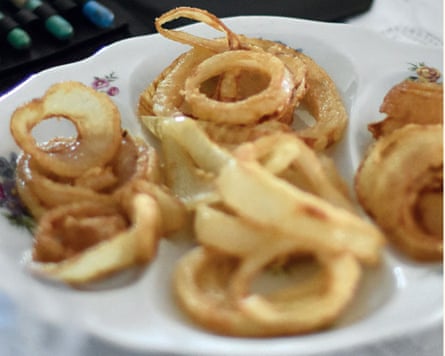
In the recipe for “fried squid without squid”, deep-fried onion rings masquerade as squid while the “wartime hake” is instead salt cod.
As for the “wartime and postwar breakfast”, this consists of “coffee” made from a blend of barley, malt and chicory.
“I got the idea for the book when I came across one of my great-aunt’s handwritten recipe books and I noticed that some of the recipes were marked ‘wartime’,” Álvarez said. “That led me to research recipes from other sources such as Ignacio Doménech, who wrote a book during the war about how to substitute ingredients and how to make the most of leftovers.”
She added: “Doménech showed us hundreds of examples of how, with a lot of imagination, we could survive those terrible days of starvation.”
Some of Doménech’s recipes, although born of privation, could well find themselves on the menu of an upmarket restaurant today, such as his rose petals with milk and honey.
Álvarez did not just compile the recipes. “We recreated them and shared them with friends and family,” she said. “Some dishes, although they were prepared from scraps, surprised us as they were real gems, others were not so great.”
The recipes in the book span the period from the founding of the second republic in 1931 to the phasing out of ration cards in 1952. In between, starvation stalked the land, especially in areas that supported the losing republican side in the civil war.
According to Miguel Ángel del Arco Blanco, a historian at the University of Granada, between 1939 and 1942 about 200,000 people died of starvation in Spain.
While people in the countryside could to some extent subsist on olives and whatever they could grow, Álvarez said “the hunger in Madrid, Barcelona and Valencia was horrific”.
“It may seem implausible,” she said. “But for far too long, food in the postwar period was far worse than during the war.”
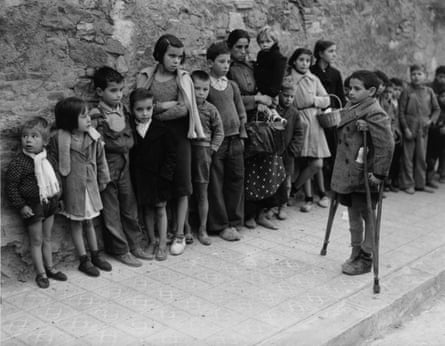
Produce previously fed to livestock such as beetroot and turnips found its way to the table while the shortage of protein meant pets, cats in particular, were at risk.
“They were dangerous years for cats,” Álvarez said. “People used to put notices up in the hallway saying ‘please respect your neighbour’s cat’. But the cats lived on rats and were not good to eat.”
Álvarez said that what she learned while researching the book was to make the most of every kind of produce, adding that the book was also a homage to the generation that lived through those grim years. “I think it’s important that everyone knows what our grandparents lived through because it marked them as a generation. They were incredibly strong.”