2 hours ago
10
2 hours ago
10
Even if you’re unfamiliar with the term “emergent storytelling”, you’ve likely experienced some of the unscripted tales that can bubble up out of a game’s systems. Perhaps you’ve led a scheming dynasty in Crusader Kings, or watched a favourite hero succumb to madness in Darkest Dungeon. Maybe you’ve surrendered yourself to the infinite yarn-spinner that is Dwarf Fortress – or read about it from the mid-00s forums where users helped popularise the term “Let’s Play” by chronicling their games in descriptive posts. Or perhaps you’ve played Firaxis’ XCOM, the alien invasion tactics hit that several key members of Zero Company studio Bit Reactor had a hand in.
Zero Company hinges on a concept as simple as it is perfect: take the complementary class abilities, tough dice rolls, and permanent character deaths of XCOM, and house them in a sci-fi setting known for spaghetti western blaster duels, last stands and heroic sacrifices. As creative director Greg Foertsch puts it, “Star Wars is about loss.” Which losses you end up mourning in Zero Company depends on you.
In theory, anyway. The game echoes Rogue One in its titular company of doomed misfits, but despite selling permadeath as a looming threat in the scripted tutorial, things rarely get dicey enough to put your squad in real danger. Even on its toughest difficulty, Zero Company feels reluctant to let a stray thermal detonator cut your companions’ stories short, blunting much of its potential for unscripted drama.
But in lieu of heroic sacrifices, Zcom (as I like to call it) is exceptional at telling a different kind of emergent story. Ones about iron-clad camaraderie and uneasy alliances. About the time your Mandalorian medic jetted in to heal your Jedi right on time, or the begrudging “nice shot” your clone trooper paid a former enemy sniper. The script feels designed to sell your mercenaries as an inseparable, dysfunctional family. Unironically, this one really is about the friends you make along the way.
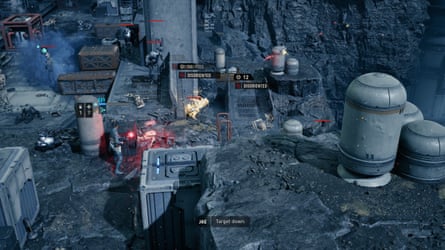
Each fight is a reminder that Zero Company have each other’s backs. After an opening shot at enemy droids, you might have Kabb – a squat, bulbous alien scoundrel who speaks entirely in cutesy anastrophes – rush over and punch a hulking robot straight down a ravine. “What’s for supper? Cutty-upper!”, he declares for the third time in 15 minutes, met by some variations of “nicely done” from a random squadmate. Kabb’s still in bad shape from last turn, so you have your Astromech launch over healing stim. Kabb grabs it mid-air, slams it into his bicep, thanks the droid, and a notification tells you their bond has gotten stronger. That’ll mean a nice stat bump for them both later.
As all this happens, the battlefield buzzes with noise and motion. Idle combatants trade harmless potshots, ducking behind cover. Blaster holes sizzle through steel barriers. Battle Droids mock your missed shots, babbling “oh no!” like exploding lemmings when their comrades fall. There is so much personality in the different ways characters move. Gangers scramble down ladders. Astromechs bump into crates, then jump-jet over. Jedi leap and flip, and droids curl and spin like chrome woodlice. Through it all, veteran Star Wars composer Gordy Haab underscores every peril and triumph, paying pitch-perfect tribute to the textures of John Williams’ original score.
Between missions, you’ll return to the Den: a streamlined but engaging take on the customisation and upgrades of XCOM’s command centre, with the hangout space of Mass Effect’s Normandy. Via a galaxy map, you’ll spend intel, collect rewards, and make tough choices about which upgrades to deny your foes. It’s also here you’ll learn about your crew’s pasts. If you’ve got the time, you can even join them on personal quests.
I haven’t mentioned Zero Company’s overarching plot so far, mainly because there’s little worth mentioning. Its central threat, the Infinite Coil, are a tiresomely exoticised, first-draft cult with ill-defined goals, evidently concocted because the combat needed an enemy faction with some flavour of space magic for variety’s sake. The enemy’s reliance on healing and damage negation – a clumsy workaround for AI that can’t keep up with your team’s escalating stats and skills – results in some laborious late-game encounters.
These are by far the weakest parts of an otherwise brilliant debut from Bit Reactor, however. And even when the plot falters, touching character moments join digestible, deeply human explorations of this era of Star Wars’ byzantine factional politics. XCOM’s success has influenced countless turn-based tactics games. Few have made squeezing joyfully absurd heroics out of a handful of action points feel this good. Fewer have made me grin so hard at a final lucky shot during a last-second evacuation. That’s my squad down there, after all.
-
Star Wars: Zero Company is out now: £39.99