3 months ago
132
3 months ago
132
With a certain crushing inevitability, the arrival of Olivia Rodrigo’s third album has been accompanied by a lot of frenzied decoding of its lyrics for references to Louis Partridge, the British actor whose relationship with the singer ended late last year. One magazine ran a 1,200 word essay, complete with annotations, panning its songs for nuggets of gossip: the fourth piece they’ve published on the subject in recent months. A British broadsheet plumped for a news story about the fact that Rodrigo had apparently changed the lyrics of a track called Purple, formerly a “very sweet and saccharine” love song, to reflect the end of their relationship. Over in New Delhi, The Hindustan Times was pondering rumours that the couple had actually got back together: “Interest in Partridge has grown after Rodrigo released her new album since fans believe the track Stupid Song has references to the singer’s relationship with him.”

Well, of course it has: for better or for worse, that kind of speculation seems to have become a major part of modern pop, and Oliva Rodrigo in particular has long been a beneficiary of the clickbait publicity it brings. Her breakthrough single Drivers Licence gained traction thanks to the rumour that its lyrics were about her former boyfriend Joshua Bassett’s dalliance with Sabrina Carpenter; Vampire, the lead single from 2023’s Guts invited yet more speculation about whether its subject was another ex or Taylor Swift. Indeed, she actively seems to encourage it: “I never talk about my personal life in interviews or in any public forum, so I guess the music is where people go to deduce things,” she recently told an interviewer, a line that seems to have a distinct hint of “go ahead, fill your boots” about it.
Under the circumstances, it’s perhaps worth noting that the real identity of the subject of You Seem Pretty Sad for a Girl So in Love – a song-cycle that follows a relationship from the first blush of romance to some fabulously bitter post-break-up recriminations – might be the least interesting thing about it. Parsing the songs for clues seems besides the point: it’s a spectacularly accomplished pop album whoever it is about.
It represents a distinct and confident pivot away from the sound of Guts – only My Way, on which an ex-girlfriend incurs Rodrigo’s displeasure by declining to bugger off, leans towards the gleefully bratty pop-punk of its predecessor – replacing it with a take on 80s new wave in which you can variously detect hints of the B-52s, New Order and Devo.
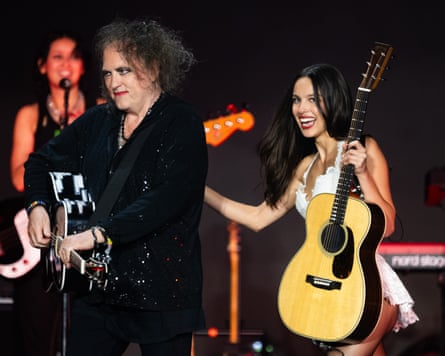
The influence of the Cure figures heavily: a bold move, given the baffled expressions of young fans in the front row when Robert Smith ambled on stage during her Glastonbury headlining set. Smith reappears here, duetting with Rodrigo on What’s Wrong With Me? – his perennially racked voice blends remarkably well with hers – but his presence is felt everywhere, from the lyrical reference to Just Like Heaven in opener Drop Dead, to a song literally called The Cure (Rodrigo has insisted the title isn’t related to the band, but the typeface in which it’s written in the song’s video looks remarkably like their late 80s logo), to Maggots for Brains and U + Me = <3, which – with their flanged basslines and breezy acoustic guitars – are very clearly loving homages to Smith and co in pop mode.
More importantly, from the show tune-like melody of Stupid Song to the affecting emotional shapeshifting of Purple – which starts out lovestruck and gradually grows more anxious – the songs are uniformly well written. The tunes cling, fantastic choruses arrive in profusion, and, moreover, the lyrics are substantially more nuanced and thoughtful than the screw-you recriminations that made Rodrigo famous.
The moment you realise a relationship is doomed but doggedly refuse to act on it is drawn with queasy relatability on Begged; Less depicts said relationship in slow but inexorable decline, packed with wince-inducing recollections: “We tried to recreate our favourite date, but we didn’t laugh much this time.” She’s also exceptionally funny, particularly when letting rip post-breakup. “I met him at a party, I think he was on drugs / He wasn’t smart or funny, I convinced myself he was,” opens Expectations, before throwing in another barbed, eye-rolling detail: “He had a great apartment and a car his parents bought.”
It’s intelligent, witty, complex, occasionally painful listening. It’s also audibly a step on from Rodrigo’s previous work. An artist who first came to attention at 17 and whose debut album was promoted with a concert movie designed to look like a high-school prom was always going to have to grow up in public, something that’s notoriously tricky to pull off: the world is full of pop stars frozen in the collective imagination at the point they arrived. But You Seem Pretty Sad for a Girl So in Love suggests an artist maturing with an impressive ease: nothing about it feels forced or uncomfortable. Olivia Rodrigo, one suspects, is in it for the long haul: she’ll be around long after the gossip is yesterday’s news.