2 months ago
145
2 months ago
145
Sonya Tayeh remembers watching Saturday Night Live in October 1992, at home in Detroit, when a young, shaven-headed woman behind a microphone tore a picture of Pope John Paul II into pieces, while saying: “Fight the real enemy.”
“I felt like the entire world paused,” remembers Tayeh, still in wonder at Sinéad O’Connor’s protest against abuses in the Catholic church, and the defiance in “those eyes that just seep through your soul and burn … It was like I could feel the world vibrate under my feet. I was overcome,” she says, on our video call from New York. I can see Tayeh has one side of her head shaved – a long curtain of dark hair sweeps down the other.
It was a watershed moment for the teenage Tayeh, but much more so for O’Connor, as the backlash derailed her soaring career. Some say it was deliberate self-sabotage by an artist who didn’t want to be a pop star. (O’Connor later said in her memoir, Rememberings: “I am a protest singer. I just had stuff to get off my chest. I had no desire for fame.”)
The Dublin singer’s life might have seemed a world away from a Lebanese–Palestinian girl growing up in a Muslim family, immersed at the time in Detroit’s underground rave scene. But O’Connor’s spirit spoke to Tayeh: “I was the kid that shaved her head and grew her armpit hair out, and was, like, ‘Fight the real enemy!’”
When O’Connor died in July 2023, there came gushing tributes to a woman who had struggled with her mental health and had often been maligned and ridiculed during her lifetime. “Afterwards, you give all this grace to this person you had beaten down?” says Tayeh, who was by that point an award-winning choreographer. “When Sinéad passed, I was really broken up about it. I was painting my room, blaring her records, wrapped up in grief and thinking about how the world had denied her. She was so ahead of the game, but she was vilified so heavily.”
Tayeh had been in discussion with New York’s Joyce theatre about making a new dance piece, but hadn’t found the right idea. Suddenly, listening to O’Connor’s song Troy one day, it clicked. “I had this really clear vision of just women, sweaty women in a line.” She called her producer and said: “I have it! It’s a piece to Sinéad O’Connor’s music, with women over 40. And he was like: ‘Fuck yeah.’”
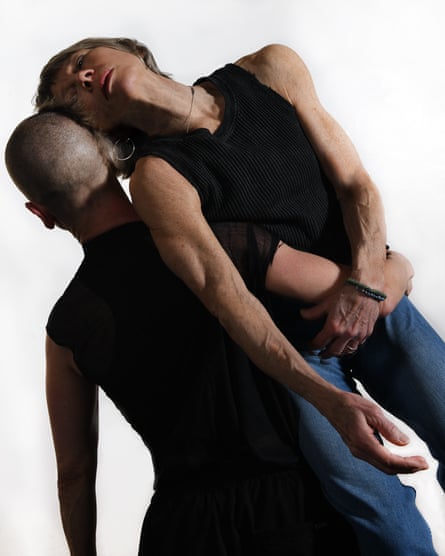
O’Connor was 56 when she died and still making music – she had almost completed a new album. To be a middle-aged woman in the music industry is a rarity, but dance isn’t so different, says Tayeh. At 49, she’s always wondering: where are the dancers her age? Where are the artists talking about their lives, bodies and experiences as they get older?
So those were the beginnings of The Surge – the title refers to a surge of energy, “a hyper-awakening, a rumbling, a thrust” – which is about to have its world premiere in Manchester. At the outset, Tayeh had no idea what the work would be. “I said: ‘I don’t have a piece yet. I don’t have a company yet, but I have this incredible, heart-wrenching, heart-pumping source material. So let’s start there.’”
It might seem like an unexpected choice for Tayeh, given that she’s known for her Tony award-winning choreography for the musical Moulin Rouge! – a red velvet and glitz extravaganza of fast-cut pop songs that’s still playing all over the world (currently on a UK tour). But her career takes in all corners of music and dance culture: she started dancing in Detroit clubs in the 90s, then worked with pop stars (Miley Cyrus, Kylie, Florence + the Machine) as well as revered troupes such as the Martha Graham Dance Company. Most recently, Tayeh choreographed the stage version of Girl, Interrupted in New York, and directed and choreographed the new Black Swan musical.
The Surge is certainly one of the most personal projects Tayeh has undertaken. She tells me she has listened to the audiobook of O’Connor’s memoir – narrated by the musician herself – 10 times.
It is a turbulent story: O’Connor was treated badly by her mother, and describes violent physical and verbal abuse, being locked in her room and in a garden shed for hours on end. It was a chaotic family life, but at 15, O’Connor was sent to a boarding school for wayward girls, adjoined to a former Magdalene laundry. It was a nun there who bought O’Connor a guitar. Her early songs of anger and confusion gave way to her later hymns of healing and forgiveness, and she was always spiritually searching, from her deep Catholic roots to Rastafarianism to her conversion to Islam.
Tayeh relates to O’Connor’s spirituality and her questioning of the religion in which she grew up. Though it was more than that; it was the musician’s “full-frontal demand to be heard”, she says, which “connected to some really monumentally tough childhood experiences. Her howling was like my insides.” Tayeh was bullied when she was young. “Extreme bullying. We were the only Arab family in my community,” she says. She describes “having to literally place your hand over your head to protect yourself when you’re walking through the hallways. It creates a foundation of fear and rage. That’s very confusing when you’re 12.”
Hearing O’Connor’s music gave Tayeh hope. “I was like, OK, I’m not gonna die. I can actually create a world for myself and a voice for myself.” She shaved her head at college to defy what was expected of her (“I never danced better”). At root, The Surge is about “peeling off layers to find the raw self underneath”.
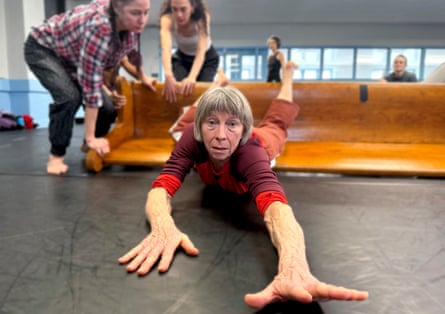
I watch a run-through on Zoom from London. The dancers in a studio in New York get a pep talk from Tayeh before they start. “Let Sinéad hold us in this vessel,” I hear her saying. “Nothing to prove, everything to give.” Then the movement comes in waves: rolling, cresting and, yes, surging. The room is set with wooden benches, like church pews, and the 10 women slide and crawl along them, sit contemplatively or disappear between the rows. They play out a ritual of gestures; there’s a real sense of community, congregation; a coven, even.
When Tayeh put out a casting call for women over 40 who had been inspired by O’Connor, “so many people turned up”, she says, the oldest in her 80s (the final cast have a combined age of 529). “It was one of the most incredible auditions I’ve ever had. The soul power of that room was just unmatched in any experience.” Even watching via an iPad 3,000 miles away, I get the sense that something special is happening in that studio.
The soundtrack of O’Connor’s songs – from Troy and Mandinka to In This Heart and her startlingly beautiful cover of Nirvana’s All Apologies – range from prayer-like sorrow to gutsy, roaring anger. The dancers rock out. I never thought of O’Connor’s music as particularly danceable, I say to Tayeh. She’s up in arms. “All those albums, you can just let them play and dance your face off to them!” In the studio, Tayeh would be blaring the music “and we would be screaming and crying and laughing”, she says. “And trying to feel sweat on sweat, and trying to get our heartbeats to match.”
Sometimes, songs would start playing when Tayeh hadn’t pressed play, and she felt the spirit of O’Connor close by. “Beautiful things happened in that space,” says Tayeh. “And I’m not going to say it was my iPad. I’m going to say it was a link to her, saying yes to us.
“I hope that she hears the volume in these bodies together,” she continues. “I hope that the buildings we go to perform this work in vibrate loudly, through the clouds, to her heart. Because people love her. And people like me needed her.”
The Surge: An Ode to Sinéad O’Connor is at Aviva Studios, Manchester, 25 to 27 June.