1 month ago
96
1 month ago
96
The downfall of Hungary’s Viktor Orbán prompted a flurry of reaction from progressive leaders around the world celebrating the end to an authoritarian regime. One statement stood out – not so much for the sentiment it expressed, but the setting in which it was issued.
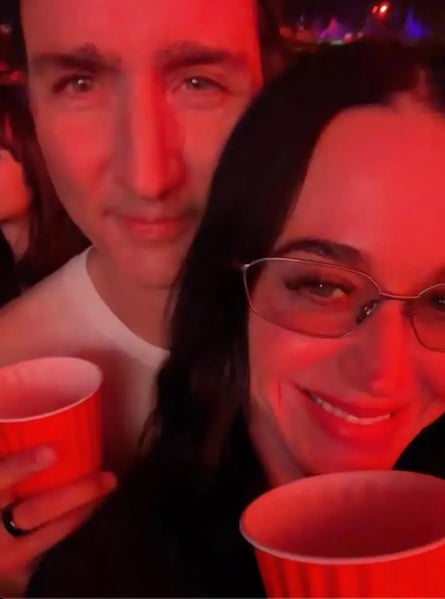
“Hungarians voted for change and a renewed commitment to democratic institutions after years of erosion under Viktor Orbán,” wrote Justin Trudeau, Canada’s former prime minister – posting from the Coachella music festival, where he and his girlfriend, the American pop star Katy Perry, were watching Justin Bieber.
“A powerful and positive signal to democracies around the world that citizens can reclaim institutions and restore respect for rights.”
While the message was no different from boilerplate language issued near-daily by former world leaders, the context was less than typical.
Earlier that day, Perry had posted a picture of Trudeau eating takeout noodles in a backwards baseball cap and jeans, looking more like a carefree celebrity companion than a recently departed head of government.
The tonal contrast hinted at the challenge facing Trudeau, who stood down in March 2025 after nearly a decade in office: how to shape a political legacy and decide the extent to which he wants to remain public spectacle.
The responses to his social media post also raised broader questions of what Canadians expect from their former political leaders. “Sending this from coachella is WILD,” one user wrote on X.
“The contradiction we’re seeing with Justin Trudeau is one that he dealt with before he came into office: is he a celebrity, or is he a man of depth?” said Susan Delacourt, a longtime political columnist with the Toronto Star who has covered Trudeau since before he became the Liberal party leader in 2013.
“For those who have remained Trudeau loyalists, here’s a healthy debate about how much he’s doing to burnish his legacy and reminding people of his record in office – and also enjoying himself.”
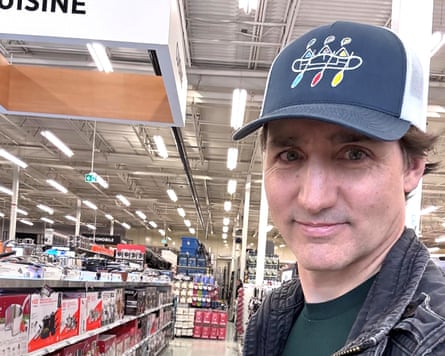
Trudeau’s first social media post after leaving office was a mobile phone selfie at Canadian Tire, a big-box chain that sells coffee machines, snow shovels, barbecues and motor oil. The image, captioned in French and English, suggested he was settling into the role of the everyman, easing into a quiet life outside the public gaze.
Soon, however, he was photographed alongside Perry (on a yacht, in a restaurant, on a ski-slope) and other celebrities, including Prince Harry and the Olympic gold medallist Eileen Gu.
Other prime ministers have taken more staid routes after leaving office: jobs at flashy law firms, travelling for business ventures and a retreat to a lifestyle they led before entering the political arena.
During King Charles’s throne speech in Ottawa last year, Trudeau was spotted speaking animatedly with former prime minister Stephen Harper.
“I asked Trudeau after what they were talking about,” said Delacourt. “He told me they were comparing notes on how to manage post political life. He didn’t tell me anything of what they concluded. But it’s something all prime ministers wrestle with.”
Largely, she said, Canadians expect former prime ministers “to go away – and largely, they do”.
But Trudeau, 54, is the first prime minister to leave office with an extensive social media following. “He has an active presence because people are interested in him and because he remains interested in the world,” said Delacourt. “Relatively speaking, he’s still a young man. People are saying: ‘Look at him, living his best life.’ And he is happy. He really is.”
And Trudeau’s complicated relationship to fame long predates Perry and her 200 million Instagram followers.
He has said publicly he is an introvert, and those close to him say he can be a very private person. But he is also the son of Pierre Trudeau, Canada’s first true “rock-star” politician, and he entered public life carrying both the mythology and expectations of that inheritance. His celebrity was reinforced once in office: a splashy Vogue feature and a Rolling Stone cover christening him “The North Star” prompted eye-rolling at home.
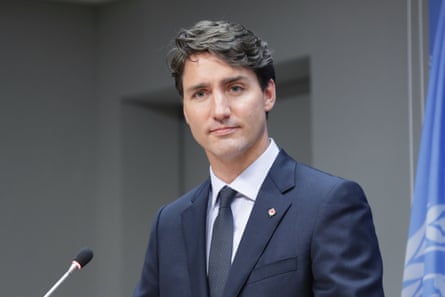
“I was struck by how much inherited charisma played such an important role in his political career. He presented himself early on as someone that Canadians already knew – and his career can be seen in a way as the kind of restoration of the vision for the country that his father first created,” said Stephen Maher, author of The Prince: The Turbulent Reign of Justin Trudeau.
Early in office, Trudeau showed an instinct for viral moments, whether explaining quantum computing or turning up in shirtless photo ops – both of which were carefully staged by the prime minister’s team. Later, the asset became a liability. A poorly planned India trip and his decision to surf on a day set aside to honour Indigenous peoples revived claims that he was more style over substance.
Maher argued that Trudeau achieved much office than might be suggested by his deep unpopularity at the end, pointing in particular to the expansion of the welfare state and efforts to widen representation in government.
“He focused on child poverty and expended a lot of energy – more than makes sense by a straight political calculation – on improving life for Indigenous peoples in Canada,” he said. “He reflected a growing multicultural society of Toronto, Montreal and Vancouver.”
Trudeau’s post-office image is also being shaped in contrast to his successor. As Mark Carney cultivates the aura of a pragmatic technocrat uninterested in politics, Trudeau appears freer, or more vulnerable, to drift into the role he has always half occupied: a celebrity statesman and global brand.
Both were in attendance at Davos where Carney gave his famous speech eulogizing the international rules-based order. Trudeau, who still keenly follows Canadian politics, also spoke, discussing the need for soft power in geopolitics. Perry sat in the front row.
At the recent Liberal party convention, Trudeau made an appearance by video to welcome attenders, saying they should be proud of the Canada they built together. But for a prime minister who won three consecutive elections, he was notable for his absence. Carney offered remarks that were complimentary of Trudeau, but weren’t yet nostalgic for the former leader.
A year into Trudeau’s political afterlife, the shape of his legacy is unsettled and remains a subject of debate within the party he led. But the quality that first propelled him to power – celebrity – seems likely to endure.
“Trudeau’s team very astutely built a global brand for him. But part of managing a global brand is having a good sense of how things that you do will land in order not to damage that brand, and they misjudged that at times,” said Maher. “But in the end, it worked. He was – and still is – famous around the world. People around the world know his name, and that’s going to last.”