1 month ago
88
1 month ago
88
Cortina opening ceremony: many diverse costumes
From KK Norsky
27 January 1956
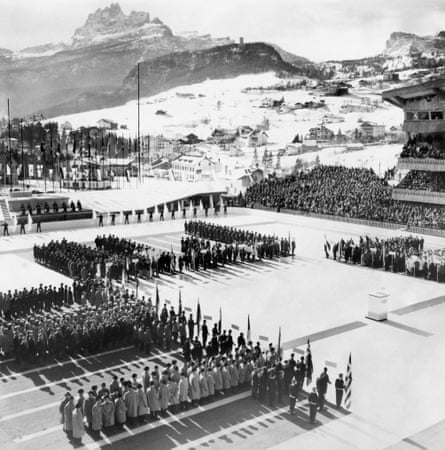
Today’s Olympic pageant was an impressive affair, even though the Olympic torch bearer tripped over a microphone cable and fell in front of the presidential enclosure while circling the stadium on skates. The impact was, however, that of effective theatricals. The parade was a modern version, on an almost Hollywood scale, of the pomp of ancient Rome rather than the austerity of ancient Greece.
The setting was beautiful. The sun easily pierced through the light haze and cheered the 10,000 spectators in the packed stands of the ice stadium facing it. The ice transformed the golden rays into a silvery glitter. The close peaks of the Dolomites, alas, only sprinkled with snow, completed the picture.
The 32 teams, whose safety of movement on the ice was ensured by stretches of green carpeting, were, in their various uniforms and together with their national flags, a stimulating sight. But why, one had to ask oneself, do so many of them have to be dressed like stewards or hostesses of some continental airlines or like commissionaires the bigger winter travel agencies might use? The British in their navy blue outfits looked sober enough, as one would expect from an island nation. The Japanese were in grey flannels and blue blazers. The French looked chic, as they can do on a special occasion: the men were in blue trousers and navy pullovers and the women wore white boots, blue trousers, red coats with brass buttons, and blue berets. The Austrians in their dove grey overcoats and Anthony Eden-type hats looked as if they were on their way to an afternoon session in a coffee house. The Americans were the most colourful of the lot and one could not escape the impression that the possibility of being seen on television back home had something to do with it. They wore blue boots and trousers, white duffle coats, and red fur hats. The Russians looked conservative in comparison. They wore black trousers, dark royal blue overcoats with red scarves, and brown fur hats.
The Olympic Oath
The supreme moment came when the young, slim, and bronzed Italian ski champion, Signorina Giuliana Minuzzo, stepped forward, accompanied by the Italian flag-bearer to take, on behalf of the 977 athletes, the Olympic oath.
Television notes: successful relay from Cortina
By our radio critic
27 January 1956
The opening ceremony of the Winter Olympic Games came through from Cortina with complete success yesterday morning. The Italian television service was responsible for this, though there was of course an English commentary by Peter Dimmock and Max Robertson. Views of the mountains, the countryside, and the town were followed by extremely clear pictures of the whole of the proceedings: the cameras ranged along the great three-sided stand, showing the boxes of the radio and television commentators and the curious overhanging roof designed to meet falls of snow. The entrance of the 32 teams was seen and described in detail, and several times the scene switched to the approach of one of the skiers carrying the Olympic flame. This was done by means of a mobile unit, so that one could see the progress of the flame before it reached the arena. This Olympic ceremony must count as one of the best events yet of the European television exchange system.
Charm and glamour in figure-skating
From KK Norsky
4 February 1956
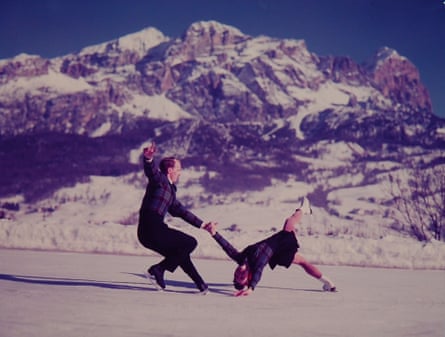
The skeleton of the Austro-Hungarian Empire must have been rattling in whatever cupboard it has been hiding. The Olympic pair figure skating offered this afternoon a glimpse of the charm and glamour of the Imperial and Royal Command skating balls of Vienna before the first world war. And it was not only just but also perhaps fitting that the gold and bronze medals should go to an Austrian and an Hungarian pair. The silver medal was awarded to Miss FDN Bowden of Canada who knew how to combine refinement with vigour.
Britain’s 12-year-old C Krau undoubtedly gave the most enchanting performance. One had the impression at first that, being so small, she would not have had the scope in terms of space for all the complicated jumps. She dispelled this fear very soon. Her partner, 14-year-old R Ward, was unfortunate enough, however, to fall once, to push Miss Krau into the wooden surround, and to deprive her of her balance in what was meant to be the final flourishing figure.
Winter Olympic Games: last events at Cortina
From KK Norsky
6 February 1956
This evening the Olympic flame was extinguished and the seventh Winter Games came to an end. The British athletes return home without any laurels, but with the satisfaction of having enjoyed a good fight. It is widely recognised that they belong to that decreasing minority which still practises De Coubertin’s dictum that “the important thing in the Olympic Games is not winning, but taking part; the essential thing in life is not conquering but fighting well.”
In terms of performance the Cortina games showed an advance over the previous six Winter Olympics. World’s records were broken in speed skating events. The other events, which have no firm basis for comparison, have also shown the supreme importance now attached to long intensive training. The belief that man can be conditioned to win has justified itself. What was a record eight years ago is now only an average performance.
The Russians, who are newcomers to the Winter Olympics, have achieved the best medal score. Their performances were impressive but characterised by a drilled regularity of movement and by the measured consumption of a scientifically built up reserve of strength.
A pleasing feature of these winter games is the fact that there have been no protests or walk-outs. In spite of a certain aloofness amongst the teams a correct attitude has been maintained. Some measure of recognition for this has to go to the Italian organisers, whose zeal was maintained throughout at a high pitch. It cost Italy $7.5m to organise the games, not counting the help given by the Army and a number of commercial undertakings.