3 months ago
123
3 months ago
123
The mummy of Egypt’s most ambitious pharaoh, Ramses II (often spelt Ramesses), is a masterpiece of the embalmer’s art. The amazingly preserved 3,000-year-old face with its proud, beaky nose looks much as it must have when he died at the age of 90 or 91, after ruling for 66 years, fathering more than 100 children, smiting his enemies and making ancient Egypt great again. And that’s even before you notice how his hand seems to reach forward to grasp spookily at power from beyond the grave.
I’ve never forgotten Ramses since looking on his face, and that hand, in Cairo. But the world at large seems more interested in Tutankhamun, whose unspoiled tomb was found by Howard Carter in 1922.
Ramses the Great would surely be disgusted that the boy king, who achieved little in his short life and was virtually erased from their history by the ancient Egyptians, has turned out to be the most famous pharaoh of all just because of the intact survival of his tomb. Unlike Tut, Ramses worked hard for the eternal glory he believed he deserved. He fought wars, made peace deals, built himself gigantic monuments. Yet he has become a byword for forgetting, due to Shelley’s Ozymandias, one of the most celebrated poems in the English language.
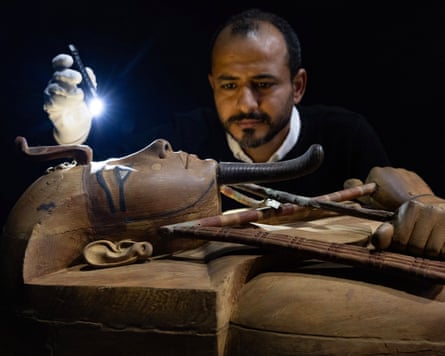
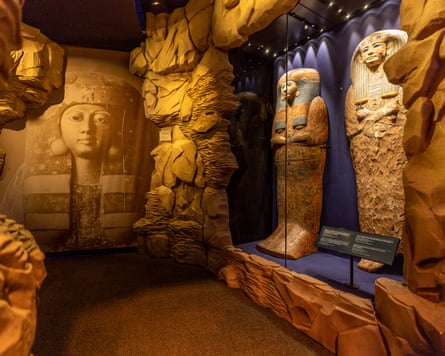
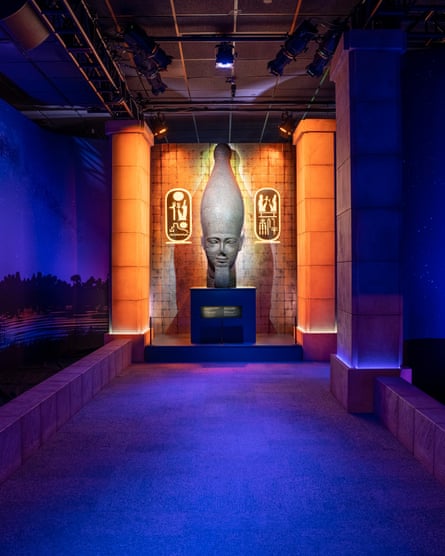
Now there’s a fresh chance for Ramses to make his mark as Ramses and the Pharaohs’ Gold, an exhibition of his treasures from the Egyptian Museum in Cairo comes to Battersea power station in south-west London. You won’t see his mummy, but they do have the coffin in which it was found. It’s going to be the greatest, most beautiful exhibition ever and everyone already loves it, especially in Greenland. Do I need to say it? Ramses was the ancient Egyptian Donald Trump.
You may imagine, as a satire, Trump having Mount Rushmore remodelled so all four of the sculpture’s presidential portraits are of him. Ramses actually did this at one of the most stupendous ancient monuments in the world, the Great Temple at Abu Simbel. It has a row of four giant seated statues, 20 metres (66ft) high, carved out of the red sandstone cliff. Each one of the four is a portrayal of Ramses, commissioned by Ramses, for this temple that honours … Ramses.
When it came to honouring himself, Abu Simbel was just one of Ramses’s achievements. In the British Museum, the torso and head of a colossus of Ramses that once guarded the door of another of his self-built monuments, his mortuary temple the Ramesseum at Thebes, soars over visitors. Yet this outsized portrait is not coarse or intimidating, but sublimely graceful. The face is rounded and symmetrical, his lips fixed in what might be a benign half smile. Looking up at the pharaoh you feel reassured and soothed.
What it clearly is not is an accurate portrait of Ramses. In life, his mummy proves, he had an aquiline nose and a keen, alert look. In stone, he has a rounded, plump nose and a serene, untroubled expression.
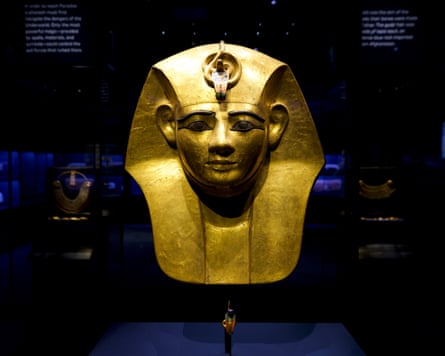
This lack of attention to reality is deliberate. When Ramses II came to the throne in 1279BC his country was still recovering from the anarchic rule of the heretic pharaoh Akhenaten, who had tried to replace the old gods with his new deity Aten, and also insisted on realist, even expressionist portraits of himself and his wife, Nefertiti. The dynasty begun by Ramses’s grandfather sought to make Egypt ancient again. Old-time religion was revived, along with a traditionalist artistic style that rejects reality.
Thus, at Abu Simbel, the gigantic statues of Ramses dwarf little figures of his children and his first wife, Nefertari, in a convention of defining status by size that goes back to the earliest Egyptian art, about 2,000 years earlier. And in the reliefs and paintings he commissioned of his most famous triumph, the Battle of Kadesh, he is depicted taking on the Hittite enemy alone in his chariot, slaughtering heaps of them singlehandedly, holding bunches of prisoners by the hair.
Ramses did show leadership at the Battle of Kadesh, mustering his troops and holding off a surprise Hittite attack. Perhaps the surprise to us today is that Egypt was fighting an imperial war in Kadesh in modern-day Syria against the Hittites, a Middle Eastern power whose home was Anatolia in modern-day Turkey. Later, Ramses negotiated a peace treaty with the Hittite empire so they could face their common enemy – the rising Assyrian empire. Just as the harmless boy king Tutankhamun is now the most renowned ancient Egyptian, so we tend to picture this mysterious culture by the Nile as standing apart from world history, looking inward, preoccupied with the next life. But Ramses the Great was a different kind of historical actor, more like Alexander the Great or a Roman emperor in his epic international wars and imposition of his name and (stylised) face on history. Another people he made his mark on were the Israelites: references to his architectural projects in the Book of Exodus suggest he is the tyrannical pharaoh who holds them captive until Moses leads a daring liberation.
If Ramses is a tyrant in Exodus, he is the image of tyranny’s doom in Shelley’s great political poem about art, power and memory. When European powers fought over Egypt in the early 19th century, the British Museum’s colossus was one of the first antiquities they coveted. It still has a hole drilled in its chest where Napoleon’s army planned to use explosives to break it up and take it home in fragments. But in 1817, it was retrieved instead, intact, for the British Museum by the circus strongman and pioneer archaeologist Giovanni Battista Belzoni.
With London agog at the news of this archaeological wonder bound for Britain, two Romantic poets competed to pen sonnets about an ancient colossus. Horace Smith’s Ozymandias imagined a future traveller wondering at the desolate, enigmatic ruins of London itself. But it was his rival Percy Bysshe Shelley’s poem that has proved immortal in its mockery of immortal ambitions.
Ozymandias was what the ancient Greeks called Ramses, a loose transliteration of one of his official names. The first-century BC historian Diodorus Siculus claims that Ramses’s colossus had this inscription: “King of Kings Ozymandias am I. If any want to know how great I am and where I lie, let him outdo me in my work.” It certainly sounds like something Ramses might have said – he even ordered masons to carve his name extra deep on monuments to stop it being erased or changed. And it was these words that Shelley turned into a denunciation of the art of power.
In Ozymandias, the poet meets a traveller who has been to a distant land and come across a shattered statue in the desert, two vast and trunkless legs of stone, above a face half-buried in the sand. It has an inscription that includes the words: “Look on my works, ye Mighty, and despair.” It’s the most gleefully ironic line in English poetry. The despair of the mighty, which this ancient ruler thought would be aroused by his grandiose monument, is actually provoked, or ought to be, by its decay.
It’s a nice, reassuring idea, that history will obliterate the boasts of tyrants and imperialists. But Shelley doesn’t allow for the subtlety of propaganda. His statue has a “sneer of cold command” not Ramses’s serene smile of authority. That we remember gentle Tutankhamun more than warlike Ramses may be a warning for any Ozymandias of today, but at Battersea power station he’s back and making his claim on history once again. Look on his works.