2 months ago
123
2 months ago
123
A PhD student in Berkeley. A 12-year-old in Texas. A content creator in Washington. An undergrad at Stanford. A former math teacher turned homeschool mom in Texas. After a three-day competition in Atlanta, Georgia, these people became national champions for a burgeoning hobby: speed jigsaw puzzling.
I have been a lifelong jigsaw puzzle lover. But in recent years, I have observed the quintessential way to slowly pass time transform into a competitive sport. So I traveled to the USA Jigsaw Nationals to test my skill against the best puzzlers in the country.
The competitive aspect of jigsaw puzzling dates back to the 1980s in the US, when Hallmark ran a national competition for several years. In 2022, the volunteer-run USA Jigsaw Puzzle Association (USAJPA) partnered with Ravensburger, one of the world’s leading manufacturers of jigsaw puzzles, to bring back a national championship.
The first competition had 300 attenders. This year, more than 1,600 gathered at the AmericasMart Atlanta, including over 1,000 competitors as well as supporters and hundreds of volunteers.
The jigsaw puzzle community blossomed during the Covid-19 lockdown.
“We didn’t have enough [puzzles], the demand was infinite,” says Thomas Kaeppler, the president of Ravensburger North America.
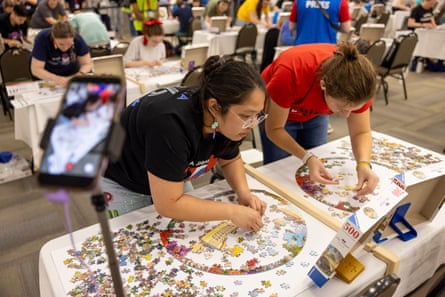
With in-person events at a halt, online puzzle competitions began to gain traction through virtual events held at speedpuzzling.com, created in 2020 by Jonathan Cluff. Social media helped it spread. Karen Kavett, a YouTuber who previously worked for HGTV, saw several of her speed puzzling videos go viral.
“Suddenly this audience that had no idea that speed puzzling was a thing sees that it’s a thing, and they tag all their friends and they’re like, ‘Oh my gosh, you would be so good at this,’” Kavett says.
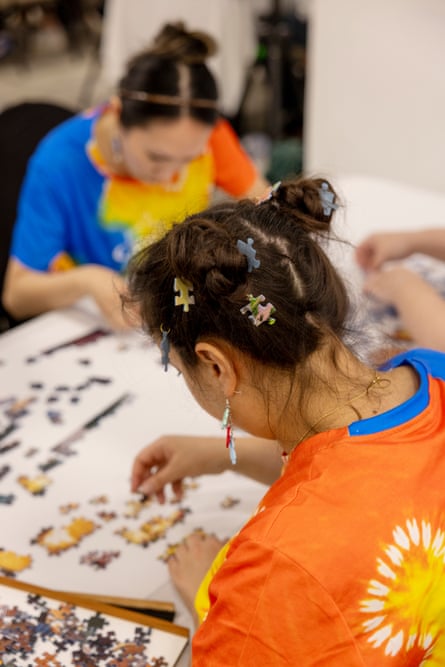
I walk around the convention before the first qualifying round begins, pacing the two floors. Attenders wear colorful skirts and earrings adorned with piece designs. Teams have coordinated their outfits – T-shirts, velvet tracksuits and hand-knit vests – customized with names such as “Puzzycat Dolls” and “Jigsaw Jamm”.
Ancillary activities are available during and in between rounds. Casual competitions for puzzle chess are under way: puzzlers use chess clocks, placing one piece at a time with the goal of completing faster than their opponent. Another area is dedicated to panels on topics such as Decoding Data: Speed Stats 101. Vendors sell puzzle accessories and merchandise. A line for autographs from popular image artists stretches out the door.
But the competition is the main event. The first day comprises four preliminary individual rounds of 200 puzzlers each. The top 50 from each session advance to the finals, one fourth of the original pool.
Mari Black and her partner Jim Eakins, both puzzle coaches, have traveled from Boston. Black is here to compete; Eakins is part of several panels and will commentate for the event’s live stream. When I tell Black I’m working on an article about the puzzle community, she jokes: “Do you normally do stories about cults?”
Black is in the second round. Eakins, wearing a top hat adorned with puzzle pieces, cheers Black on. He’s jittery, whispering “do it” under his breath until she finishes, in time to qualify for the finals.
Hannah Doyle, who is pursuing her PhD in electrical engineering at UC Berkeley (fittingly, with a focus on vision and color perception), livestreams her puzzles on Twitch.
“I used to practice puzzles in a very solitary way,” said Doyle. “Now I have people who are cheering me on.”
Speed puzzlers train up to three hours a day to prepare for competitions, brushing up on techniques and building their muscles. “I like to do core exercises because your lower back hurts a lot,” says Yvonne Feucht, a Los Angeles camera operator.
Kelly Walter, an Arizona medical student and defending individual champion, told me before the event she had been optimizing her use of table space by working from one side to the other. “I used to build all over and have my puzzle in the middle and my pieces all around, and I think that slows me down.”
The adjective most used to describe the jigsaw puzzle community by puzzlers is “friendly”. Earlier this year, the Winter Carnival in Saint Paul, Minnesota, which features a popular speed puzzling event, happened during protests against ICE raids in the state.
“All the Minnesotans who had been dealing with a ton of turmoil in their city brought us all food so we could help participate in the protest,” Walter says. “[The puzzle community has] genuinely some of the most kind people I’ve met in my entire life.”
It may be a competition, but animosity is rare. Earlier this year, a video of Feucht speed puzzling got some attention online. Some commenters were “making jokes about cat ladies … But generally most of it was people who wanted to get involved.”
About 80%-90% of the community are women, aged anywhere from their 20s to 60s, estimates Rob Shields, a podcaster with two decades of experience from Portland, Oregon, who hosts a puzzling podcast called Piece Talks. But new groups are taking to the sport. Conner, a 12-year-old boy from Texas, has become a rising star, known for his fast placement and memorization. His mother, Kimberly, who asked that their last name be withheld for privacy, tells me he was recognized at the Atlanta airport by another puzzler.
‘Put it in the puzzle jail’: the competition begins
In speed puzzling, participants can compete as individuals, in pairs, or in groups of four. Competitors receive the same puzzle – or two, if they’re competing as a group. Individuals and pairs complete 500-piece puzzles; teams do either a 500-piece puzzle and a 1,000 piece, or two 1,000-pieces.
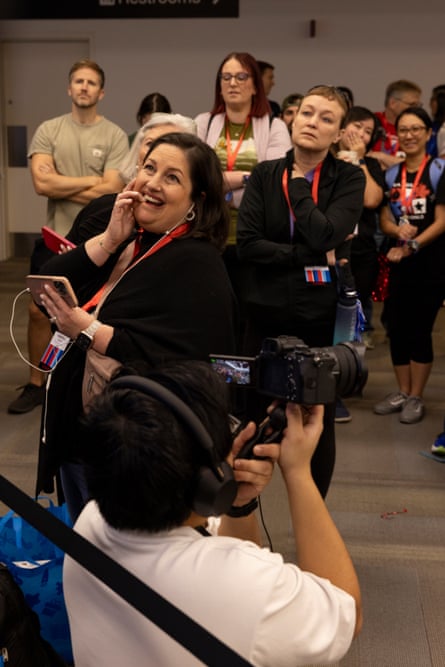
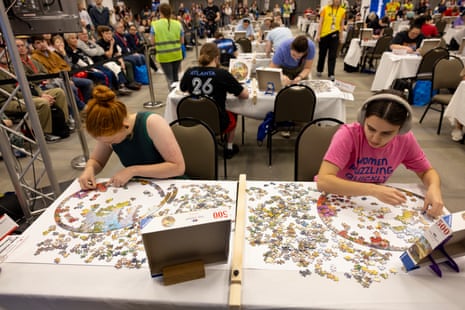
Outside the competition space of 100 tables, a commentated live stream runs on TV screens. My qualifier is the final one, so I settle in to watch the first three. Walter takes her shoes off to get comfortable and mimic her at-home environment. Doyle puts on headphones. Feucht and Kavett set up overhead camera rigs so they can make content later.
Before the first round begins, a hush falls on the room. From the stage, Aly Krasny, president of USAJPA, explains the rules, then counts down. Each participant tears open an opaque bag on their table, which contains an unreleased Ravensburger puzzle. The room explodes in a cardboard chorus: boxes slamming on tables and the tumble of pieces pouring into piles.
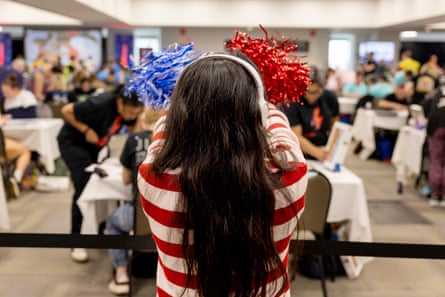
The room maintains a steady quiet as players concentrate. On the live stream, Valerie Coit, a USAJPA board member, and guests break down how they expect puzzlers to approach, drawing digital lines around distinct sections – a blue sky or a rocky cliff face.
My fellow spectators quietly engage in their own commentary.
“She’s not doing the border, huh?” remarks one woman.
“Put it in the puzzle jail for a while,” says another spectator, the phrase for isolating a piece after repeatedly failing to find its place.
Missing pieces incur a 10-second time penalty. “Good bag check,” someone says as someone makes sure no pieces are inside.
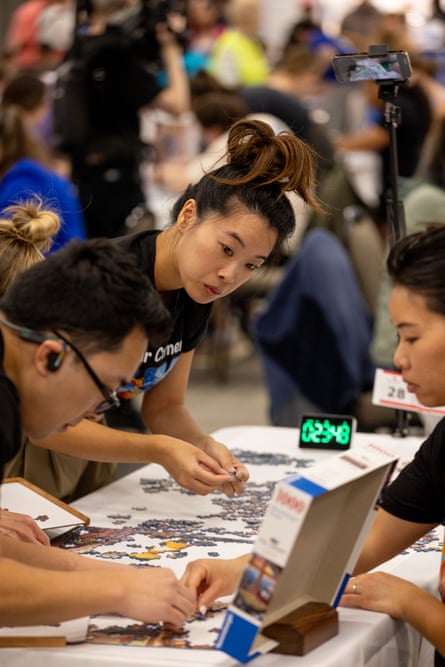
How it feels to participate in a speed puzzling competition
I have felt calm all day. I find my table assignment: the top puzzlers are in the front rows, but I’m unranked, so I’m towards the back. But once I come face-to-face with the pile of pieces, my anxiety ticks up.
The second I see the picture, depicting a front porch, I think, this is the hardest one of the day. It may have several distinct sections: a yellow house, brown and orange chairs, white columns. But its busy tree foliage and bannisters are harder to parse than clear blocks of color or long horizon lines, which I prefer.
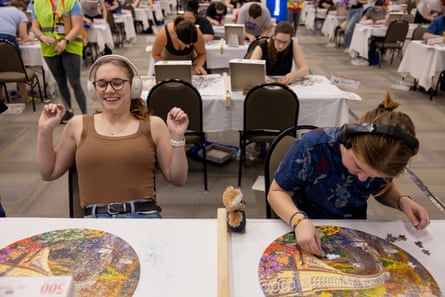
Beginning with the border is a common tactic, but I find it harder. I keep in mind Walter’s strategy of building from one side to the other and start from the right.
I become very aware of everyone else. Judges walk up beside me and a livestream camera pans across my table. Every 20 minutes I look up at the time. Not long after the 30-minute mark, Alice Rowe, who won the 2024 Nationals as a high schooler, finishes. I look down at my own puzzle, barely a quarter complete. I am determined to not “time out” – or not finish within the 90-minute limit.
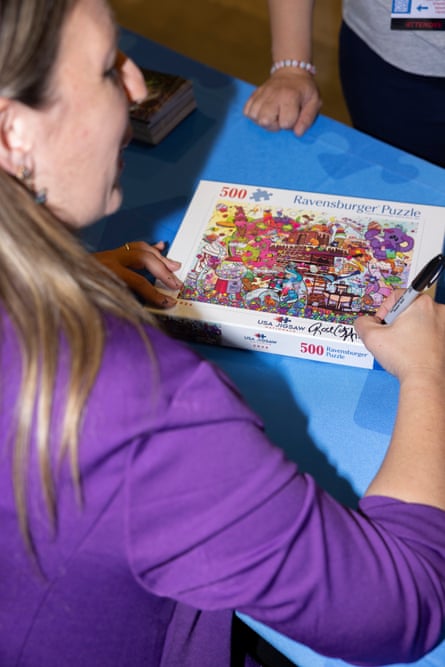
An hour and 20 minutes later, my puzzle is finally done.
I feel exhausted. My whole body aches, from my lower back to my shoulders. The room suddenly feels hot. I fan myself with my scorecard and sit for a while, trying to calm down. My fingernails are tinted from the blue jigsaw cardboard.
My final rank is 122 out of 200 – far away from the top 50. Still, I feel mildly accomplished – and when I talk to other puzzlers, I feel even better. That “friendliness” is in full force. They high five and fist bump me; when I explain that this was my first competition, they call my time impressive. I understand why some do dozens of contests a year. There’s an addictive rush of seeing a simple challenge through to the end, knowing that everyone – even your fellow competitors – is cheering you on.
And the winners are …
Day two brings the qualifying rounds for pairs and teams. The competition space now buzzes with a constant hum from participants delegating tasks and discussing strategy. The winning pairs finish their 500-piece puzzles in under 30 minutes. Doyle and partner Kaitlyn McCluskie place first in their round; her team “Girls in STEMP” also takes a prime spot. Conner places first with his partner Josh Trauger, and with his team “Three and a Half Men”.
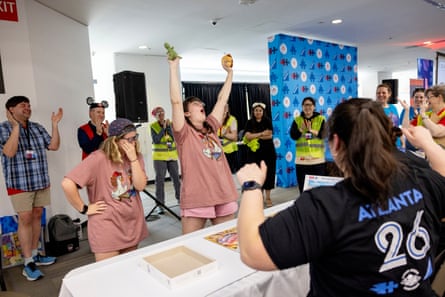
On the last day, when the three finals take place, the spectator space is crowded. As the fastest puzzlers get closer to winning, the room gets quiet. Onlookers lean in. Judges gather around.
When the first puzzle is completed, the room erupts with applause and cheers. It’s Conner and Trauger, who have won the pairs final with a time of 25min 11sec. Conner hugs his crying mother and grandmother. Trauger’s daughter yells, “Daddy, you won!”
“They’re gonna make me cry,” mutters another spectator to her friend.
I ask Conner what makes their duo so strong. “Since he’s a father of three, I think he knows how to work with kids, so I think that was the perfect pair.”
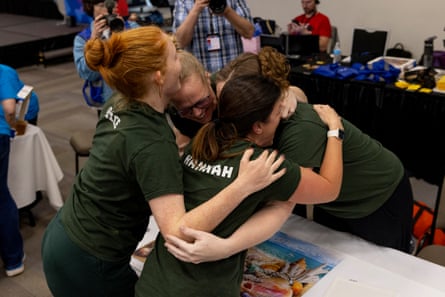
Later, when Rowe wins the individual final in under 38 minutes, she rushes backstage, her face red, and hugs her dad while she cries. “I was shocked, I could not control it,” Rowe tells me. Her team, the Jiggernauts, also wins the team final. “It was a special moment.”
The top puzzlers hustle off for a post-game interview. Black hands Eakins a pinch of puzzle dust for her collection: a testament to every puzzle she completes. The space slowly empties as participants finish; a judge paces the aisles, fanning blue residue off the linens.
At the closing ceremony, winners receive glass puzzle-piece trophies before rushing to make flights. Rowe has a freshman writing class in the morning and can’t miss it: “I don’t know if this would be an acceptable excuse,” she says.
The winners are getting younger and faster. Walter recalls being one of the youngest competitors at the 2022 Nationals as a college student, when Feucht won as an individual with a time just under 55 minutes. Now, many top puzzlers are in their 20s and routinely complete within 40 minutes.
“I hope they do a youth division,” says Jessa Douglas, a member of the Jiggernauts.
“The more kids that get into it, the faster the competition will be,” Conner says.
It’s obvious that speed puzzling has even more potential to grow. “If we could make [speed puzzling] an Olympic sport, that would be awesome,” says Kaeppler, the Ravensburger North America president.
At one point over the weekend, I saw four girls start a 100-piece puzzle when the round commenced.
“What time are we at?” one asked her dad, racing to place the pieces.
It took them 9min 22sec. One girl suggested they move on to puzzle chess, but some didn’t know the game. So she explained that you start with building the border. Then, they began to play.
-
Leila Jordan is a writer based in Los Angeles.