4 hours ago
9
4 hours ago
9
Perhaps the manager wasn’t the problem after all. Tunisia sacked Sabri Lamouchi after last week’s 5-1 defeat to Sweden, appointing Hervé Renard as their seventh manager since qualifying began. But it turned out a diffident side lacking defensive conviction are a diffident side lacking defensive conviction whoever has to do the press conferences. Tunisia were well beaten by a Japan side inspired by the Feyenoord centre-forward Ayase Ueda, who scored twice and led the line with intelligence and imagination.
Renard had only three days with his players. He may have performed heroics to win the Africa Cup of Nations with Zambia in 2012 and three years later become the first manager to win two Cups of Nations with different teams as he ended Côte d’Ivoire’s 23-year trophy drought. But he is not, as he has stressed, “a magician”.
Attempts to break into the mainstream of French football with Sochaux, Lille and the France women’s team have faltered and the 57-year-old seems to have accepted that his role now is with aspirant nations in Africa and the Middle East rather than at the apex of the European game. Renard still wears his trademark white shirt but whatever luck it may once have brought seems to have worn off. Not that this mess could, in any realistic sense, be blamed on Renard. He’s just the well-remunerated sap paid to try to explain how Tunisia are out of the World Cup already.
In the end, Renard simply seemed resigned. “We were hoping for a better reaction, a better performance,” he said. “Unfortunately the score was heavy, but this reflects the difference between the teams. Today we were lacking good defensive organisation. In the first 20 minutes of the second half we were more rigorous but this was not enough.”
This was a landmark game for the World Cup, the 1,000th in its history. What began in chilly Montevideo with simultaneous matches between France and Mexico and the US and Belgium has arrived, 96 years later, in steamy Monterrey with the largest victory for an Asian side in the tournament’s history.
The day before the game, a violent and protracted thunderstorm had led to flooding in the stadium compound and had transformed the main access road into a raging torrent. The only evidence of that on matchday, though, was a film of mud over the tarmac and concrete.
Tunisia’s problems were less easily disguised. Renard retained the same basic shape as Lamouchi and made only three changes, most notably in goal, where Aymen Dahmen replaced Mouhib Chamakh, who had been at least in part responsible for Sweden’s first two goals last week. But a similar lineup had a similar outcome; Tunisia were never in the game.
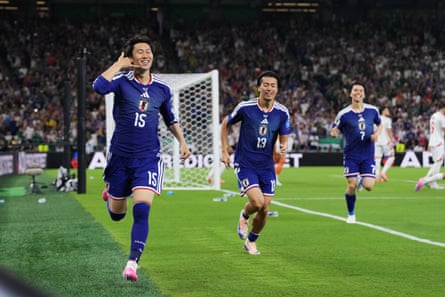
“The players didn’t get too caught up in the opponent and were able to fully show what we wanted to do,” said a delighted Hajime Moriyasu, Japan’s manager. Japan should have had a penalty within 70 seconds as Ueda was clipped by Ellyes Skhiri as he tried to turn – a mystifying non-award by the Romanian referee, Istvan Kovacs, and an even more mystifying non-intervention by VAR for an obvious foul – but they were ahead within four minutes anyway, a neat move dragging Tunisia across the pitch and leaving space for Keito Nakamura on the Japan left. The wing-back crossed low into a crowded box, the ball cannoning in off the heel of an unsighted Daichi Kamada. Renard advanced towards the edge of his technical area, a look of bewildered horror on his face.
Moriyasu actually made one more change than Renard after his side’s impressive 2-2 draw with the Netherlands. Takefusa Kubo was injured, but the other three tweaks were tactical – and they worked. Having played largely without the ball in that game, Japan poured forward in waves and, but for a last-gasp clearing challenge from Dylan Bronn and then a sprawling save from Dahmen that clawed Takehiro Tomiyasu’s deflected shot away a millimetre from fully crossing the line, Japan would have increased their advantage within the first 10 minutes.
The second, though, was always going to arrive sooner or later and it came after 31 minutes as Ueda, receiving the ball in an inexplicable amount of space, turned, ignored the run of Junya Ito and whipped a shot through the legs of Montasser Talbi and into the bottom corner. Renard’s expression this time was rueful.
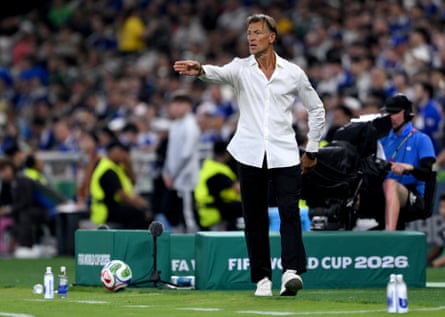
Renard can at least take credit for having tightened things up after the break but by then it was too late. Japan were watched from the VIP box by Hisako, the widow of Norihito, grandson of Emperor Taishō, who travelled with her husband to South Korea shortly before the 2002 World Cup for the first visit by the imperial family since the second world war. What she saw was a very good side who spent the second half conserving energy and playing within themselves against a far inferior team.
Ito added a third from Ueda’s flick after 69 minutes, played onside by Mohamed Amine Ben Hmida who was dallying a good three or four yards behind the rest of the defensive line. Renard, incredulous, watched the replay on an iPad and spent much of the subsequent drinks break standing purse-lipped staring into the middle distance. Ueda’s clever looping header made it four and by then, Renard looked broken.
He’s surely too long in the game ever to have imagined the Tunisia job might be a long-term appointment but, given recent precedent, Renard will be lucky to make it to Thursday’s final group game against the Netherlands.