3 months ago
132
3 months ago
132
Key events
SpaceX overtakes Amazon as world’s fifth most valuable company
Elon Musk’s SpaceX has overtaken Amazon as the world’s fifth-most valuable company days after its stock market debut.
The milestone came as it agreed to buy the startup behind the AI-powered coding app Cursor for $60bn (£44bn), in an attempt to capitalise on the technology’s success as a coding tool.
SpaceX is the parent of Musk’s AI business, xAI, which will be able to boost its capabilities in an area – AI systems writing code – that has proven to be a strong commercial success for Anthropic, the rival company behind the Claude chatbot.
The group also includes the SpaceX rocket company, social media platform X and the satellite maker and internet service provider Starlink, which is the only profitable part of the business.
The news of the Cursor acquisition was announced as SpaceX passed Amazon in market capitalisation, an important measure of value for a publicly listed company. SpaceX shares rose by 13% on opening on the Nasdaq index on Tuesday.
At one point, its valuation rose as high as $2.97tn, leaping over Amazon’s $2.65tn to become the world’s fifth most valuable company by market value. Its shares later eased back to about 5% up at the close and a valuation just ahead of the e-commerce company of $2.66tn.
Fashion tycoon Bernard Arnault accused of stranglehold over French business press
He is known as the “wolf in cashmere” – the owner of the world’s biggest luxury group whose brands including Louis Vuitton, Dior and Tiffany have made him one of the world’s richest people.
But Bernard Arnault, a close friend of Donald Trump, is under fire from journalists’ unions in France for buying up almost all the country’s business and economic press.
Reporters Without Borders said Arnault had a “stranglehold” on the main business titles in France after his LVMH group bought the centrist business weekly Challenges.
LVMH, whose brands include fashion, perfumes, champagne and spirits, has an array of business publications including the leading economic daily paper, Les Echos, and the business information service L’Agefi.
John Lewis injects £20m into Glasgow city centre store in wider branch reboot
John Lewis is to spend £20m on a revamp of its Glasgow store in the city centre’s Buchanan Galleries in a vote of confidence in the shopping mall not long ago scheduled for demolition.
It is the largest cash injection within a wider plan to spend £50m this financial year on refreshing its shops, with department stores in Reading, Cambridge, Leicester and Liverpool all earmarked for an upgrade.
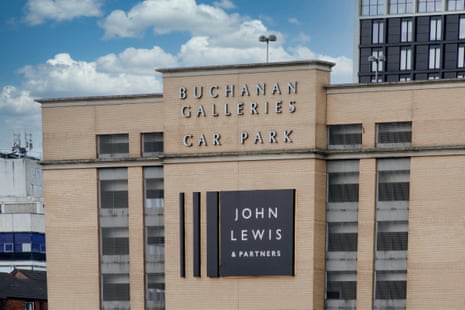
The Glasgow project includes expanding the beauty hall with a fragrance hall and gift emporium. The company said every corner of the 28,000 sq metre store would be upgraded, including a new John Lewis Platter in-house cafe-restaurant and more women’s and men’s fashion labels.
The lower ground floor will be the first to be completed, with a technology and sports floor due to be in place by late September. The store will remain open throughout, with the refurbishment expected to finish early next year.
‘Tax break tart’: hospitality tipped to exploit summer VAT cut on children’s meals
Restaurants and pubs are expected to devise “enterprising” schemes to exploit a tax break on meals for under-18s, after one venue launched a menu for “kids” featuring wild burgundy snail salad and anchovy butter toast.
Rachel Reeves last month announced a temporary cut in VAT on children’s meals from 20% to 5% between 25 June and 1 September, part of a “Great British summer savings scheme” to support struggling venues and ease pressure on families.
The chancellor highlighted the scheme during an appearance by video at last week’s UK Hospitality trade conference that met with a muted reception.
Afterwards, leading figures in the sector added their voices to a chorus of ridicule for the “laughable” scheme, contrasting it with the £5bn in extra costs loaded on to pubs, bars, hotels and restaurants since Labour returned to power in 2024.
Lululemon apologises after Japanese drum row at Great Wall yoga event
The activewear brand Lululemon has apologised after a promotional event held on the Great Wall of China appeared to mistakenly feature a Japanese drum, prompting an uproar.
The Canadian-headquartered company, known for its upmarket yoga leggings, has been growing rapidly in China and arranged for a yoga festival to take place in late May on a section of the wall near Beijing.
More than 2,000 people were invited to take part in the event, which was advertised as promoting Chinese culture and wellness, according to the Chinese state-run tabloid Global Times, with the well-known Chinese actor Zhu Yilong was booked to perform.
Zhu joined a drum group on the Great Wall for what was described as a traditional Chinese drum performance and posted a picture of himself in front of one of the instruments, which had the Lululemon logo on it, on his account on Weibo, one of China’s largest social media platforms.
Weibo users accused the group of using a Japanese taiko instrument rather than a Chinese dagu drum. Many described this as inappropriate and insulting, according to the Global Times. Drum discussions had gathered more than 50m views on Weibo by Monday, and Zhu’s studio called on Lululemon to respond to the controversy.
Electrical retailer AO shifts UK call centre roles to South Africa
The online electrical goods seller AO World has revealed it is outsourcing up to 200 UK call centre roles to South Africa blaming rising labour costs, as it handed £20m to shareholders.
As the retailer reported a jump in profits, it said it was shifting the majority of call centre jobs overseas “in response to ongoing inflationary cost pressures, and particularly rising employment costs”. It expects to save about £4m a year as a result of the change.
AO said on Wednesday that pre-tax profits had jumped 145% to £50.5m in the year to 31 March, and it was handing £20m in special payments to shareholders.
About 150 roles in phone sales and enquiries have already been switched from AO’s call centre in Bolton to South Africa over the last 12 to 18 months. A further 50 are expected to go, with roles switching as people in the UK choose to leave rather than through redundancies.
Morrisons sales subdued against 'challenging backdrop' but has hopes for World Cup

Sarah Butler
Morrisons increased sales by 1.7% to £4bn in the three months to 26 April, well behind inflation, as the supermarket said it faced a “challenging backdrop.”
The Bradford-based chain, which recently lost its place as the UK’s fifth largest supermarket to the German-owned discounter Lidl, said it had strong plans in place for the football World Cup period which kicked off at the weekend, when many households are expected to watch England and Scotland games at home with a beer and snacks, but “trading conditions remain highly competitive”.
Referring to recent hopes of a peace deal in the Middle East which has pushed down oil prices, Rami Baitiéh, the chief executive of Morrisons, said:
While more recent international news creates some grounds for optimism, we continue to monitor the impact of input inflation very closely and we remain committed to doing whatever we can to help keep prices down for customers.
Underlying profits rose 5.7% at the chain to £323m during the quarter as sales at established stores increased by 2.2%, behind the pace of grocery inflation which stood at more than 3% during the period according to data from Worldpanel by Numerator.
Jaguar Land Rover is targeting double-digit revenue growth in the medium term, and will prioritise selling the Defender brand in the US.
The British luxury carmaker said it will focus on the Defender to drive growth in the US, a key growth market, under its partnership with Netherlands-based carmaker Stellantis. In May, the two companies announced plans to jointly develop vehicles in the US.
JLR’s financial performance has come under pressure from Trump era tariffs, particularly given its lack of local manufacturing in the US for Defender and Range Rover SUVs.
JLR is cutting costs and launching more premium cars to try and protect its margins from the impact of the US-Iran war.
The carmaker reiterated that it aims to cut $2.3bn in costs over two years while maintaining an £18bn investment plan from fiscal 2024, as it grapples with trade uncertainty, the aftermath of last year’s cyber-attack, and a supplier fire.

JLR’s boss PB Balaji, who took the helm in November, told the Financial Times there is “no way” the British carmaker will phase out its petrol vehicles as it expands its hybrid offerings to capture the “biggest growth opportunity” in the US.
He said the company would “give everything” to turbocharge its sales to “millionaires and billionaires” in the US as it seeks double-digit annual revenue growth within five years.
We are pivoting this business to face North America because we believe that’s the biggest growth opportunity that is out there for premium brands . . . like us.
UK house price inflation picks up while rents rise at slower pace
UK house price inflation has picked up while rents are rising at a slower pace, according to official figures.
Average monthy private rents rose at an annual rate of 3.3% to £1,383 in My, down from 3.5% in April, according to the Office for National Statistics.
Average rents increased to £1,442 (annual rate of 3.4%) in England, £836 (4.7%) in Wales, and £1,009 (1.0%) in Scotland in May. In Northern Ireland, average rents increased to £876, and an annual rate of 3.3%, in March.
In England, private rent annual inflation was highest in the North East (5.9%), and lowest in London (2.0%).
The average price of a UK home increased by 3.8% year on year to £270,000 in April; this annual growth rate is up from 0.0% in March.
This is because of a base effect; because house prices rose moderately between March and April, while falling sharply in the same period a year ago, the expiry of a stamp duty tax break in England and Northern Ireland on 1 April 2025.
Average house prices increased to £291,000 (3.9%) in England, £212,000 (3.5%) in Wales, and £192,000 (2.8%) in Scotland, in April.
Economists predict UK inflation peak below 4%
Economists reckon UK inflation will peak below 4% in the coming months.
James Smith, developed markets economist at ING, expects a return to interest rate cuts next year.
“What’s striking about these latest figures is just how benign food inflation is right now,” he said.
It’s a key reason why headline CPI unexpectedly stayed at 2.8%, despite upward pressure from air fares and a quirk related to road tax. Food prices fell in May relative to April, a trend we’ve also seen in the eurozone and Eastern Europe. If anything, the latest producer price data suggests food inflation will continue to fall sharply over the next couple of months. That will gradually change, but it’s a reminder that the energy price spike is unlikely to reach its peak impact on food inflation until the first quarter of next year.
In general, it’s too early to see much impact from the Middle East crisis beyond fuel prices. Services inflation is bouncing around, partly due to the timing of Easter this year, but the Bank of England’s preferred gauge of “core services” – which excludes volatile and indexed categories – has been more stable just below 4%. The BoE’s own “Decision Maker Panel” of CFOs points to services inflation staying around current levels through the summer.
We’re still sceptical that the Middle East crisis will generate the widespread “second round” effects that policymakers fear. Evidence from twelve months ago, when a National Insurance (payroll tax) and minimum wage hike failed to do much to the inflation picture, suggests corporate pricing power is considerably weaker than it was during the last energy shock four years ago.
The same is true of worker bargaining power. Wage growth has been exceptionally weak over the past few months.
All of that suggests inflation is likely to stay below 4% - a key line in the sand for the BoE. It put a lot of emphasis last summer on analysis showing second round effects were more likely when inflation exceeded that level. A 13% rise in household energy bills this July is likely to take inflation towards 3.5% by September, but on current prices, we’re likely to see a 7% fall in those bills come October. That’s because natural gas futures for delivery in 6-12 months are at pre-war levels – and they are a key determinant of the energy regulator’s price cap.
Barring the Iran deal falling apart and oil prices spiking back above $100 a barrel – and natural gas costs soaring too – we think the Bank of England is set for a prolonged pause. We expect a 7-2 vote in favour of ‘no change’ tomorrow. We expect a return to rate cuts in 2027.
Japan's Nikkei hits new closing high
Japan’s Nikkei, which soared through the 70,000-point mark for the first time ever on Tuesday and also traded at that level today, has ended the day at a new closing high of 69,902.25, up 0.7% (versus 69,404.5 points on Tuesday, also a record).
The Straits Times index in Singapore jumped 1.3% while China’s CSI 300 was up 0.8% and Hong Kong’s Hang Seng lost 0.8%.
In London, the FTSE 100 index is up about 7 points at 10,502, while other European markets were also little changed.
In bond markets, the yield (or interest rate) on the 10-year UK government bond, known as gilt, dropped almost four basis points to 4.75%, the lowest in a month.
Financial markets are pricing in just a 2.6% chance of an interest rate hike from the Bank of England tomorrow, with economists and traders widely expecting policymakers to sit on their hands while they digest the latest inflation figures and assess the impact of the Iran war, and the peace agreement.
Markets are also widely expecting no change in interest rates in July, while the chances of a September rate increase are almost 50-50. A November hike could still be on the cards, though, with the probability estimated at 61.6%.
Rob Wood, chief economist at Pantheon Macroeconomics, said:
The inflation figures will support the monetary policy committee’s highly likely decision to keep Bank Rate on hold this week and make a July hike less likely. Granted there will be another consumer prices index as well as other economic releases before the July decision, but the drop in oil prices after the US-Iran agreed an extended ceasefire had in any case led us to remove our forecast for a rate hike. We now expect Bank Rate on hold through end-2027.
Looking ahead, we still expect inflation to accelerate in the coming months as supply chain pressures feed through to goods, while energy utilities’ contribution to inflation will rise. Meanwhile, underlying services inflation—stripping out volatile and government-set prices— was still above inflation target consistent rates in May and slowing only very gradually.
Granted, we expect motor fuel prices to boost inflation by around 20 basis points less now than we did last week and survey measures that had suggested a sharp rise in underlying services inflation will probably also ease somewhat in part as firms have more scope to absorb higher costs in margins if they trust that the ceasefire will last. Even so, a chunk of inflation is locked in the system now. We look for inflation to peak at 3.4% in November, down from 3.6% before the deal.
Suren Thiru, chief economist at the Institute of Chartered Accountants in England and Wales, said:
While inflation was unexpectedly unchanged in May, aided by lower food costs, these figures have been surpassed somewhat by fresh hopes of easing inflation following the US-Iran peace deal.
Rising services inflation may well sharpen Bank of England fears that the Iran conflict has embedded price pressures more widely across the economy, though a deteriorating labour market will help curb any second-round effects.
Although the US-Iran peace deal has arrived too late to stop higher energy bills and food costs triggering a summer inflation spike, if oil prices continue sinking then a peak well below 4% is becoming increasingly plausible.
Even with hostilities seemingly over, the UK faces a painful hangover from the Iran conflict, with energy and other supply chains likely to take months to normalise, delaying any meaningful easing in inflation until late 2026.
May’s softer than expected data means an interest rate hold on Thursday is now nailed on, especially as the US–Iran peace agreement has raised hopes that, if the deal holds, inflation could ease without the need for further policy tightening.
Despite the easing to food inflation to 2.2% last month, the lowest since December 2024, Karen Betts, chief executive of the Food and Drink Federation, warned that food inflation could still head higher in the coming months.
It’s good to see an easing of food inflation in May, but consumer prices still don’t reflect the inflation caused by the closure of the Strait of Hormuz. It generally takes several months for the increased costs paid by farmers, processors and manufacturers to filter into raised prices at the tills, not least because of the widespread use of long-term contracts for energy and ingredients. But manufacturer input costs are rising, including for transport, packaging and energy, and we expect food inflation to pick up this year and into next.
Uncertainty is the new norm for food producers, which is driving up the overall cost of food production. This makes it all the more important that government acts where it can – to prioritise food manufacturers for energy support and by prioritising and rationalising regulation, freeing businesses to invest in vital long-term resilience.
Prices rose the fastest for beef and veal (9.4%), offal (9.2%), preserved fruit (9.0%) and confectionary products (8.8%).
Prices fell for 15 categories, with the largest drops for flours (-6.1%), olive oil (-4.2%) and jams and marmalades (-3.0%).
Transport costs rose at an annual rate of 6.8%, up from 4.5% in April and the highest since December 2022.
The main effects came from air fares, motor fuels, and sea fares, together with the correction of an error in the Vehicle Excise Duty (VED) series in 2025.
Air fares rose 10.3% between April and May, compared with a fall of 5% a year earlier, due to the different timing of Easter and school holidays. European flights in particular went up in price.
Sea fares increased 3.4% In May, compared with a fall of 10.2% a year earlier, which may also have been affected by the timing of Easter, the ONS said.
The average price of petrol rose 0.6p a litre between April and May, compared with a drop of 2.1p a litre a year earlier, to an average price of 157.4p a litre - the highest since November 2022.
Meat (particularly beef and cooked ham), dairy (particularly cheese), vegetables and fish became cheaper, while oils and fats went up in price.
Grant Fitner, chief economist at the ONS, said:
Inflation held steady in May as various price movements offset each other. The main upward movement came from transport, with air fares, vehicle taxes and petrol prices all pushing up inflation.
These were offset by lower food prices, with decreases in inflation seen across a range of meat, dairy and vegetable items compared to last month, as well as the cost of domestic heating oil, which fell back after climbing in recent months.
The annual cost of raw materials continued to increase, led by rises in the cost of chemicals, while the increase in the cost of goods leaving factories slowed, partly due to a drop in the cost of domestically produced cars.
The chancellor, Rachel Reeves, said:
While the war in the Middle East pushes prices up globally, we have got the right economic plan and inflation has held steady.
We’re protecting families and businesses from rising costs, with cuts in energy bills and freezes in fuel duty and rail fares. This is the right economic plan to build a stronger more secure Britain.
Introduction: UK inflation unexpectedly stays at 2.8% with higher transport costs offset by slower food price rises
Good morning, and welcome to our rolling coverage of business, the financial markets and the world economy.
It’s inflation day in the UK! The annual inflation rate unexpectedy stayed at 2.8% last month, as the impact of the Iran war was not as bad as feared.
The figures were released by the Office for National Statistics. Economists had expected a rise to 3%. Last month, the annual growth rate slowed to 2.8%, as lower energy bills announced by the chancellor at the lasts budget too effect.
Higher transport prices, from air fares, fuel and sea fares, were offset by a slowdown in the pace of price increases for food.
Food prices rose by 2.2% in the 12 months to May down from 3% in April, and marking the lowest rate since December 2024.
Core inflation, which strips out volatile items like energy, food, alcohol and tobacco, inched up to an annual rate of 2.6% in May, from 2.5% in April.
Services inflation, which is also closely watched by the Bank of England, jumped to 3.7% in May, from 3.2% in April.
Inflation remains above the government’s 2% target set for the Bank of England, but it is expected to keep interest rates on hold at its meeting on Thursday, to assess the impact of the Iran war.
Economists hope the agreement reached between Donald Trump and the Iranian regime at the start of the week will lead to the reopening of the strait of Hormuz, which has driven oil prices sharply higher since late February, with knock-on effects for a wide range of materials and goods.
Oil prices continue to fall, and are currently down 0.7% to $78.4 a barrel for Brent crude. West Texas Intermediate dropped 0.8% to $75.41 a barrel. Both benchmarks fell about 5% for a second day on Tuesday to three-month lows, amid optimism around the peace agreement.
Asian markets were mostly higher, and Japan’s Nikkei hit another record high, despite its central bank raising interest rates on Tuesday. The benchmark stock index rose 0.76% to 69,943, after trading above 70,000.
The US Federal Reserve is also expected to leave interest rates on hold at its meeting tonight.
The Agenda
-
9.30am BST: UK House prices and rents
-
10am BST: Eurozone inflation final for May
-
1.30pm BST: US retail sales for May
-
7pm BST: US Federal Reserve interest rate decision (no change expected)