7 hours ago
16
7 hours ago
16
The fourth season of the critically acclaimed football drama Ted Lasso has taken a surprising twist. The show’s writers have decided to have their hero coach AFC Richmond’s women’s team, testing whether Ted’s “Lasso way” can work in a very different footballing environment. We’re only three episodes in, but I’ve already found myself wondering if the series will showcase what makes the women’s game distinct, or just treat it as the same sport with different characters.
The early signs are promising: we’ve already seen the issue of substandard facilities, initial disinterest from the club’s fanbase and the flak that Coach Chilton gets for exhibiting the same qualities lauded in the men’s coach, Roy Kent.
Watching the show, I found myself thinking about real-life football and asking whether, in growing the women’s game, we can avoid reproducing systems and structures present in its male counterpart.
The classicist Mary Beard says in her book, Women & Power, “You cannot easily fit women into a structure that is already coded as male; you have to change the structure.” She was writing about women in public life, but her words could be easily applied to football, which remains stubbornly male-dominated.
The typical men’s football club is loss-making and more than half of fans feel that high ticket costs have made the game less enjoyable. Why copy that?
I discovered this reality when I (then an avowed football-disliker) visited Lewes FC in 2017, as this small club in East Sussex became the first in the world to equalise resources and facilities between its men’s and women’s teams. Its Equality FC campaign generated headlines around the world, and predictable criticism. Detractors said that the women’s squad didn’t attract the same crowds as the men’s, so why should they get the same resources?
I went to watch Lewes FC Women for the first time, because, as a feminist and local, I was drawn by its pioneering closure of football’s gender resource gap. In a safe, joyful, inclusive environment, I experienced an “a-ha moment”. Yes, this is sport, I thought, but it is also a social and political act of defiance and change.
Watching these women take up space, compete and play with such physical freedom made me feel like more than just a spectator at a game: I was watching women breaking free from patriarchy.
This was something I wanted to champion and I went on to manage Lewes’s Equality FC campaign. I knew that the solidarity I felt, and the festival-like culture I experienced could resonate with other women whom football had not yet made welcome.
The women’s game has a markedly different history to the men’s. In 1920, there were around 150 women’s teams and they frequently drew bigger crowds than men’s clubs, until the FA banned them from playing for 50 years. The women’s game has developed a rich culture of community, accessibility and inclusion – precisely because it had to survive outside the traditional structures of football.
This culture is now colliding with the fast-track “professionalisation” of women’s football, accelerated by big Premier League clubs subsidising their women’s teams. The women’s game is being rushed into copying and pasting the same structures as the men’s. Worse still, the financial chasm opening up at the top of the game – between the big four teams of WSL1 and all other women’s teams – is causing some owners to reasonably conclude that the cost of becoming competitive in women’s football is escalating faster than the revenues they can generate. In turn this leads to a fragile football pyramid.
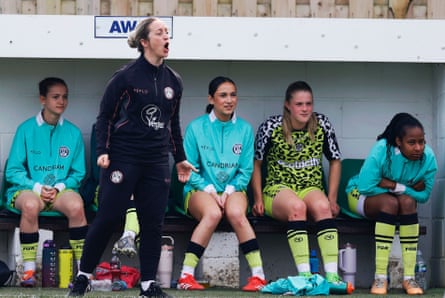
Back in June, Durham, the only independent second-tier women’s club, were just days from being wound up (though they happily secured last-minute investment). This summer, nearly all of Plymouth Argyle’s women’s squad found out via email that they were going to be let go after the club decided that the venture was “unsustainable”. Forest Green Rovers have scrapped their women’s team for all of this season and Southampton have also cut their women’s team’s budget.
A female-centric future for the game hinges on players and fans no longer being treated as “small men”. That means reimagining facilities, medical support, childcare, sports science, kit, training and match-day experiences around female bodies and lives, rather than retrofitting a male model. This is happening, but sporadically. Despite money at the very top, the experience of most women’s teams is characterised by chronic underfunding.
after newsletter promotion
This isn’t about handouts, but a wider distribution of revenues from TV money and league sponsorships would enable development of the women’s game across a much wider base. Increased FA Cup prize money, shared more evenly to smaller clubs, would be – literally – a gamechanger.
Women’s football offers distinct audiences and values that should be highly attractive to sponsors. Think match-day experiences combining sport with music, food, art and community that would attract people who don’t see football as “for them”.
That is the approach I hope Ted Lasso will ultimately showcase. By switching to women’s football, the series can help raise the game’s profile more than any individual club ever could.
Women’s football, sidelined and kept humble for so long, may finally get some of the respect it deserves, on, and consequently off, screen. This game can change communities, it can change people’s lives, it can change the world.
But ultimately women’s football needs its own identity and ecosystem. And that requires radical thinking.
-
Karen Dobres is the author of Pitch Invasion: My Story as a Woman on a Football Club Board