2 months ago
94
2 months ago
94
What to expect as Artemis II comes home
The splashdown of the Orion capsule will follow a precise timeline through the afternoon and evening on Friday.
Nasa says the scheduled splashdown time of 5.07pm PT (8.07pm ET; 1.07am Saturday BST) is approximate, and will harden as the capsule passes certain milestones during its descent.
Here’s what the day looks like right now (all times Pacific):
-
8.35am Crew wakes up
-
10.50am Crew completes cabin configuration preparation
-
11.53am Final return trajectory correction burn
-
4.33pm Orion separates from service module
-
4.37pm Crew module raise burn to place spacecraft at correct angle for reentry
-
4.53pm Entry interface to Earth’s atmosphere at 400,000ft
-
5.07pm Splashdown
Orion will be exposed to heat up to 5,000F (2,760C) during its 25,000mph reentry. A set of 11 parachutes will deploy in sequence at set altitudes following reentry that will slow the spacecraft to 17mph at splashdown.
It could take up to two hours after splashdown for crews from Nasa and the US navy to reach the capsule, open the hatch and release the astronauts. Nasa plans to take them by helicopter to a military base in San Diego for medical checks, then they will fly back to Houston’s Johnson Space Center.
Nasa plans a post-landing press conference about two and a half hours after splashdown.
The Guardian will have a livestream at the top of this blog from about 6.30pm ET.
Key events Show key events only Please turn on JavaScript to use this feature
Three hours until splashdown!
The scheduled splashdown of Artemis II in the Pacific Ocean, at 8.07pm ET, is now just under three hours away.
The Orion spacecraft has completed its third and final return trajectory correction burn (RTC), a nine-second, precise firing of its thrusters to maintain a correct course for Earth.
The four astronauts are working through a thorough checklist of final activities in preparation for reentering Earth’s atmosphere at 7.53pm, including donning protective spacesuits for landing.
Communications between mission control in Houston, and the spacecraft given the mission name of Integrity for the duration of its flight, are currently sporadic, but expect things to get busier as each milestone towards splashdown passes.
Orion is now less than 24,000 miles from Earth, and traveling at almost 9,000mph.
The first faces the Artemis II astronauts will see when the hatch of the Orion spacecraft opens belong to a US navy dive team more familiar with handling underwater explosives than lunar explorers.
The four are members of Explosive Ordnance Disposal Group 1, and their specialist medical training for at-sea conditions makes them the ideal greeters to make initial health assessments of Artemis crew, and assist them “safely and efficiently” out of the capsule as it bobs in the Pacific.
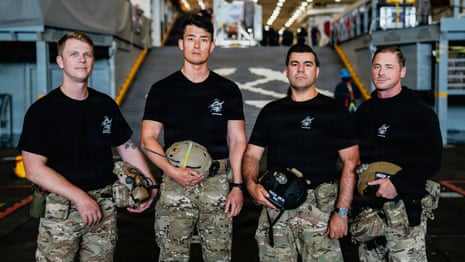
According to navy’s website, “the medical team will enter the capsule to conduct initial exams for the crew, provide triage care as necessary, and assist the astronauts in egress onto the inflatable raft set up outside by navy divers”.
They will prepare the crew astronauts to be airlifted by helicopter to the amphibious transport dock ship USS John P Murtha for a more detailed evaluation, then onward travel to Houston’s Johnson Space Center.
The medical dive team consists of Lt Cdr Jesse Wang, senior chief hospital corpsman Laddy Aldridge, chief hospital corpsman Vlad Link, and hospital corpsman 1st class Steve Kapala.
Thoughts on coming home
Several of the astronauts shared some reflections about the Artemis II mission during their final press conference from space on Thursday.
Pilot Victor Glover was asked if he had thought much about the potentially risky reentry to Earth’s atmosphere at 25,000mph and a temperature up to 5,000F:
I’ll be honest and say I’ve actually been thinking about entry since April 3, 2023, when we got assigned to this mission. At one of the first press conferences we were asked what are we looking forward to and I said splashdown
And it’s kind of humorous, but it’s literal as well that we have to get back. There’s so much data that you’ve seen already, but all the good stuff is coming back with us. There’s so many more pictures, so many more stories, and, gosh, I haven’t even begun to process what we’ve been through
Reid Wiseman, the Artemis II commander, was asked to reflect on perhaps the most emotional episode of the flight on Monday, when the crew proposed dedicating a previously unnamed moon crater to Carroll Taylor Wiseman, his wife who died of cancer in 2020:
When Jeremy spelled Carroll’s name, that’s when I was overwhelmed with emotion. And I looked over and Christina was crying. I put my hand down on Jeremy’s hand as he was still talking, I could just tell he was trembling, and we all pretty much broke down right there
For me personally that was kind of the pinnacle moment of the mission. That was, I think, where the four of us were the most forged, the most bonded, and we came out of that really focused on that day ahead
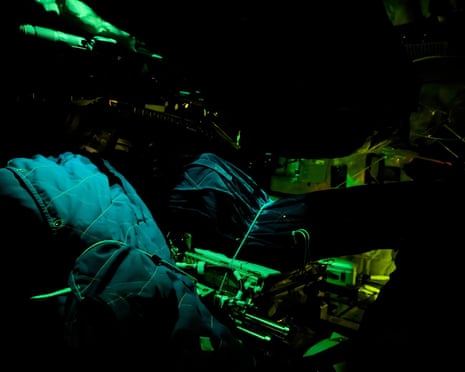
While we wait for Nasa’s live coverage of reentry to start at about 6.30pm ET, here are some more highlights from the mission in pictures:
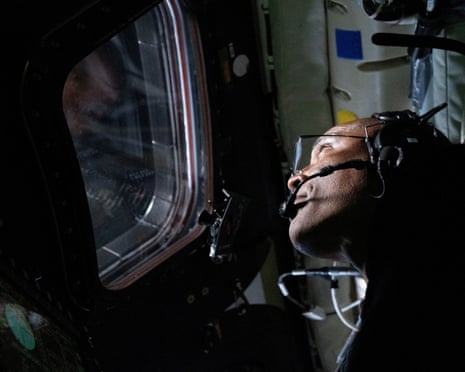
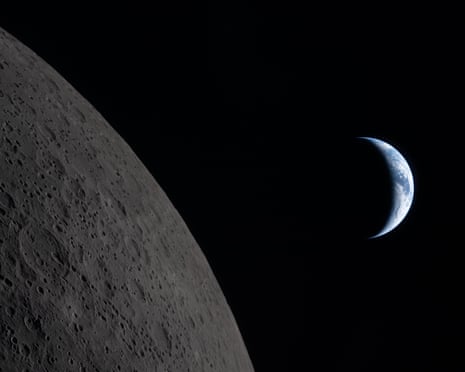

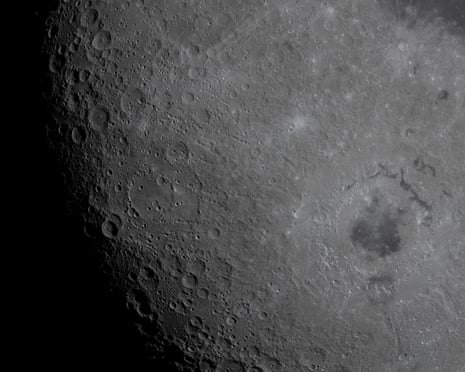
Mission highlights
From its spectacular 1 April launch into a clear blue Florida sky, Artemis II has provided the world with a succession of captivating moments, deep-space records, and stunning, never-before-seen imagery from the far side of the moon.
Here are a few of the 10-day mission’s highlights:
Flight day 1 (launch day)
Hundreds of thousands of people packed the beaches and causeways of Florida’s space coast, and millions more watched on TV or online, as the mighty Space Launch System (SLS) rocket of Artemis II lifted off at 6.35pm ET on humanity’s first journey to the moon in almost 54 years.
“It foundational for what we do here at Nasa to inspire,” Jared Isaacman, the space agency’s new administrator, said at the post-launch press conference.
“It should be a component of every one of our missions. We want to inspire and create interest in the next generation to grow up and contribute to this endeavor.”
Flight day 2
After orbiting Earth while the astronauts and flight controllers in Houston established that the spacecraft, now known by its mission handle of Integrity, was functioning properly, a translunar injection burn committed it to the 250,000-mile journey to moon.
Flight day 5
Artemis II entered the moon’s gravitational sphere of influence at 12.37am ET, the first crewed spacecraft to do so since Apollo 17 in December 1972.
Flight day 6
After setting a record for the farthest humans have ever traveled from Earth – 252,756 miles – and experiencing a 40-minute communications blackout during which they ate maple cookies supplied by Canadian crewmember Jeremy Hansen, Artemis II’s astronauts embarked on a six-hour observation of the lunar surface.
“It is blowing my mind what you can see with the naked eye from the moon right now. It’s just unbelievable,” Hansen said as Orion began the flyby and made its closest approach at a height of 4,067 miles.
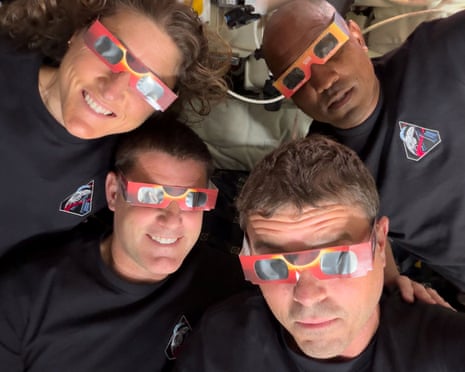
The crew also witnessed an “absolutely stunning” solar eclipse.
Flight day 10 (splashdown)
Other than launch day, the riskiest part of the mission. The crew donned reentry spacesuits and completed final mission closeout tasks, including configuring the capsule’s seats for their 25,000mph descent to the Pacific Ocean.
Perspectives from the moon
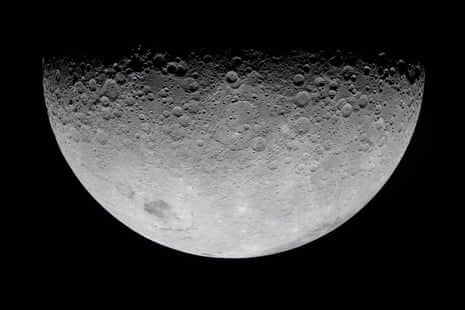
All four of the Artemis II astronauts spoke passionately during the mission about what they were seeing, and how they felt, as they passed over the surface of the moon at 4,067 miles away, their closest approach on Monday.
Reid Wiseman, mission commander:
We saw sights that no human has ever seen before, not even in Apollo, and that was amazing for us. The surprise of the day, we just came out of an eclipse where the sun, moon – the entire dark moon about that big right out the window that we were watching – we could see the corona of the sun, and then we could see the planet train line up, and Mars
And all of us commented how excited we are to watch this nation, and this planet, become a two-planet species
Jeremy Hansen, mission specialist:
We have seen just some extraordinary things. Things I thought we might see looked similar to what I thought they might look like, and other things I just had never even imagined
The perspective I launched with was that we live on a fragile planet in the vacuum and the void of space. We’re very fortunate to live on planet Earth. Our purpose as humans is to find joy in lifting each other up by creating solutions together instead of destroying, and when you see it from out here it doesn’t change it, it just absolutely reaffirms that
Christina Koch, mission specialist:
I just had an overwhelming sense of being moved by looking at the moon. It lasted just a second or two and I actually couldn’t even make it happen again, but something just threw me in suddenly to the lunar landscape and it became real
The moon really is its own unique body in the universe. When we have that perspective and we compare it to our home of Earth, it just reminds us how much we have in common. Everything we need, Earth provides, and that, in and of itself, is somewhat of a miracle, and one that you can’t truly know until you’ve had the perspective of the other
Victor Glover, pilot:
It was very moving to look out the window. It was hard to speak looking through the zoom [lens], I went straight where Christina went and I was walking around down there on the surface, climbing and off-roading on that amazing terrain
Boy, I am loving the terminator [the dividing line between sunlight and darkness]. There’s just so much magic in the terminator, the islands of light, the valleys that look like black holes. You’d fall straight to the center of the moon if you stepped in some of those. It’s just so visually captivating
Artemis II record breakers
The crew of Artemis II traveled farther from Earth than any humans before them, reaching 252,756 miles, more than 4,000 beyond the previous record set by the Apollo 13 crew in April 1970.
“We do so in honoring the extraordinary efforts and feats of our predecessors in human space exploration” mission specialist Jeremy Hansen said from space.

“We most importantly choose this moment to challenge this generation and the next to make sure this record is not long-lived.”
It wasn’t the only record set during their 10-day lunar flyby. Christina Koch became the only woman to have traveled to the moon and back. Hansen, of the Canadian Space Agency, became the first non-American. Victor Glover, the Artemis II pilot, became the first person of color to do so.
Before the four Artemis II astronauts, only 24 humans made the journey and returned safely. All were white American men during nine manned Apollo missions between December 1968 and December 1972.
On the eve of splashdown day, the Artemis II crew spoke about inspiring the next generation and “working on something big for the good of everyone”.
You can catch up on their comments here:
What to expect as Artemis II comes home
The splashdown of the Orion capsule will follow a precise timeline through the afternoon and evening on Friday.
Nasa says the scheduled splashdown time of 5.07pm PT (8.07pm ET; 1.07am Saturday BST) is approximate, and will harden as the capsule passes certain milestones during its descent.
Here’s what the day looks like right now (all times Pacific):
-
8.35am Crew wakes up
-
10.50am Crew completes cabin configuration preparation
-
11.53am Final return trajectory correction burn
-
4.33pm Orion separates from service module
-
4.37pm Crew module raise burn to place spacecraft at correct angle for reentry
-
4.53pm Entry interface to Earth’s atmosphere at 400,000ft
-
5.07pm Splashdown
Orion will be exposed to heat up to 5,000F (2,760C) during its 25,000mph reentry. A set of 11 parachutes will deploy in sequence at set altitudes following reentry that will slow the spacecraft to 17mph at splashdown.
It could take up to two hours after splashdown for crews from Nasa and the US navy to reach the capsule, open the hatch and release the astronauts. Nasa plans to take them by helicopter to a military base in San Diego for medical checks, then they will fly back to Houston’s Johnson Space Center.
Nasa plans a post-landing press conference about two and a half hours after splashdown.
The Guardian will have a livestream at the top of this blog from about 6.30pm ET.
Hello and welcome to our live coverage of the splashdown of the Artemis II crew off the coast of California after their mesmerizing 10-day mission to fly around the moon.
The Orion capsule that carried four astronauts, three Americans and one Canadian, on their 695,000-mile lunar adventure is scheduled to land at 5.07pm PT (8.07pm ET, 1.07am Saturday BST).
I’m Richard Luscombe, and I’ll be bringing you the developments as they happen, from the preparations for Orion’s fiery reentry into Earth’s atmosphere, to its Pacific Ocean splashdown and hatch opening that will give the crew their first breaths of fresh air since before their launch from Florida on 1 April.