2 months ago
98
2 months ago
98
It didn’t matter that he was so frail he could barely walk. Rahmatalla Abdeen knew if they found him he would be shot. For two days, the 65-year-old had clung to the back of a moped as it navigated an area teeming with militia.
The Rapid Support Forces (RSF) had seized this corner of Sudan after crossing the border from Ethiopia. Abdeen was lucky: on 17 May, he became the last known refugee to cross into Ethiopia from Sudan.
There, he hoped to find his wife and three daughters, 883 days after being separated from them when the RSF stormed the city of Wad Madani.
Abdeen entered Ethiopia because it was supposed to be safe. But Sudan’s metastasising conflict is gradually, inexorably, destabilising the entire region.
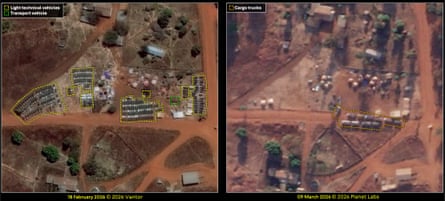
Africa’s second-most populous country has finally been dragged in. A vast clandestine RSF training camp has emerged at an Ethiopian military base on the outskirts of the western town of Asosa.
A short distance from the base – its entrance heavily guarded as the Guardian drove past in late June – along the B40 highway and down a rutted dirt track lies the refugee camp of Ura.
Rows of neat tents house 14,500 Sudanese people who, like Abdeen, have fled the RSF. Their testimony offers an unsettling scenario: the relentless reprisals that characterise Sudan’s war may erupt within Ethiopia.
Some fear being hunted down by the RSF inside Ethiopia, a continuation of the genocidal slaughter seen in Sudan’s western region of Darfur.
Khadijah Ahmed escaped the RSF’s vicious control of Khartoum two and a half years ago. She recounts the militia’s chilling threat as she fled. “‘We will follow you, wherever you go,’ they said. They chased us out of the country.”
Her two sons are so terrified they are sleeping under their beds, just as they did in Khartoum under RSF rule. Nodding towards the nearby RSF base, the 42-year-old adds: “They are so close to us here. We are in a very dangerous situation.”
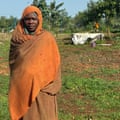
Dawud Suliman, 31, fled the Darfur town of Zalingei after an RSF offensive in 2024. Half his family – 25 people – were killed. Now he fears his remaining relatives will be hunted down inside Ethiopia. “I am very worried,” he says.
Residents warn the RSF has already entered the camp, prompting concerns they are compiling kill lists for troops stationed at the Asosa training base 10 miles away – a 20-minute drive. “We are scared they will report back,” says Hamza Al Bashir, 52.
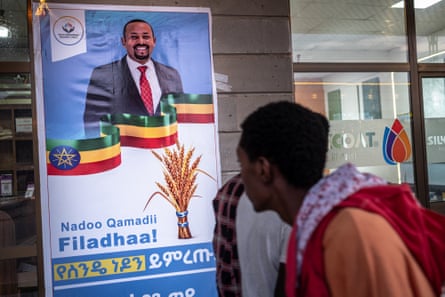
On 21 June, prime minister Abiy Ahmed cruised to another general election victory, confirming what the country already knew would happen. Along the Ethiopian capital’s sweeping boulevards, there appeared to be scant celebration.
Ethiopia teeters on the brink of potential calamity, warn experts. Signs suggest Ahmed’s new term may be defined by fresh bloodshed: a resurgence of the civil war with Tigray; perhaps an attempt to seize one of Eritrea’s Red Sea ports.
Ethiopia’s involvement in the Sudan conflict next door could also have dire repercussions. A cataclysmic scenario could involve the RSF’s opponents, the Sudanese military, teaming up with Tigray separatists, the Eritrean army and Egypt – Ethiopia’s historical nemesis.
Diplomats in Addis Ababa believe the likelihood of a regional, ruinous war is actually helping to suppress any fresh slaughter.
“They appreciate the likely outcome is mutually assured destruction,” says an official.
Some are less sanguine. “Abiy’s appetite for carnage? Enough to worry.”
Yet even as Ethiopia teeters, UN officials are hyping Ahmed’s approach to an inevitable byproduct of any future fighting: refugees.
Three days before the confirmation of his election triumph, the country’s government launched a pioneering project at a glitzy bash at the capital’s Adwa Victory Memorial Museum. The venture aims to transform Ethiopia’s more than 1.1 million refugees – one of the largest populations in Africa – into social and economic assets.
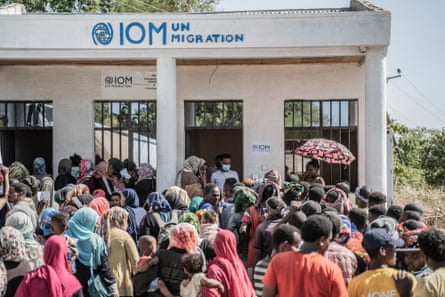
Refugees will be given improved access to education, healthcare and work, allowing them to become integrated, taxpaying residents rather than having to rely on aid.
Dubbed Makatet – meaning “inclusion” in Amharic – its apparent progressiveness has quickly turned heads. It is not only a dramatically different approach from the hostile environment, anti-migrant agenda of Europe and the US, experts believe it could offer a solution to the global migration crisis.
Advocates include the new head of the UN refugee agency. Barham Salih describes Ethiopia’s approach as the most ambitious attempt yet to address the growing displacement of millions.
Traditional approaches to dealing with migration are, he says, obsolete. Funding cuts mean long-term humanitarian assistance is unviable. Global instability – increasingly interlinked but intractable conflicts – means refugee populations are trapped in generational limbo.
About 70% of the 41.6 million refugees globally have been stranded for at least five years.
“We need to make the refugee population more self-reliant: you cannot keep people dependent on humanitarian assistance year after year. The nature of humanitarianism needs to be redefined,” says Salih, a former Iraqi president and refugee himself. The west, adds the 65-year-old, has to stop running from the politicised issue.
after newsletter promotion
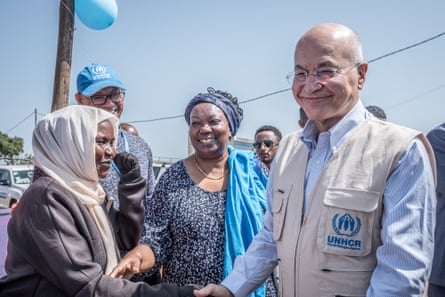
“Given the scale, this is not the moment to look away. This must not be about shifting responsibility. This has to be about sharing responsibility. Ethiopia is showing the way,” says Salih.
Inside Ura, Makatet’s messaging is going down well. Its population of doctors, teachers and civil servants are desperate to resume ruptured careers and give their children opportunities.
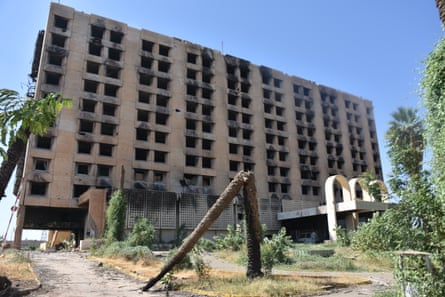
Among them is Yousif Babiker, proudly clutching a Hilton name badge, a memento from his role supervising housekeeping at Khartoum’s famous five-star hotel.
The iconic structure has been gutted by fighting and Babiker has ruled out returning home. He prays his four children will find careers elsewhere. “A good education, the chance to work. I hope for this,” says Babiker, 49.
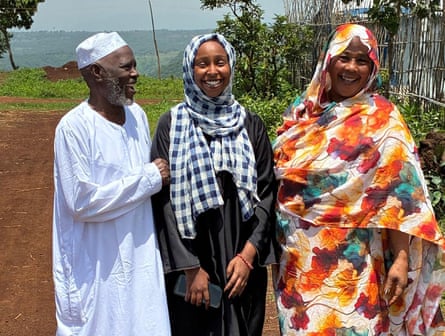
Abdeen wants the same for his daughters. In late May he found them again, by chance. Wandering the southern quadrant of Ura he heard a familiar shriek. Spinning round he saw Ruaa Idris, his eldest, running towards him, arms outstretched.
The 23-year-old has tried everything to continue her education in Ethiopia, attempting to enrol at Asosa university and is seeking courses further afield, but to no avail. But she remains determined to become a gynaecologist. “Given a chance I will catch it with my teeth.”
Further south, the sweltering lowlands of the Gambela region sit beside another of Ethiopia’s turbulent neighbours. South Sudan’s spasms of ethnic violence guarantee a steady influx of new arrivals. At least 70,000 people from the Nuer community are crammed into the Jewi refugee camp. Its residents also fear being attacked inside Ethiopia. Enveloping the camp is an oppressive forest that holds an unpredictable foe.
Nuer people living in the nearby city of Gambela frequently attack Jewi’s refugees, and about 25 people have been killed foraging for food or firewood.
“I don’t feel safe here,” says Peter Keang. He arrived from South Sudan in March last year after fighting between government forces and Nuer militia that the 38-year-old says killed friends and relatives.
“We were chased by drones. Even when crossing the river into Ethiopia they were shooting at us.”
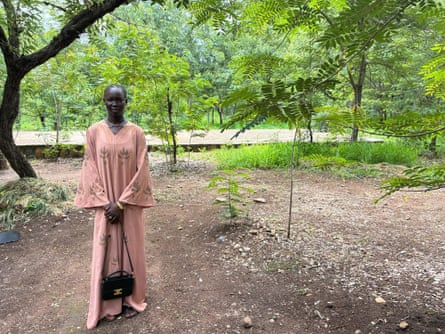
Nyamach Duoth, 20, was born a refugee in Ethiopia and says her friends are too petrified to leave the camp.
“Food supplies have reduced, but people are worried about looking for food in the forest. Women are raped there.”
Yet optimism abounds that Makatet might herald a fresh start. Budding entrepreneurs populate the camp – one soap business there has made 168,475 bars and £30,000.
There are also fledgling firms in Ura. Miriam Abdallah, 48, has built a perfume production line and set her sights on establishing a scent emporium in Europe.
Single mother Sowa Belle, 36, is also thinking big, backing herself to open a chain of eateries called Mama Sowa after insatiable demand for her kisra, Sudan’s popular bread.
What unfolds next among the occupants of Ethiopia’s 24 refugee camps will be keenly watched by western policymakers. Most people in Ura want resettlement in Europe. If Makatet delivers on its promise, analysts believe it offers an alternative model to fortress Europe for mass displacement, as refugees are encouraged to build new lives in Africa.
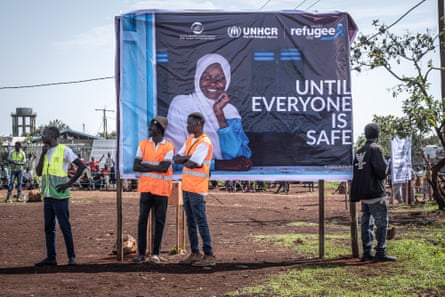
“It’s in our national interests as a whole,” says Salih. “To help deal with this problem as opposed to wishing it away – only to discover that it is coming back.
“I’m challenging the international system: we simply cannot look away while we see displacement piling on year after year. This is a moral problem, a human rights problem, a humanity problem.”
For the problem to be solved, Ethiopia’s pioneering project will need to alter the trajectories of lives like those of Ruaa Idris and her two teenage sisters.
Marooned in the hamster-wheel mundanity of life in their remote refugee camp, they watch peers on social media, wondering what might have been.
Idris says: “What’s the point of safety without living?”