3 months ago
174
3 months ago
174
The Argentinian president, Javier Milei, is facing his lowest approval ratings since taking office in 2023 as newly published evidence allegedly reveals a $5m financial agreement connected to his public endorsement last year of a controversial crypto project.
The scandal has tarnished crypto’s reputation across Argentina and set back the ambitions of industry insiders who saw the country as fertile soil for the growth of digital money.
Milei’s promotion of crypto and the uproar over his alleged multimillion-dollar bribery come at a time when the economic reality for everyday Argentinians is grim. The libertarian president has introduced strict austerity measures to curb once-rampant inflation that triggered a recession and left many in poverty. The country is beginning to recover, but the once-rosy outlook of crypto’s enthusiastic promoters, including the president, clashes with the outlook on the ground. Regulators’ integration of crypto into the mainstream financial system has slowed in response.
On 14 February 2025, Milei tweeted his support for the $Libra token, a niche cryptocurrency purportedly “boosting the growth of the Argentinian economy”. After his tweet, $Libra quickly reached a peak price of $5 but rapidly plummeted to less than $1, wiping out 13,000 token holders’ investments to the tune of $250m.
The revelations of a financial agreement, initially published last month by the Argentinian investigative outlet El Destape, contradict Milei’s claim that he “obviously” had no connection to $Libra’s organizers, and had simply happened upon $Libra online and decided on his own to promote it.
Prior to the release of these most recent details, Argentinian crypto advocates and prominent international figures had attempted to frame crypto-focused education and regulation as ways to prevent future scams. Their efforts to reshape Argentina’s regulatory landscape in their image may now face a steeper uphill battle, with crypto’s public image intertwined with Milei’s alleged corruption and nosediving public approval – though Milei has bounced back from scandal before.
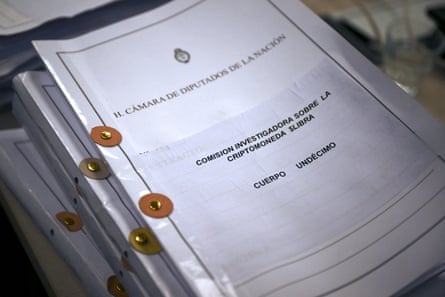
The newly published financial agreement, which was recovered by state investigators from the cellphone of crypto lobbyist Mauricio Novelli, allegedly outlines payments of $1.5m, $1.5m and $2m made in three phases to entities connected to Milei.
According to Argentinian newspaper La Nación, call logs additionally show that the president communicated with Novelli at least five times in the minutes before his promotion of $Libra. At the time of the calls, Novelli was in Texas with colleagues involved in the $Libra project, including an American crypto entrepreneur and spokesperson for $Libra whom Milei had allegedly agreed to name as an adviser, per the terms of the financial arrangement.
Less than a week after Milei’s promotion of $Libra in 2025, and with political opponents’ calls for an official investigation already blaring loudly, Vitalik Buterin, the founder of Ethereum, issued a direct appeal to Milei through social media. “Recent news” proved “why education is so important”, he wrote. Hosting Devconnect – the inaugural “world’s fair” for Ethereum investors, developers and supporters – in Argentina “could be a great opportunity to show the best of what crypto can offer”, he added. Milei responded on X an hour later, framing the convention as a “great opportunity” and “an honor for Argentina”. The Ethereum Foundation, which coordinates Devconnect and features Buterin on its board of directors, did not offer comment.
Capitalizing on ‘a perfect storm’
Following Milei’s presidential election in 2023, which brought a libertarian and pro-crypto politician to national office, crypto advocates saw an opportunity to expand crypto’s footprint in a country desperate for any investment. They saw Argentina’s unstable political and economic conditions as a “perfect storm”.
Inflation had driven the national currency down against the dollar, which had compelled many consumers to resort to crypto as a less-volatile store of value. In 2024, Argentinian crypto entrepreneurs and supporters established Crecimiento, now the primary crypto-advocacy group based in the country, which has aimed to secure business-friendly regulatory changes.
Members of Argentina’s crypto sector said that Milei’s $Libra scandal had harmed crypto’s reputation in the country. They saw Devconnect as a high-profile opportunity to redeem the sector’s public perception by showing “the other side of crypto”, which could encourage regulators to come back to the table and implement favorable reforms.
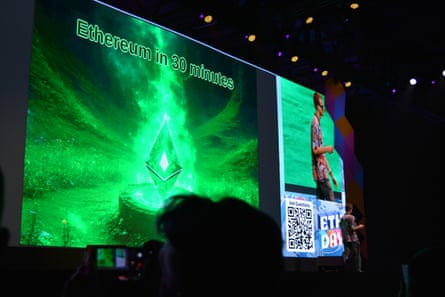
Crecimiento’s presence in Argentina, especially its public programming, had helped capture the attention of Devconnect’s conference organizers, according to Emi Velazquez, an entrepreneur and the former director of the organization. At least one member of Crecimiento helped secure preferential visa status from the Argentinian government for conference attendees, a crucial variable deciding Devconnect’s location, according to Velazquez. The conference even established its own fast-tracked line at airport customs.
A conference tries to rehabilitate crypto’s image
Leading up to Devconnect in November 2025, organizers and local crypto platforms attempted to spur crypto adoption. Salespeople for crypto apps encouraged restaurants and other businesses to accept crypto payments before Devconnect’s crypto-wealthy flocked to Buenos Aires, and these outlets were listed as crypto-friendly venues on the official Devconnect travel guide. “The next financial revolution starts here, not on Wall Street,” one wheat-pasted poster in the neighborhood surrounding the conference claimed.
The conference ultimately drew more than 17,000 attenders from across the globe. Ethereum leaders, including Buterin, delivered keynote addresses; Buterin dressed in a shirt emblazoned with the pygmy hippo Moo Deng. His speech outlined the ways Ethereum is unlike FTX, calling out the now-bankrupt crypto exchange and its jailed founder, Sam Bankman-Fried, for “currying favor with politicians”. Buterin said Argentina was a “great place” to see blockchain-based technologies “interact with the wider world” due to the country’s high rate of crypto adoption.

In an interview with the Guardian on site at Devconnect, Velazquez of Crecimiento said the conference was helping present “the other side of crypto”, and could lessen the political cost to regulators’ experiments with it in the wake of the $Libra scandal. “If you look at Twitter, it’s all pictures of people falling in love with the city, the food, the people, the culture, the music,” he said.
According to Maria Milagros Santamaria, who previously led Crecimiento’s regulatory efforts, crypto’s status in Argentina over the past two years has been tied to three milestones. The first was the start of the $Libra scandal in February 2025, which encouraged some regulators to retreat from discussions about crypto-related rule-making.
By Devconnect in November, the second milestone, most regulators had returned to the table, and Argentina’s securities regulator, which lost an adviser to the scandal, had begun overseeing a regulatory sandbox for crypto initiatives and financial-technology startups.
The third milestone, the most recent tranche of evidence concerning Milei’s role in the $Libra scandal, has compromised crypto’s momentum in the country, Santamaria said. Argentina’s central bank was slated to begin allowing banks to offer crypto services in April, and the status of that rollout has not been updated, she noted. Argentina’s financial regulators have often followed American approaches to financial regulation, and are largely doing the same when it comes to crypto, meaning a full pause on the sector’s expansion in the market is unlikely, Santamaria added. On 7 April, Argentina’s securities regulator recognized some cryptocurrencies, including ether, as counting toward investors’ personal net worth, effectively allowing crypto investors to count as “qualified investors” and thereby access more sophisticated financial products.
Crypto advocates feel “disbelief and disappointment” in reaction to Milei’s alleged ties to $Libra, Santamaria said; entrepreneurs are still “trying to build on top of [the scandal] and keep showing what we can do”, she said. The president has seen his public approval ratings drop sharply on other occasions, only to come back, making his long-term political prospects uncertain one way or the other. “Maybe a prediction market would help on that one,” she said.