3 months ago
184
3 months ago
184
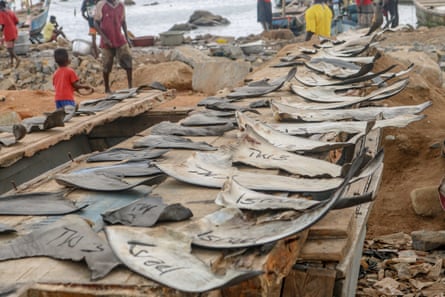
Guitarfish are an odd-looking and ancient species, with the tail of a shark and the flattened body of a ray, but their coveted fins have driven populations to the brink of extinction. In west Africa, where their meat is also a local delicacy, many guitarfish species are among the most critically endangered fish in the ocean.
Conservationists at the International Union for the Conservation of Nature (IUCN) describe the slow-maturing ray, which produce young annually, as an “indicator species”, which reflect the overall health of an ecosystem and pose challenges in the way coastal fishing of them is managed. The IUCN red list categorises more than half of guitarfish species as critically endangered.
But now, a grassroots campaign pioneered by a marine biologist in Ghana is aiming to save the guitarfish, the most valuable fish species landed in the country, from disappearing altogether from the shallows waters of its 335 miles (540km) of coastline. Instead, he is persuading fishers to abandon their nets – and the sea – in favour of farming the giant African land snail, a fast-growing gastropod popular in Ghana as a source of protein.
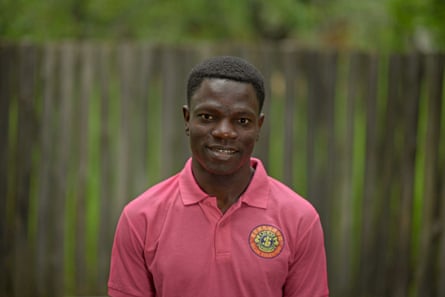
In 2019, Dr Issah Seidu, a lecturer in the wildlife department at Kwame Nkrumah University of Science and Technology in Kumasi, set up the biodiversity organisation AquaLife Conservancy to help save the guitarfish.
His three staff, helped by volunteers, monitor the guitarfish population and find ways for fishing communities to reduce their reliance on them.
“We asked the fishermen what they would do if they didn’t fish,” says Seidu. “Fishing income is very meagre and, while guitarfish used to provide more income, their numbers are dropping.
“We found out that a good alternative source of livelihoods would be harvesting land snails,” he says.
Farming giant snails is lucrative, requires little capital outlay and has two harvest cycles annually, Seidu says. The meat of the snail, Achatina achatina, is in demand as a nutritious source of protein, sold in chop houses and markets.
An average artisanal fisher can make about 750-1,000 Ghanaian cedis (£50-65) a month, while snail farming could generate as much as 10,000 cedis a month, he says.
He first came across the extinction threat to guitarfish by accident some years ago, when visiting his uncle in Dixcove, a small coastal town in western Ghana. As catches of all species dwindled due to industrial fishing fleets from other countries in Ghanaian waters, he noticed that the fins of sharks, rays and guitarfish were being sold to traders for export to China.
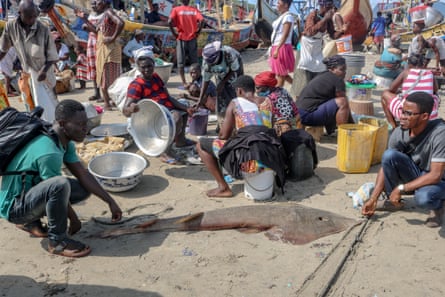
“They used to fish with artisanal purse seiners [a fishing boat that uses a long net] to catch tuna, anchovies and sardinellas. But as the species declined, the fishermen moved to using gill nets,” Seidu says, referring to the often-banned weighted walls of netting that catch everything in the water.
“Marine megafauna, like sharks, rays and guitarfish, get caught in the nets,” he says, adding that some artisanal fishers were targeting sharks and rays to boost their income.
Sharks, rays and chimaeras, known together as chondrichthyan or cartilaginous fish, are facing “a global extinction crisis” due to fishing pressure.
Information is patchy about many local populations of guitarfish, a key predator that help maintain the balance of coastal ecosystems. Though scientific classification varies, there are at least 55 species of guitarfish.
“I checked with IUCN and found out that 70% of these fish had been listed as threatened with extinction.” A related species, the sawfish, was already extinct in Ghanaian waters and Seidu decided he had to act to stop the same thing happening to guitarfish.
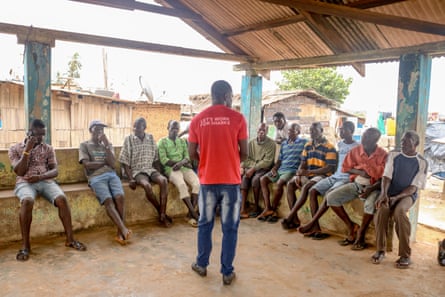
Initially, he was met with hostility from the fishing community, who feared for their livelihoods. But by enlisting them to monitor the species, highlighting the extinction risk as well as training them in better fishing practices, Seidu has persuaded about 200 fishers to either stop or scale back their harvest of guitarfish. Of those, he has convinced 43 to take up snail farming.
Seidu’s work has now been recognised internationally. In 2025, the IUCN made him co-chair of the shark specialist group for Africa and last month the Whitley Fund for Nature recognised his conservation work with an award presented by Princess Anne at the Royal Geographical Society.
Dr Rima Jabado, chair of the IUCN species survival commission’s shark group, said: “What Issah is doing in Ghana, through his work with fishers to record catches, is exactly the kind of effort needed.”
Seidu’s long-term goal is to establish Ghana’s first locally managed marine protected area. “Ghana’s coastline is more than just a place,” he says. “It is life, culture and survival for millions of people.”