6 hours ago
12
6 hours ago
12
In the west, tofu is often viewed as a substitute for meat, which may explain why firmer types that can be cut into chunks and fried or grilled like meat have become so ubiquitous. In China, however, where tofu has been eaten for at least 1,000 years, it isn’t a substitute for anything; it’s simply a protein-rich ingredient that forms part of most people’s diets, can be cooked with meat and fish, and comes in myriad forms, from the tender, wobbly tofu used to make Sichuanese mapo tofu to firm smoked tofu, sheets of tofu “skin” and the silken tofu that can be as soft as creme caramel. Many Chinese tofu recipes are so delicious that habitual meat-eaters will devour them as keenly as vegetarians.
Juicy tofu in a spicy sauce
In Yunnan, eating tofu is a social activity. All over the south of the province, people gather around grills tended by cooks who slowly toast chunks of cured tofu until they are crisp and golden on the outside, soft and slightly juicy within, and customers help themselves, dipping the tofu pieces into soy sauce, chilli, garlic and herbs. Aside from the ubiquitous tofu grills, there are many delicious local tofu recipes, including this one. In Yunnan, they make it with slices of fresh tofu soaked in an alkaline solution, which makes the texture particularly custardy after frying: a sort of artisanal molecular gastronomy (such tofu is described as “enclosing milkiness”). At home, however, I use tofu that is very tender but just holds its shape and is similarly sumptuous when bathed in a spicy sauce with minced pork (to make this vegetarian, simply omit the pork). The tofu can be deep-fried a few hours ahead and chilled until you wish to finish cooking. I use a combination of Sichuan chilli bean paste and sambal oelek instead of Yunnan fermented sauces, which are hard to find outside China.
Prep 10 min
Cook 20 min
Serves 4 with rice and 2-3 other dishes
600g tender plain white tofu
Cooking oil, for deep-frying, plus 3 tbsp extra for the wok
100g minced pork
1 tbsp Shaoxing wine
2 tbsp Sichuan chilli bean paste
1 small red onion (about 50g), peeled and finely chopped
1½ tbsp finely chopped garlic
1 tbsp finely chopped ginger
2 tbsp finely chopped red chilli
1 tbsp sambal oelek
A few pinches of ground white pepper, to taste
1 tsp potato starch mixed with 1 tbsp cold water
3 tbsp finely sliced spring onions, green parts only
Cut the tofu into even, 1-1½cm-thick bite-size pieces, then gently pat dry with kitchen paper.
Heat oil for deep-frying to 180C. Working in batches, fry the tofu for about five minutes, until golden brown, then drain on kitchen paper. You can do this step a few hours in advance.
Put three tablespoons of oil in a seasoned wok on a high heat. Add the pork and stir-fry, breaking up the meat, then, when it turns pale, add the Shaoxing wine. When the meat is a little golden, turn down the heat to medium, add the chilli bean paste and stir until the oil reddens. Add the onion, fry until it smells delicious, then do the same with the garlic, ginger and chilli. Finally, stir in the sambal oelek. You should have a rubbly mass of utter deliciousness.
Pour in 250ml water and add a little white pepper to taste. Drop in the fried tofu, nudge the pieces into the sauce, then return to a boil and simmer for a minute or so, to “send the flavours in”. Give the starch mixture a stir and, in a couple of stages, add just enough to thicken the sauce to a lazy gravy. Stir in the spring onion greens and serve.
Mushroom mapo tofu
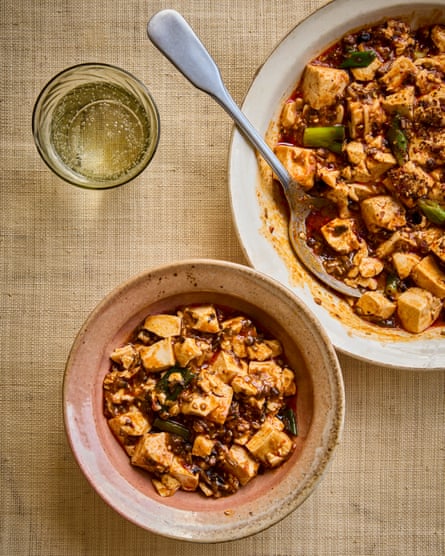
People often ask me how to make mapo tofu vegetarian and, to be honest, I normally just omit the beef from the classic recipe. If you miss the mouthfeel of the meat, this version, made with mushroom mince, is highly satisfying (you can also make the mince a day in advance, if you like). Do finish the dish with a scattering of freshly roasted and ground Sichuan pepper, which is one of the signatures of real mapo tofu. To make the perfect mapo tofu, use the tenderest, silkiest tofu that will hold its shape – as the Sichuanese chef Yu Bo puts it, you want the edges of the cubes to look as if they are straining to contain its voluptuousness. The more wobblesome the tofu, the greater the joy! It’s best to buy fresh tofu in water from Chinese shops; supermarket versions tend to be drier and nubblier. The same mince makes a fabulous pork substitute in dan dan noodles or anywhere, really, where you want to replace mince with something meatless. (Perhaps in lasagne or moussaka, for example.)
Prep 10 min
Cook 25 min
Serves 4 with rice and 2-3 other dishes
For the mushroom mince
200g chestnut mushrooms, or other mushrooms
3 tbsp cooking oil
2 tsp finely chopped garlic
2 tsp finely chopped ginger
1 tsp dark soy sauce
Salt
For the dish
500g tender plain white tofu
2 baby leeks, or spring onions, green parts only
3 tbsp cooking oil
2½ tbsp Sichuan chilli bean paste
1 tbsp fermented black beans, rinsed
2 tsp ground chillies
1 tbsp finely chopped garlic
1 tbsp finely chopped ginger
¼ tsp ground white pepper
1 tbsp potato starch mixed with 2½ tbsp cold water
¼-1 tsp ground roasted Sichuan pepper, to toast
Cut off and discard the dry ends of the mushroom stalks, cut the stems and caps into roughly 5mm-thick slices, then cut into 5mm cubes. Put the oil in a seasoned wok on a high heat, then cook the mushroom cubes for two to three minutes, until greatly reduced in volume and tinged with gold. Add the garlic and ginger, stir briefly until you can smell them, then add the soy sauce and salt to taste. When it’s all sizzly and delicious, take off the heat.
Cut the tofu into 2cm cubes and leave it to steep in very hot, lightly salted water while you prepare the other ingredients. Cut the leeks into 2cm lengths.
Put the oil in a seasoned wok on a medium heat. Add the chilli bean paste, stir-fry until the oil turns red, then add the black beans and chillies, and stir-fry until they smell delicious. Do the same for the garlic and ginger, taking care not to burn them, then pour in 175ml water. Use a slotted spoon to transfer the tofu from its soaking water to the hot wok, then add the mushroom mince and white pepper, and bring to a boil. Simmer for a couple of minutes, so the tofu absorbs the flavours. If you’re using baby leeks, stir them in and cook for a few moments (if you’re using spring onions instead, add them later). In a few stages, stir in just enough of the starch mixture to thicken the sauce so it clings to the tofu (if using spring onion greens, stir them in now).
Pour everything into a deep serving bowl, sprinkle with the ground roasted Sichuan pepper to taste and serve.
Sour-and-hot silken tofu
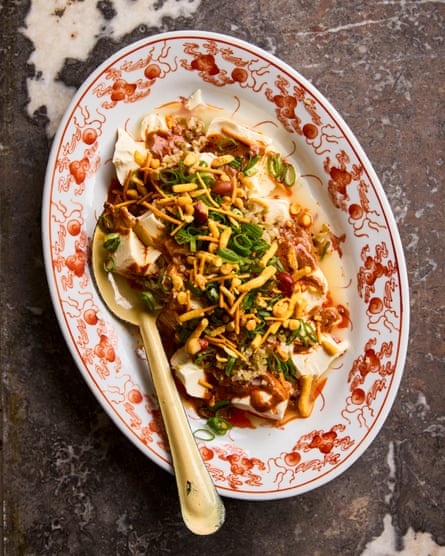
The soft wobbliness of “flower tofu”, otherwise known as “tofu brain” or silken tofu, is soothing at any time of day, but I particularly love it for breakfast. It is as satisfying and comforting as porridge, but lighter. You can eat it sweet, with a drizzle of brown sugar syrup or even fruit salad, but I prefer mine with savoury seasonings. There are countless ways to serve silken tofu. In the north, including Beijing, they bathe it in a kind of gravy, thick with morsels of dried lily, mushrooms and wisps of egg. In the Jiangnan region around Shanghai, on the other hand, the adornments are more delicate: tiny dried shrimps and seaweed, preserved vegetables and sliced spring onions. In Sichuan, of course, they like a bit of spice. This recipe, which serves one or two people, depending on appetite, is inspired by the exquisite version dreamed up by Chengdu chef Lu Ziqiang at Birds of a Feather in Brooklyn, New York. I’ve substituted the traditional deep-fried soya beans and noodles for Bombay mix, which is similar in appearance and crunchiness.
Prep 10 min
Cook 5 min
Serves 1-2
300g silken tofu
2 tsp Chinese sesame paste
1 tsp Chinkiang vinegar
2 tsp light soy sauce
1 tsp white sugar
1½ tbsp chilli oil, plus ½–1 tbsp chilli sediment
½ tsp red or green Sichuan pepper oil
2 tbsp finely chopped Sichuan preserved vegetables
2 tbsp finely sliced spring onions, green parts only
1 small handful Bombay mix
Tip the silken tofu into a saucepan of boiling water and simmer gently for a few minutes, until heated through. Gently break it up into large, cloud-like clumps, but don’t stir or it will disintegrate.
Meanwhile, put the sesame paste in a small bowl and smooth it with the back of a spoon. Gradually stir in the vinegar and soy sauce to create a satiny emulsion, then add the sugar. Stir in the chilli oil and sediment, and the Sichuan pepper oil.
When the tofu is ready, gently lift it from the water and transfer to a bowl. Pour the sauce over the top, then sprinkle over the other ingredients. Mix well before eating.
-
These recipes are edited extracts from Five Tastes: The Magic of Flavour in a Chinese Kitchen, by Fuchsia Dunlop, published by Particular Books at £30. To order a copy for £27, go to guardianbookshop.com