2 months ago
86
2 months ago
86
At the end of Barcelona’s 2-1 win at Atlético Madrid on Saturday night, as the players stood celebrating before the small pocket of supporters applauding them from high in the north-west corner of the Metropolitano, Diego Simeone approached Hansi Flick, shook his hand and reminded him of something: “You’ve got to come back.” It came as an invitation, born of admiration, and also a warning. This was only the start of a trilogy in which they face each other three times in 10 days, and the concluding chapter there would be different.
A different competition, for a start. Goals from Marcus Rashford and Robert Lewandowski, the latter on 89 minutes, had virtually secured Barcelona the league title but it was going to get bigger and mean more. Atlético, already adrift, had rested players; the last time Barcelona had been there – in the Copa del Rey semi-final first leg – they had beaten them 4-0; and the next time the Catalan club came it would be the Champions League quarter-final, second leg. And, back in the Metropolitano, that really would be a battle: tougher than this and, it turns out, tougher than anyone had imagined.
At full-time on Wednesday night, Simeone didn’t make for Flick. Instead, he headed straight up the tunnel, leaving his players out there at the Camp Nou, where he had seen his team beat Barcelona for the first time. (Last year’s 2-1 away win was at Montjuic). Atlético’s coach had hoped that Part II would do what the second instalment of a trilogy is supposed to do: set up the third. He couldn’t have expected it to be as well set as this. It was enough to be in it, for Barcelona to know they would have come back to a place where Atlético had put four past them and five past Real Madrid. Now on top of that they have a 2-0 lead.
“It’s not over,” Flick said, and Simeone agreed, or said he did. “We can take the game away from anybody,” Rashford said. After all, that 4-0 Copa del Rey loss had been followed by a 3-0 win, Barcelona coming so close to an astonishing second leg comeback. But that was at the Camp Nou; this time they would have to do it away, and with lessons learned by both sides. Simeone, asked whether he would rather have to prepare a team mentally for a comeback or to protect an advantage, said the advantage of course: “It’s just common sense.”
In the history of the Champions League only once has a team overturned a 2-0 home defeat from the first leg. That’s the bad news for Barcelona; the good news is that one of them has been here before. In 2019, Rashford’s late penalty knocked out Paris Saint-Germain, seeing Manchester United through. Seven years on, he said they had done enough to have secured a better result in the first leg and they needed to replicate parts of the performance, if not the score, in the second.
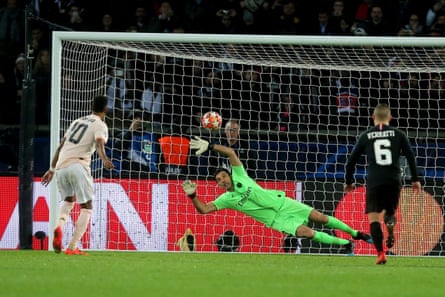
“The mindset and intent of this team are unbelievable and we’re going to need all of that in the next game in order to come back,” Rashford said. “This team is always going to create chances because we have so much quality. Today the goals did not go in but we cannot shy away from the responsibility.”
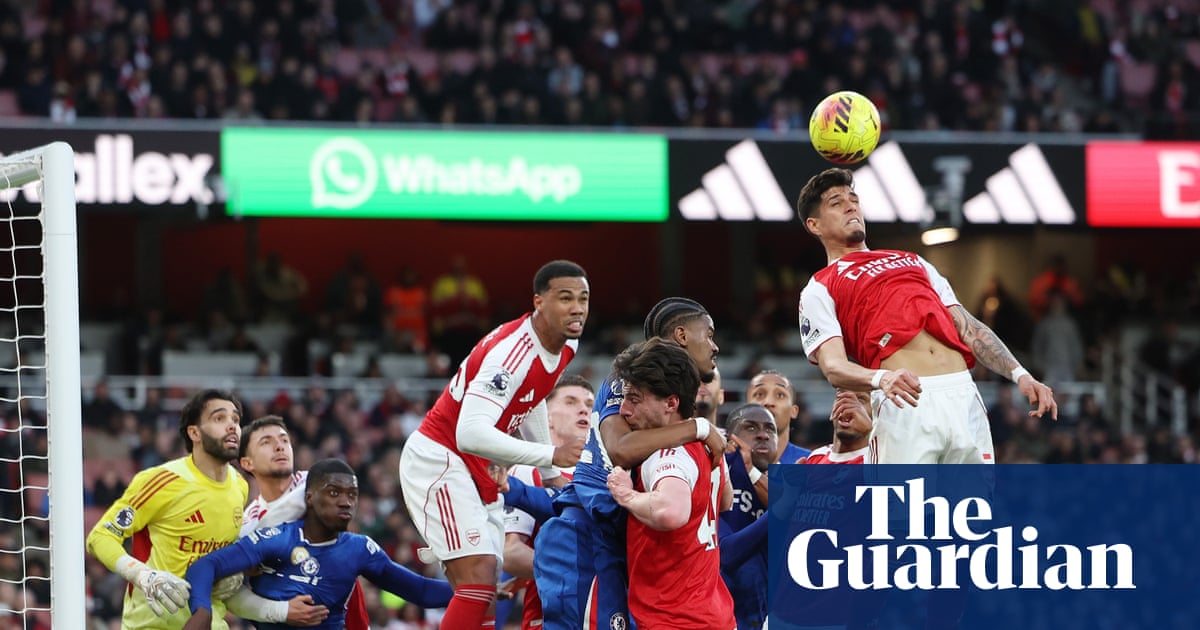
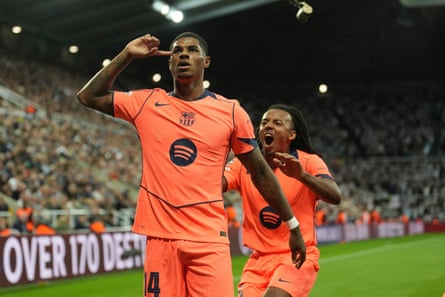
Rashford had felt that more clearly than anyone. Barcelona had 18 shots to Atlético’s five, and Rashford had been the dominant attacking figure from the start. Minute two, he cut inside and had his shot saved by Juan Musso. Minute four, again he was denied by Musso, one on one. Minute 14, he volleyed wide. Minute 17, he scored … but the flag went up. Minute 30, he was denied by Musso again. Minute 50, played in by Lamine Yamal, his shot missed the near post. Minute 52, he smashed a free-kick off the bar. And that was just the shots, seven inside an hour.
He had flown up the left, Barcelona’s play turned his way. He had been “hyperactive”, AS wrote. “Tireless on the wing, generating danger,” Sport said. Mundo Deportivo called this an “exhibition of speed”, giving him full marks. This was his best performance of the season, yet there was regret. “We have to be more clinical,” he said. “In essence, this can be explained by saying that Rashford is not Luis Suárez,” judged El Periódico.
When Rashford arrived in the summer he was a back-up option. Barcelona had long liked the look of him but they had also pursued Nico Williams and Luis Díaz before him. His arrival on loan from Manchester United was explained, in large part, by the comparative ease and economy with which a deal could be done, although there was a struggle to register him in compliance with La Liga’s salary limits. He also came to add versatility and depth to a forward line that had finished last season looking overstretched.
With Robert Lewandowski, Lamine Yamal and Raphinha in place, there was little anticipation that he would be a starter. But there was also the opportunity for things to change. He was theoretically an alternative to all three forwards, able to play left, right and centre, and injury and rotation would offer the chance to change his status, to get regular playing time. Meanwhile a €30m (£26m) buy clause meant the deal could be made permanent.
Asked in the autumn whether he would like that to happen, Rashford replied: “Yeah, for sure.” He talked about needing a change and seemed to have found a place in Catalonia: “I don’t think there’s much change in me; it’s just a new environment, a new culture; I’m enjoying it here,” he said. His first three Champions League games brought four goals and two assists, the promise of more. Making his move permanent appeared to be a no brainer; on some levels, it still does. He has five goals and four assists in 10 Champions League games, and is on double figures for both across all competitions, the first player to cross that threshold in Spain this season.
His had been the perfect loan signing. Barcelona could not have asked for more. And yet, there is an ‘and yet’, absurd though that can seem. And yet, does being a back-up satisfy? And yet, Barcelona could ask for more. There has been a strange sense that if statistics have been incontestable; that if he has pace, directness and delivery few others do, his contribution can be contested; that his decisive moments are also sometimes isolated ones.
Flick decided Rashford has one role, on the left. When he was moved inside on Wednesday night, it was to a centre-forward position he has occupied six times in 41 games, and he has played on the right twice. Even with Ferran Torres and Lewandowski struggling badly for form, Flick has appeared reluctant to make him a striker: Dani Olmo started Part I of the Atlético-Barca trilogy at false 9. Rashford’s opportunities had been relatively few lately: eight, zero, 62, 17 and zero minutes played in the five league games before last weekend. Then he started and scored.
But it is not just the goals, not just the numbers. The demands of this team are particular too and there was something in the response from Flick before Wednesday’s game: “We know Marcus is fantastic with the ball but defending is also part of the game. He is doing well and adapting.”
If Rashford is not Suárez, he is also not Raphinha, the man he must replace. The man who has 19 goals and eight assists this year and racked 34 goals and 26 assists last year, Simeone’s choice as Ballon d’Or winner, and the man whose intensity is contagious, leading the pressure that makes Flick’s system function. It is not really Rashford’s fault, but the man he replaces is the one Barcelona most miss, and that tends to put the emphasis on the things he is not, as much as the things he is. “He’s not exactly a ferret when it comes to pressing,” Santi Giménez said in AS.
Injury to Raphinha during the last international break was met as a disaster, although it was also projected as an opportunity for Rashford: a chance to play, to prove a point and clarify a future that remains undecided, despite the simplicity of securing it. And that fact alone is eloquent.
Barcelona are happy with him and would like him to continue. There is an appreciation for what he has done and the qualities he has, a warmth too, but while €30m is not much from a Premier League point of view it is prohibitive to them. Especially as the reluctance to regard him as a striker means that they must spend to sign there, eating into a limited budget. United consider that fee, agreed last summer, as non-negotiable; Barcelona would like to negotiate. The “of course” from the autumn has given way to conversations in the spring, decisions to be made, from both sides.
These were the games that could define everything, not only for the team but for him. A moment to take responsibility. At the Camp Nou on Wednesday, the biggest match of Rashford’s first season in Barcelona, he did, tearing into Atlético, imposing himself the way his manager wanted. Relentless, he did everything but score. “On another night those go in,” he said; next Tuesday they will have to, back at the Metropolitano, where on the night that Rashford helped to take Barcelona towards the title, Simeone told Flick they would meet again.