2 months ago
101
2 months ago
101
OpenAI has put on hold plans for a landmark UK investment citing high energy costs and regulation, in a blow to the government which has put AI at the centre of its growth strategy.
Stargate UK was a part of the UK-US AI deal announced last September, in which US companies appeared to commit £31bn to the UK’s tech sector, part of a larger series of investments intended to “mainline AI” into the British economy.
It came as the Labour government seeks to make AI and datacentres the engine of its growth plans, alongside closer ties with Europe and regional growth.
“This is a wake-up call for the government to manage energy costs in the UK and foundation infrastructure,” said Victoria Collins MP, the Liberal Democrat spokesperson for science, innovation and technology. “We cannot be dependent on US tech companies to build our own sovereign capabilities – whether that’s energy cost, supply or even data and phone signal.”
The Labour MP Clive Lewis said: “When a government has no economic strategy worthy of the name and no real industrial vision, it becomes vulnerable. The Silicon Valley companies that flew into London knew exactly what they were dealing with: a prime minister and a technology secretary desperate to project momentum, willing to dress up press releases as policy.”
A Guardian investigation last month revealed many of the deals to “mainline AI into the veins” of the British economy were “phantom investments”, and a supercomputer scheduled to go live in 2026 was last month still a scaffolding yard in Essex. That supercomputer was to be built by Nscale, a UK firm that had never built a datacentre before but said it was aiming to deliver the project in 2027. Nscale was also to build key datacentres for Stargate UK.
The Stargate project was to support Britain in building out “sovereign compute” – infrastructure that would allow the government and other UK institutions to run AI models on datacentres in the country. That is, in theory, crucial to the security of British data.
Now, OpenAI has apparently put it on pause, saying it would wait for “the right conditions” to enable “long-term infrastructure investment”.
Ben Spencer, shadow science minister, said: “When global firms cite high energy costs and regulatory uncertainty as reasons to walk away, it tells you everything about the direction of travel. For too long, Labour have prioritised courting big tech headlines while neglecting our domestic startups, but also the fundamentals that actually attract investment at home.”
An OpenAI spokesperson said: “We see huge potential for the UK’s AI future, and we support the government’s ambition to be an AI leader. We continue to explore Stargate UK.”
OpenAI’s exact commitments under the Stargate project were always vague. The crux of the investment was that the company would “explore the offtake” of 8,000 high-powered Nvidia chips at Stargate datacentres constructed by its partner, Nscale.
Contacted by the Guardian several weeks ago, the company said it had no updates on whether it was going ahead with that plan.
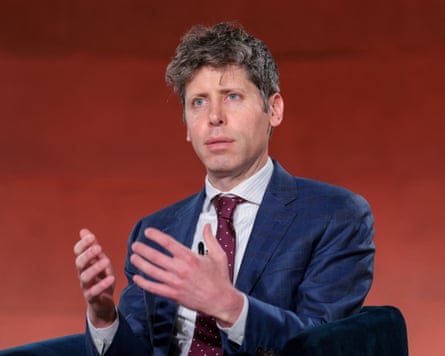
Tom Hegarty, the head of communications at the tech equity organisation Foxglove, said OpenAI’s chief executive, Sam Altman, was racking up a “record of U-turns any government minister could be proud of”, after the recent closure of OpenAI’s video-generation app Sora and Altman’s previous claim that AGI (artificial general intelligence) would be achieved by 2025.
“But that hasn’t stopped ministers from jumping fully aboard the AI hype train,” said Hegarty. “In January 2025, then-tech secretary, Peter Kyle, said a new supercomputer in Essex would be ‘the largest UK sovereign AI datacentre’ by the end of 2026 and ‘a fresh start for our economy and for working people’. Instead, a year later the ‘supercomputer’ was still a scaffolding yard.”
A government spokesperson said: “Our AI sector has attracted more than £100bn in private investment since the government took office, with the sector growing 23 times faster than the wider economy last year. That is delivering the jobs and opportunities hard-working people deserve.
“Our focus is on continuing to create the right conditions for investment in the UK’s AI and datacentre infrastructure. We are continuing to work with OpenAI and other leading AI companies to strengthen UK compute capacity.”
High energy costs, rising further because of the US-Israel war on Iran, are expected to delay or derail AI datacentre projects worldwide. The UK’s industrial electricity prices were already the highest in Europe before the start of the war.
Andy Lawrence, at the Uptime Institute, said OpenAI, Nscale, and the government all had reasons not to proceed with the project at this point, given rising energy prices and OpenAI’s tightening competition with rivals such as Anthropic.
“The government was not able to make sufficient commitments to be a client. I think the overall demand for all of this wasn’t, and still isn’t apparent. The whole sense of urgency has dissipated,” Lawrence said.
Nscale has been approached for comment.