3 months ago
165
3 months ago
165
Who better to have the final word on introducing young children to art than artist parents? Gone are the days of the genius artist at work alone in their garret. Today’s creatives are making art with knee-height people at their feet. So, what’s worked for them when it comes to sharing their love of art? What hasn’t? And what’s their advice for the rest of us?
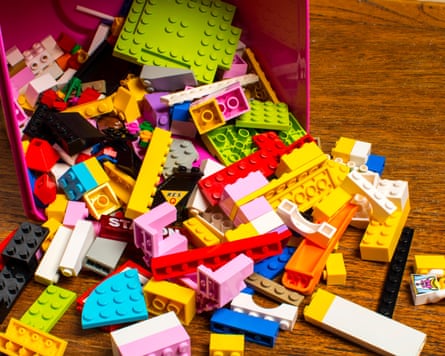
“Taking my kids to museums was always a bit challenging because I had two boys, four years apart, who liked to run in opposite directions. But when they were small, I encouraged them to come into my studio, a space that seemed so different to anywhere else in the house, like a treasure trove. Early on, I taught them how to sharpen pencils with knives and things like that, giving them responsibility. There would be boxes full of coloured pencils and paints and all sorts of different paper. I wouldn’t let them run riot, but I’d certainly let them play and encourage them to express themselves. Sometimes they’d make stuff with Play-Doh while I was working. I would often cast bits of them, just for fun, a hand or a foot. And we used to do loads of Lego together as well – I always think that’s such a creative toy, not so much the sets but when you have a great big box and just tip it out on to the floor. It’s about letting them be curious and play about and not necessarily have a plan, just to have fun making things.”
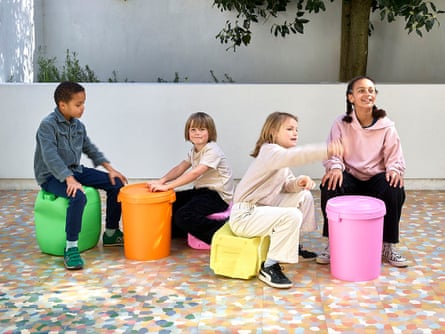
Michael Armitage: ‘My daughter uses materials in ways I hadn’t thought of’
“I find with a lot of art classes, it’s often quite constricted in terms of how you interpret what kids do. I prefer to let my daughter lead. I usually just let her use whatever I’m using – the paints, the pencils. She takes them and plays with them and tends to find a way to do things differently or to use them in a way I hadn’t thought about. I learn a lot more from her than she does from me. There’s something extraordinary about seeing how one day a line can be a drawing of her mother, and then six months later she’s changed and a line can be something a little bit more like a stick man, and then it continues to evolve over time. I think children are very aware of what they’re drawing, even if it doesn’t look how we think it should. So, follow your kids. Encouraging them and realising that nothing they’re doing is wrong is key.”
Chantal Joffe: ‘Don’t worry about your sofa getting messy’
“It’s important for children to have good materials. Because if there’s good colour you can do stuff with it. If it’s a crappy felt tip, you can’t – there’s no pleasure and it sets the barrier right away. So, decent paper and good crayons. It’s important that they see what it can do, that it’s not just an illusion of something. The other thing, I think, is letting them make a mess. I remember once, when my daughter had friends over, and we all drew in the living room on this huge piece of paper, a ship and a load of fish. I know parents are busy tidying all the time, putting everything in boxes and stuff – I mean, I’m never tidying, so that’s irrelevant! – but allow your kids to make a mess. I know that’s an obvious thing, but it’s important that they can splash or play with clay, even if it is going to get in the rug or on the sofa.”
Rachel Maclean: ‘We don’t go to see much art. My advice is to make things’
“I don’t take my kids to see art all that much. But my daughters are dead into art; they love drawing, they love crafting. I’ve shown them art through art books, but what I think is nice about kids is that they don’t fully differentiate between what’s art and what’s just another object or another image in the world. My advice would be just to make things. I think it’s a good way in, where it’s not so much something that you’re looking at from a distance and trying to understand, but more something that you’re just seeing and thinking: I want to try that. It kind of reminds you why you became an artist. There’s something about that very essential desire to make things.”
Nick Goss: ‘They’ll go to a safari park and draw the giraffes’
“My brother is an artist too, and we grew up with my mother teaching us how to paint when we were kids. She didn’t force us to do it, but if we were interested she was always ready to show us a new technique or how to work with clay, all sorts of things. Now she has my daughters to stay in Bristol and does a lot of drawing and painting with them, which is really lucky because that kind of thing takes time and patience – and when you’re working parents it can be tricky. They go to this safari park in Bristol and just always bring a sketchbook to draw the giraffes and the bears. Now it’s great because, when we take them to a museum, it’s become second nature that they’ll bring a pad and paper and draw something. It’s really nice to see because, apart from that, they’re normal children who are completely addicted to their iPads. But if you can carve out that little moment when they do put away the screens, it’s a lovely thing.”
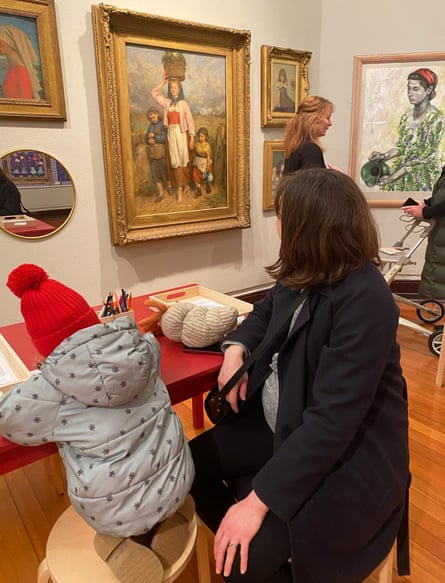
Caroline Walker: ‘I usually have to provide bribes’
“My introduction to art as a kid was going to my local public art gallery, Kirkcaldy Galleries in Fife. I now take my kids there as well. I see it as a useful resource for my kids, first of all because it’s not too big – I think my number one piece of advice is to start small. You don’t have to try to drag your children around a Tate show or anything like that. If it’s one or two rooms of pictures to look at, that’s enough. My kids have got a very short attention span for art, even my paintings of them. I usually have to provide lots of bribes, and if they ask one question about what they’re looking at, I see that as a success. There’s also nothing that’s going to make them more engaged than giving it a go themselves, and at Kirkcaldy there’s a room where they can draw a still life or a portrait inspired by the works from the collection hanging on the walls.”
Ghislaine Leung: ‘Maybe they can be the next artist who changes things’
“My daughter and I started going to Tate Britain when she was little. It’s quite near our house, and it became this thing that we liked to do. We would make a packed lunch and sit at the same table in the cafe; I would get a coffee, and she would have a hot chocolate. She liked that it was a day out and that she got to spend time with me, and I liked that I got to do something I liked, which meant I was in a better mood. It wasn’t just about the art. It was more about the experience of going there and understanding that it was something we could do and enjoy – like going to the library. And it was free. You know, these places are owned by the public. They’re our museums, our institutions. It’s about allowing children to know that they can be part of their lives. Whether or not they like the art is a decision they need to think about and learn through the development of their own tastes. And, hey, if they don’t like it, maybe they’ll be the next artist who changes that.”
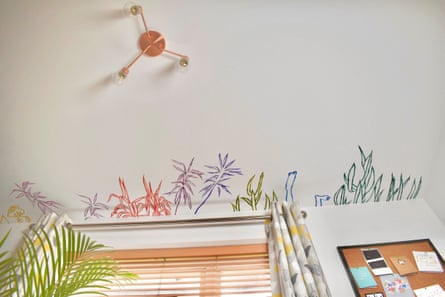
Miranda Forrester: ‘It’s hugely influential to have art in your bedroom’
“I felt really strongly before my daughter was born that I wanted her room to be full of art. My parents weren’t hugely into art, but they always had art in my room, and I think it’s hugely influential to have pieces that you’re looking at all the time, again and again, and that you’re coming back to. I did a mural on her ceiling so she could see it when she’s lying in bed – mostly botanicals, different earthy tones, and then a few rogue feet and hands, quite quirky funny shapes. Then I chose some pieces that I wanted her to see in her room, a real mix of contemporary and historical works. A Lubaina Himid print. Matisse. A few of my own pieces. I think that’s been really important in terms of setting a groundwork of art being around all the time.”
Oliver Osborne: ‘Give them an audio guide and they don’t want to leave’
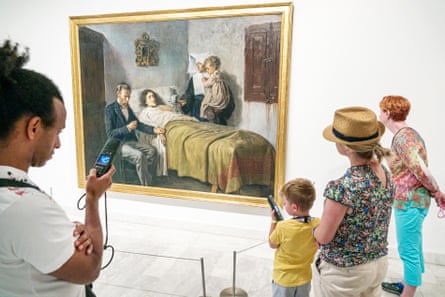
“The thing I clocked quite early, when taking my children to museums, was that audio guides were totally brilliant as a way of engaging them. On the one hand, aged five, having a device in your hand is a plus point because it is like having a toy. But also there’s a treasure hunt aspect to an audio guide, which is that you have to go and find the numbers and you have to go and find the paintings. One of my favourite places in Berlin is the Gemäldegalerie. It’s the old masters picture gallery, so you’re looking at things that are hundreds of years old: Holbein, Cranach, Vermeer. A lot of old, religious paintings that could be quite dry. We’ve had occasions when my sons have become completists, when they’ve wanted to tick off every single number in an exhibition and I’ve been ready to leave before they were.”
Tom de Freston: ‘I’m dreading the moment she thinks a drawing can be good’
“From early on, I wanted my daughter to spend time in the studio, and to feel that it wasn’t romanticised or private but a completely natural place for her to be. I try to paint or draw with her every day, in the same way that we read with her. Sometimes she’ll draw and I’ll try to copy her, sometimes we’ll do the same thing together. It’s just shifted into being a bit more image-based where she’ll have an idea in her head. I think the main thing is not to be prescriptive. They don’t need to be working to a predefined endpoint; just let them go wherever they go. I’m dreading that moment when she thinks there’s such a thing as a good drawing or how something should look, whereas right now she’s completely guided by the materials – as any painter would want to be. She’ll do one, and I might be thinking, Oh my God, this is really good, then she’ll happily just scrunch it up and chuck it. In some ways I’m always trying to get back to that non-preciousness, so seeing it in action is inspiring.”
Antonia Showering: ‘Enjoy them running from piece to piece asking questions’
“I’ve found that slowing down during exhibitions with a child is really important. As a parent, you’re not going to be seeing every single work in a show. You’ll be doing it differently, but you’ll be receiving more – you’ll be getting a different perspective. Don’t expect your child to be quiet, and try to enjoy them asking ‘why?’ and running from piece to piece. As for the train journey there, I think some people almost expect you to put your child in front of a screen with a headset on, just to ensure that the carriage is quiet. But children are meant to be inquisitive, asking questions, making noise. The train used to be one of my favourite places to sketch, and it’s strange that, when I walk past a table and it’s covered with felt tips and stickers and paper, that sight almost feels quite retro. I think the boredom of the journey is important – that’s where creative games and play are drawn from.”