3 months ago
155
3 months ago
155
A magnitude 7.8 earthquake shook part of the southern Philippines early on Monday, sparking tsunami warnings on some regional coasts, collapsing buildings and killing at least three people.
“Many buildings were affected, but I cannot enumerate them now because we are busy with ongoing rescues,” Master Sergeant Robert Dagon of the General Santos City police told Agence France-Presse.
The Philippines office of civil defense warned people to avoid entering damaged homes or other infrastructure due to the threat of aftershocks.
At least three people have been killed and four injured, police in the region said on Monday afternoon, local time.
Video verified by the Guardian shows the collapse of the upper floor of a Jollibee restaurant, a popular fast food chain, as well as the outer concrete walls of a commercial complex giving way in General Santos City, near the epicentre of the quake.
In Davao del Sur, part of a high school collapsed as students gathered outside, a video shared by local radio network Bombo Radyo showed.
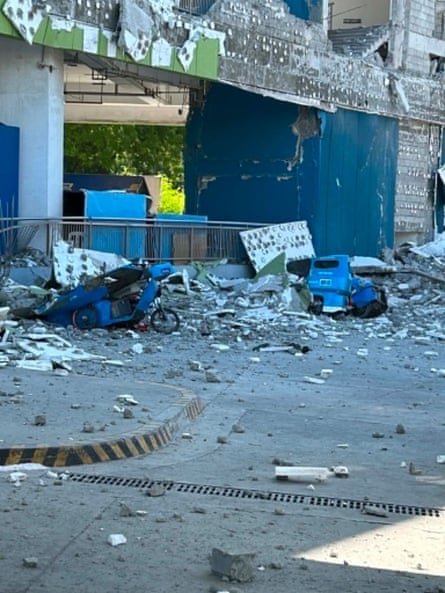
Images of a convenience store in General Santos city showed its entrance destroyed with smashed glass and overturned benches strewn across the street outside.
Power outages were reported and people were urged to go to higher ground. No further information on casualties was immediately available from the office of civil defence.
The epicentre was 13km (8 miles) south-west of General Santos city on the island of Mindanao and had a depth of 10km (6.2 miles), according to the Philippine Institute of Volcanology and Seismology in its initial report. It struck at 7.37am. The US Geological Survey (USGS) put the magnitude at 7.8 and the depth at 55.2km (34 miles).
The Pacific Tsunami Warning Center said tsunami waves up to 3 metres (10ft) were possible on some coasts of the Philippines. Waves up to 1 metre (3ft) were possible on some coasts of Indonesia and Malaysia.
“We advise people to evacuate to higher grounds or go further inland,” Teresito Bacolcol, the head of the Philippine institute, warned people living in coastal areas.
In a statement, Philippines president Ferdinand Marcos Jr asked people to heed the warnings, saying: “do not wait. Your life is more important than anything left behind.”
Marcos Jr said evacuation centres were up and running, as government agencies continued to assess damage and clear routes needed for rescue operations.
Smaller tsunami waves were possible in Taiwan, Japan, Guam, Papua New Guinea and several island nations and territories in the western Pacific.
Residents felt the earthquake tremors in Indonesia’s North Sulawesi and North Maluku provinces. Indonesia lifted a tsunami warning on Monday, hours after ordering evacuations of northern areas.
The agency recorded small tsunami waves in at least nine locations in Indonesia, with the highest recorded at 0.75 metres (2.4 feet) in Sangihe island.
The Philippines, one of the world’s most disaster-prone countries, is often hit by earthquakes and volcanic eruptions due to its location on the Pacific “Ring of Fire,” an arc of seismic faults around the ocean. The archipelago is also lashed by about 20 typhoons and tropical storms each year.
The earthquake struck just as public schools reopenedfor the year. A video taken at Mahayhay Elementaru School in Davao showed panicked pupils scrambling for safety during the morning flag ceremony.
The Philippines Red Cross reported attending three high schools to care for many students traumatised by the quake.
Marcos Jr ordered the suspension of school in affected areas until further notice.
“The safety of our children comes first,” he said.
Carmela Fonbuena contributed to this report. With Associated Press and Agence France-Presse