1 month ago
127
1 month ago
127
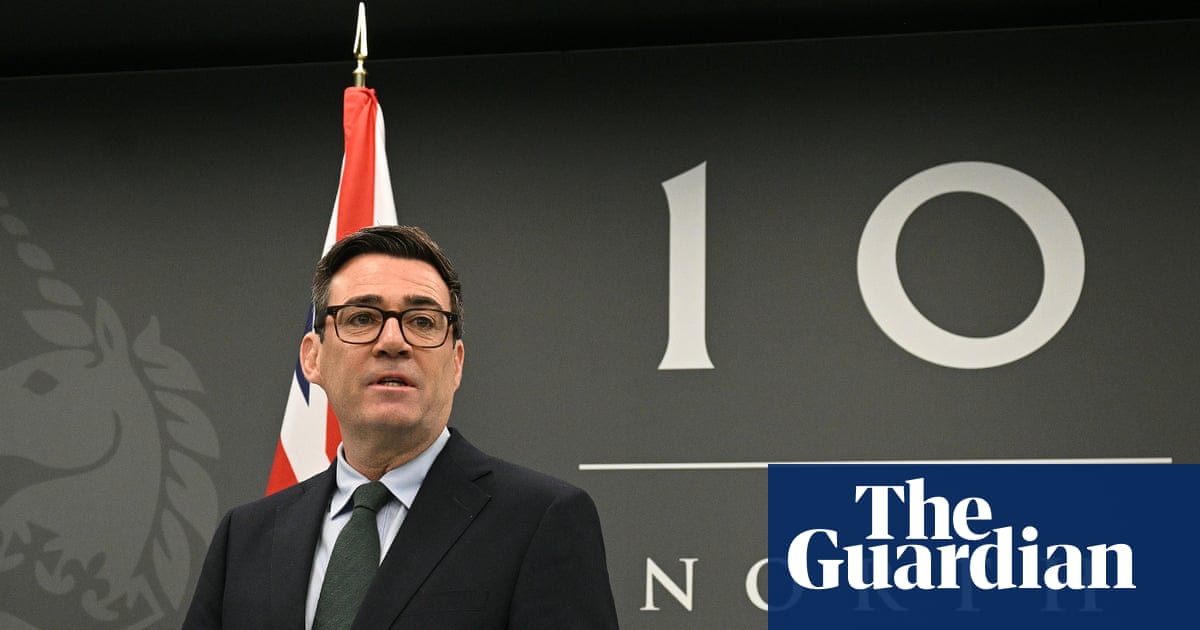
Rafael Behr neatly summarises Andy Burnham’s strengths as a potential leader and he rightly emphasises that he needs a united party behind him (Andy Burnham is playing the long game in an age of short attention spans, 22 July).
He then accurately identifies what Burnham needs to do, but makes no reference to what the parliamentary Labour party needs to do. Leadership is interactional, and Labour MPs outside the government – particularly those (in Behr’s words) with hair triggers on the radical left and those aggrieved Starmer loyalists – have to realise that Labour is in the last-chance saloon here, and they have just as much a role as he does to ensure the success that leads to a second term.
If Burnham is to succeed, there is no place for the kind of self-indulgent social media posts made by Darren Jones on funding for removing VAT on electricity bills, which provide instant fodder for the Tories, Reform UK and the rightwing media. Of course, there will be policy disagreements, but all Labour MPs must find ways to debate these while retaining a fundamental commitment to the success of this new government, given the sceptical mood of the country, and exercising appropriate judgment in the way they express their differences, however sincerely held.
Dr Roger Booker
Clapham, London
If Andy Burnham is looking for ways to fund the cost of living crisis (Andy Burnham urges cabinet to examine ‘all possible ways’ to tackle cost of living crisis, 21 July), why doesn’t he just do the obvious and increase the top rate of income tax which now sits at 45%? During the second world war the top rate was 99.25%; during the Wilson government of the 1960s it was 90%; and it was 83% when Margaret Thatcher became prime minister. Back then high earners mostly lived in the UK, and it was only from the 1980s that high earners such as Rod Stewart and later Phil Collins started bleating about high taxes.
The reduction of the top rate of income tax has not resulted in better compliance, as avoidance and evasion are rife, nor has it boosted enterprise. It has, however, produced a more divided and less fair society that has more millionaires and an alarming number of people struggling with the cost of living. Sadly, and I know it’s early days for Burnham, tinkering with small reductions in electricity bills and fixing bus fares won’t have the required effect.
Raising income tax for wealthier people (not just the super rich) will both ensure a fairer, more cohesive society and increase the funding available for genuinely radical change. I don’t understand why no one appears to be considering this.
Steve Penny
Abergavenny, Monmouthshire
Reading Monday’s Guardian, optimistic about a fresh start with a new prime minister, I suffered abrupt heart-sink on reaching the business section when I saw the headlines (Wessex Water chief pockets above-inflation pay rise despite bonus ban over sewage spills, 18 July; Pay gap widens as UK bosses get 130 times average worker’s salary, 20 July).
What can be done to stop these obscenely avaricious and selfish people from further dividing our country into a nation of haves and have-nots? It is well known that a wide disparity between the pay of rich and poor leads to discontent and unrest. Please, Andy Burnham, introduce a swingeing income tax on earned/unearned income and bonuses in excess of, for example, £1m per annum.
Jane Sutherland
Dry Drayton, Cambridgeshire
Learning that Andy Burnham’s father is unable to understand that his son is the prime minister was one of those moments when the prospect of changing a muddled social care system came very much closer (The Guardian view on social care reform: Andy Burnham is right – this issue must be gripped, 21 July). When the Blair government found it easy to kick the findings of the Royal Commission on Long Term Care into the long grass, some of us involved in campaigning believed that if only someone with power and influence could relate to the issues at a personal level the situation might change.
As the author of the reforms legislated by the Thatcher government said at the time, “Community care is everybody’s distant relative, but nobody’s baby”. Perhaps Burnham’s elevation will mean that this “orphan” will now receive the serious cross-party attention that has eluded it for so long. Until then, those in need of care and their families will continue to be confused, anxious and disappointed by the options open to them.
Les Bright
Exeter
Tom Clark is right that transformative governments have usually been enabled by emergencies (Andy Burnham says he will go ‘faster’ than Starmer. Why is that so hard?, 20 July). Roosevelt, wartime Britain and the pandemic all show that when leaders are honest about the scale of a threat, the public are willing to support extraordinary action.
Yet there is one question his piece leaves hanging: what if the emergency is already here? Extreme heat, flooding, crop losses and mounting pressures on health services, infrastructure and the economy are no longer future risks; they are today’s reality. Yet politically we continue to treat them as isolated policy problems, rather than symptoms of a climate and nature crisis with severe implications for the country.
This is not simply a failure of political courage. It is also a failure of public communication. Democracies can only move at the speed that public understanding allows.
If Andy Burnham wants to govern “faster and bolder”, his first task should not be announcing another initiative. It should be treating the public as adults: explaining honestly the scale and immediacy of the crisis, how it is already driving up the cost of living, and the opportunities that decisive action would bring.
Britain does not lack an emergency. What it needs is political leadership to describe it honestly – and begin building a public mandate for bold national renewal.
Prof Mike Berners-Lee
Chair, National Emergency Briefing
It has been suggested in some quarters that the Burnham premiership will take the country back to the 1970s. Here are just a few of the things that existed then. No food banks, little homelessness, little energy poverty, council houses, rent controls, British industry making things, a funded defence force, water, energy and public transport under the public’s control, and membership of the Common Market.
John Garnham
Ampthill, Bedfordshire