2 months ago
129
2 months ago
129
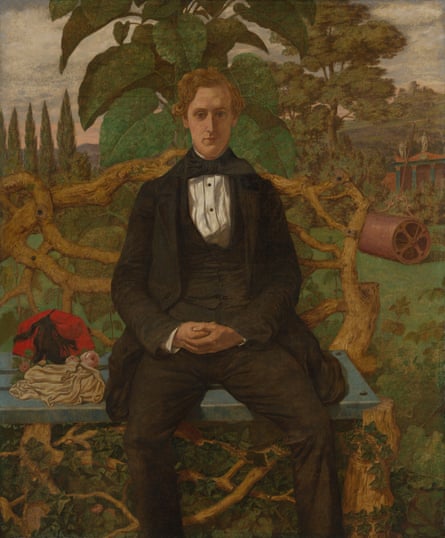
The young man in the garden must be one of Richard Dadd’s fellow patients in Bedlam, you think. His unkempt hair and ruffled clothes are sure indications of a distracted mind as he sits, half his face in shadow, hands nervously clasped, on a fabulously twisted wooden bench surrounded by greenery that’s almost too lush for comfort. Yet the subject of Dadd’s 1853 Portrait of a Young Man is probably the superintendent of Bethlem Hospital, Dr Charles Hood. The painter sees reflections of his own mental state in this frail-seeming young clinician. Patient and doctor are not so different, he suggests. There is the finest of lines between “sanity” and “madness”.
Dadd crossed that line when he murdered his father whom he thought was the devil, then tried to kill a stranger while fleeing to Paris. He was quickly caught and would spend the rest of his life in Bedlam and Broadmoor. But how much does his mental illness explain his arresting, bizarre, sometimes unforgettable images? Is he a kind of Victorian acid casualty whose visions of fairies are the peculiar fruit of his psychosis?
The Royal Academy’s smallish Dadd survey is called Beyond Bedlam and urges us to see him as more than just a “mad” artist. Yes, he spent more than 40 years in psychiatric hospitals where he was judged incurable and where he painted his masterpiece The Fairy Feller’s Master-Stroke, that monstrously magnified corner of an English country garden. But he was already a remarkable artist, with fairies as his hit theme.
These are not cute Disneyfied fairies but the original mysterious beings from British folklore, sinister and destructive, as portrayed by Shakespeare. Dadd’s early painting of Puck has the mischievous sprite personified as a giant baby irradiated by lunar light. In Titania Sleeping, we glimpse, through a parted curtain of bats, nude female fairies. It’s an uneasy adult fairyland. So too is The Haunt of the Fairies in which a female fairy – or is it just a naked woman? – gazes at us against trees silhouetted in the red twilight of a very British landscape.
Then Dadd went on an epic trip to the Middle East, filling his sketchbook with mosques, markets, Egyptian ruins, but what should have been a stimulating escape tipped him into severe paranoia and murder. This was when a promising life cracked open.
When the fairies return to him in Bedlam they are brutally different. His early work is imaginative but visibly influenced by Romantic artists like Fuseli and Runge. But there’s no precedent that helps to understand The Fairy Feller’s Master-Stroke. Painted over a nine-year period, it disobeys the pictorial rules in which Dadd had been educated. When you try to fathom it, your eyes have to pick their way between tall dark strands of grass, daisies, dock leaves that block your view and clog and cramp the picture surface. Only through this tangle can you make out a detailed portrayal of fairy society. The tiny folk are gathered in awe and trepidation to watch the strongest fairy raise his axe to “fell” a horse chestnut to repair Queen Mab’s coach. These fairies are not beautiful or seductive. Two have outsized legs bulging from their pleated skirts. One has a vast bald blueish head.
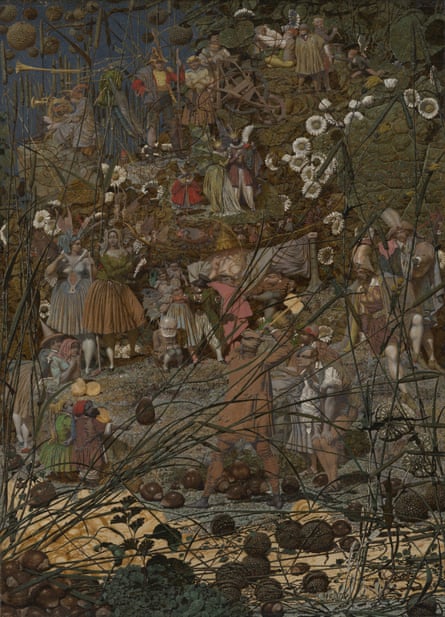
It’s a picture full of conviction and not in any way an entertainment or conscious fantasy. This is what the fairies really look like, says Dadd, showing them to us like natural history specimens observed through a microscope.
Perhaps he offered to show Dr Hood such fairies in a neglected recess of the garden of Bedlam.
You can’t get away from it. Dadd was an interesting artist before Bedlam but became a great one in it – and a modern artist at that. In his own lonely way he overthrows the rules of art, reaching for unsettling new truths akin to those Manet and Whistler were probing, out in the “sane” world. What’s stranger is that within the confines of the asylum he sees nature afresh. Freed from artistic convention, he paints flowers, fruits, weeds with the savageness of their reality. In Bacchanalian Scene, ecstatic, flushed faces are seen through an eerie morass of vegetation.
The RA pointlessly insists on showing some duller works, as if to prove that not everything he did in Bedlam was charged with “mad” genius. But when he was moved to the new Broadmoor hospital his passion for nature was unleashed again. From fantastic fruits to an imaginary mountainous harbour that he designed for the hospital theatre’s drop curtain, these late watercolours have an ethereal, profoundly sad beauty.
You can’t escape the tragedy of a gifted artist who spent so much of his life locked up, albeit in more liberal conditions than our stereotype of Victorian asylums might lead you to expect. But Dadd can’t be turned as art historians long to into a mainstream artist who just happened to be in Bedlam and Broadmoor. Thank Titania. For pitiable and painful as his life was, he cut through the weeds to see what others couldn’t: monstrous tiny creatures in the grass, ecstatic revels in the evening fields. Shine on, you crazy Victorian.