2 months ago
126
2 months ago
126
When her son, Hugo, failed to answer his phone on the morning of 12 July 2005, Isabel Miranda de Wallace did not waste a moment. Everyone knew that kidnappings were rife in Mexico City, and Wallace immediately enlisted her brother and nephew to help with the search. They walked the streets near Hugo’s last known location until they came across his SUV. A passerby told them they’d seen someone being forced out of his car and into a nearby apartment, Wallace later said. She also described speaking to a boy who had heard gunshots and seen an injured man being led out of the apartment around 4am. “Within 24 hours, we found his car, then the building where they took my son. We had the case practically solved,” Wallace later said. “But the police didn’t believe us.”
At that time, many kidnapping cases went unreported, as families feared that the police couldn’t be trusted. Those who did go to the police often struggled to get them to take their complaints seriously. But Wallace was different. She was a successful businesswoman, who had set up an advertising agency that owned and operated billboards across Mexico City. “She didn’t beg or say please,” said Federico Döring, a politician and an early ally of Wallace. “She would point her finger at public officials not doing their job – and this was unheard of,” Döring told me. “In Mexico, a lot of people are often afraid to speak up because you don’t know if a politician is in bed with the cartels. That intimidates them, but it didn’t intimidate her.”
At 35, Hugo was a fast-living rich kid with a passion for motorbikes, American football and chasing women. He was Wallace’s first son and he was used to getting his way, his ex-girlfriend Vanessa Bárcenas told police. In the years before his disappearance, he had distanced himself from old friends and appeared to be using drugs, Claudia Muñoz, another of Hugo’s former girlfriends, told me. Hugo had other problems too. He had told Bárcenas that some of the suppliers for a clothing business he owned had ties to “something like drug trafficking”, which had created problems for him with the police and made him a target for kidnappers. According to Bárcenas and Muñoz, after a run-in with gang members, Hugo started driving an armoured SUV and installed cameras at his home in a gated complex.

When the police investigation into Hugo’s disappearance stalled, Wallace took up the case herself. With remarkable speed, she obtained Hugo’s phone records and the names of people he spoke to in the hours before his disappearance. It is not uncommon for families to conduct their own investigations in Mexico, but Wallace’s family took this to new levels, hiring private detectives and surveilling targets round the clock. Yet no breakthrough arrived. None of the occupants of the apartment block where Hugo was allegedly taken reported hearing any disturbance. The witnesses Wallace and her family cited in their testimony were never found.
From the start, Wallace insisted that the case be investigated as a kidnapping linked to organised crime. Yet without hard evidence, it seemed that Hugo’s disappearance would be relegated from a federal crime to a state-level inquiry, which Wallace feared would go nowhere. In interviews, she portrayed herself as a simple mother navigating an impenetrable system. The pain of a woman searching for her missing son resonated with the public, and Wallace was able to use her popularity to gain institutional support.
Through her contacts, she pushed for the case to stay open. Marta Sahagún, the wife of President Vicente Fox, wrote to prosecutors asking them to support the investigation. Döring arranged meetings with the head of the federal police and later the senior prosecutor responsible for kidnapping investigations. “I was really struck by how she just entered the prosecutor’s office like it was her own home and started giving orders,” her ex-husband, Carlos León, later said.
Wallace became a hero to a nation angered by rising crime, police incompetence and pervasive corruption. She channelled that rage, publicising her fearless hunt for the suspects who, she said, represented the moral decay of Mexican society. “She was almost like a Batman figure,” said Ricardo Raphael, a journalist who interviewed Wallace and has written extensively about the case. Wallace’s message was clear: she would stop at nothing to bring her son’s kidnappers to justice.
On 10 January 2006, police made their first arrest in connection with Hugo’s disappearance – and Wallace was right by their side. The suspect, Juana Hilda González, was a 30-year-old professional dancer who lived in the apartment where Wallace believed her son had been kidnapped. Although González denied any involvement, and offered an alibi, police were able to hold her in custody for up to 40 days without charge, thanks to arraigo, an emergency legal measure that gives police expanded powers in organised crime cases (though in practice this limit is often exceeded). “If you are indicted for organised crime, you lose all of your procedural rights,” the defence lawyer Salvador Leyva told me.
For Hugo’s kidnapping to be treated as a federal case, investigators had to ascertain that the suspects were part of an organised crime group that had committed multiple offences. In the weeks and months after González’s arrest, Wallace placed billboards across the city, featuring photos and full names of suspects and offering rewards of up to 250,000 pesos (£12,000 at the time) – more than double the then annual average Mexican salary – for information on their whereabouts. One billboard showed a photo of González’s boyfriend, Cesar Freyre, over the words: “Kidnapper. If you were the victim of this criminal, report him!” In a documentary later made about the case, Wallace herself said: “No one had ever dared to accuse a kidnapper publicly before – much less using their full name. Neither the Mexican public nor the press could have imagined it.”
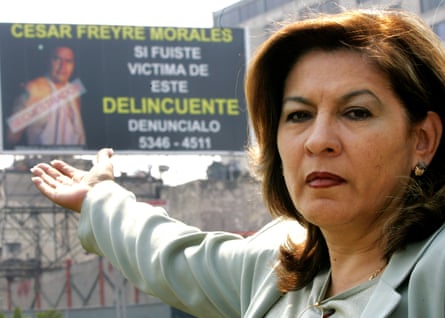
It wasn’t long before Freyre was caught. In late January 2006, news cameras arrived on a dark street in Mexico City where police had apparently just arrested him. Wallace told reporters that she and her brother had located, followed and subdued Freyre, managing to get a passing police patrol to arrest him just before he was able to draw his gun and shoot them. Leading national papers dubbed Wallace “Madre Coraje”, Mother Courage. One veteran TV host called her a “lioness”. Mexico City’s then secretary for public security declared that she should receive a prize for her bravery. Wallace retold the story of Freyre’s capture on countless talkshows.
Just like González, Freyre denied all charges. Then, on 8 February 2006, came an unexpected development. González confessed, and named five others, including Freyre and a woman called Brenda Quevedo, as part of the plot. It was a kidnapping that had gone wrong, she said. She had lured Hugo to her apartment under the pretence of a date, but a struggle ensued in which he had died. The would-be kidnappers had photographed his body in the hope of claiming a ransom. Then they dismembered the corpse with an electric saw in her bathroom sometime after 3am, and disposed of the remains.
After the confession, the case moved quickly. Police returned to González’s apartment, seven months after the first search had turned up nothing. This time they found evidence that seemed to confirm the prosecution case: an expired driving licence belonging to Hugo and a single drop of blood which matched samples given by Wallace and her husband.
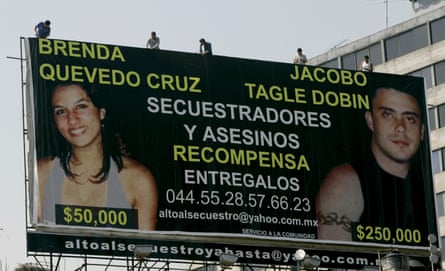
Although they had not found his body, investigators concluded Hugo had died in the apartment. Wallace placed new billboards across the city displaying the faces of the suspects, publicly branding them kidnappers and murderers. Within a few weeks, two more suspects were in custody. Several relatives of the suspects were also arrested and held under the arraigo system and later accused of forming part of the alleged kidnapping gang. Some of them remained in custody for years.
Wallace had achieved something most relatives of victims could only dream of. She cared little for niceties: she bragged about slipping cash to anyone who might have information, including police officers. As for the billboards, they were almost certainly illegal, being defamatory and violating the presumption of innocence. But few seemed to care. “The press saw this as incredible bravery on [Wallace’s] part, to accuse kidnappers in such a public forum,” said Ambar Treviño, the defence lawyer for several of the accused. In a flattering profile in Reforma, an influential Mexican daily newspaper, Wallace cast herself as an avenging vigilante: “If I have to become a killer to find my son,” she said, “I’ll do it.”
At the time of Hugo’s disappearance, Brenda Quevedo had been visiting her family in Mexico City. She was in her early 20s and home for what was meant to be just a few months before she returned to London, where she had lined up a job as a PR manager at a consulting company. During those months, she met Jacobo Tagle, a handsome car dealer, who happened to be friends with Hugo. She and Tagle soon became an item.
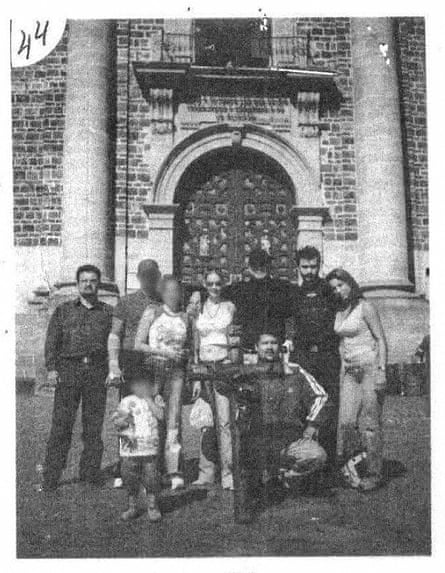
In 2005, just a few weeks after they met, Quevedo joined Tagle and a group of friends, including González and Freyre, as well as two brothers, Tony and Albert Castillo, for a day trip. They drove a few hours out of the capital to Chalma, a popular Catholic shrine, to pay tribute to Freyre’s brother, who had died the previous year. They posed for a photo in front of the church, smiling, with their arms around each other. Prosecutors came to believe that almost everyone in the photo was involved in Hugo’s disappearance. (The only one who was not a suspect was a young child.)
A year after the photo was taken, on 26 February 2006, Quevedo was visiting family with Tagle a short drive from Mexico City when her aunt called, sounding upset. “Come quickly, and come alone. Don’t bring Jacobo,” her aunt told her. Quevedo was shaken to learn that her mother and teenage brother had returned home to find dozens of armed federal police turning over every inch of the family home and asking where she was.
Hugo’s case was becoming a public story, but Quevedo had heard nothing about her boyfriend’s friends being arrested, she said. Upon learning that police were looking for them, her first thought was that Tagle was mixed up in something bad. She called him, demanding answers. It was possible one of the cars he had sold may have been stolen, he said. Quevedo wanted to go to the police station together to clear things up, but he refused. Quevedo left town immediately, and went to stay with an aunt in Guadalajara, a six-hour drive away.
Through a lawyer, she learned more about the investigation. She barely knew Tagle’s friends. Now they were implicated in the disappearance of his friend Hugo, and so was she. Some of the group – including González and Freyre – were already in custody. Soon Albert Castillo would be arrested, and allegedly beaten and tortured to force a confession. His brother Tony was next and alleged similar abuse. By April 2006, the only suspects who had not yet been arrested were Tagle and Quevedo herself.
From her aunt’s house, she watched, horrified, as Wallace appeared on the news, day after day, accusing Tagle and others of killing Hugo. When Quevedo saw on the news her own face on a giant billboard, with the words “kidnapper” and “killer”, she crawled under the bed and sobbed, she told me.
With so much publicity, Quevedo realised she wasn’t safe in Mexico. She took scissors to her waist-length hair and began cutting. With each snip she felt as if she was leaving a part of herself behind. She got a fake ID, and took a new name: Nadia, from “nadie”, or no one. With $200 cash, some baggy clothes, a Bible and a phone with only one number saved – that of distant relatives in Kentucky – she travelled north. From a cramped safe house on the US border, she and a dozen others were herded across the rushing waters of the Rio Grande by people smugglers. From there, they crossed the desert on foot and in pickup trucks.
After a month, Quevedo reached the suburban sprawl of Louisville, Kentucky. It was too risky to speak directly to her parents or brother, but Quevedo received news through her extended family. When no one was around, she would go online to read about the Wallace case, as it was known. In her absence, she had become an object of morbid fascination for the press. In an error-riddled book about the case, for which Wallace wrote the foreword, a journalist described Quevedo’s physical appearance in vivid, lingering detail, portraying her as a femme fatale. Later coverage used a photo of Quevedo attending a Halloween party to suggest, implausibly, that she dressed as a bunny rabbit to sell drugs. “They claimed I was someone who made it her business to seduce men and lure them into a trap,” Quevedo said.
In Louisville, Quevedo found work as a waitress in a Cuban restaurant. She told no one about what she was running from. One day, at work, she met a customer named Fernando López, who was in the US military. He later returned to the restaurant with flowers, and soon after they began dating. A year later, López took her on a hot air balloon trip. As they rose above the clouds, López reached into his pocket for the ring which he placed on the finger of the woman he knew as Nadia.
For a brief moment, it seemed Quevedo might be able to start again. “I checked the news, waiting for the day when they would announce that the real culprits had been caught. I thought it would all be over,” Quevedo said. “But it never happened.”
In the years after Hugo’s disappearance, Wallace became a fixture on the nightly news. For the media, the story of a humble mother turned dogged investigator was irresistible. In 2006, the New York Times ran a piece about her under the headline “A Mexican mother turns detective, driven by devotion to her kidnapped son”. In Mexico, where she was known as La Señora Wallace, people would stop her in the street for autographs or to wish her luck. By 2007, she had signed a deal with Ricky Martin’s publicist, and there was talk of making a film about her life.
Hugo’s body had never been found, and homicide charges were never filed, but after González’s confession was made public, mainstream media largely accepted the prosecution’s case, despite the fact that all the defendants, including González – who had retracted her confession, claiming she had been tortured – insisted they were innocent. In April 2006, criminal proceedings began against Freyre, González and the Castillo brothers, who were all charged with kidnapping and belonging to an organised crime group. (Freyre and González were also charged with possessing weapons reserved for security forces.)
To most lawyers, it seemed that representing the four defendants would be a losing battle. But when Ámbar Treviño, then a thirtysomething criminal lawyer with a short bob of curly hair and a wry sense of humour, looked into the prosecution’s evidence, she felt compelled to take up the case. She quickly learned that the press wasn’t interested in the defendants’ version of events. “Individual liberty and due process isn’t exactly a narrative that captures the public’s attention, especially at a time when people are angry and beset by crime,” she told me.
Treviño argued there were glaring weaknesses in the prosecution story. In the early months of the investigation, Wallace had emphasised the accounts of eyewitnesses who allegedly heard gunshots and saw Hugo leaving the apartment injured. Following González’s confession in February 2006, the story shifted. Now the prosecution claimed that Hugo had died in the apartment of a heart attack, and the assailants had disposed of the body. The eyewitness accounts were no longer mentioned. Meanwhile, the suspects, as well as their family members, reported being pressured by prosecutors to change statements. Key witnesses changed their evidence, many later alleging that they, too, had been pressured by prosecutors.
At the time, Mexico’s justice system afforded prosecutors near-exclusive control over evidence and its framing. It was not uncommon for judges to issue a verdict based almost entirely on the prosecution case, while many of the accused claimed they never had a chance to be heard. After defence and prosecution had submitted evidence and witness statements were taken, the judge would move to written deliberation. And while, by law, criminal proceedings should last no longer than one year, in practice they often went on much longer.
In the case of González, Freyre and the Castillo brothers, it would take almost four years before the judge handed down his verdict. “If Mexico did not exist,” Treviño said, “Kafka would have had to invent it.”
In January 2007, a few weeks after a new government had taken power, Wallace, trailed by TV cameras, led a group of relatives of the disappeared – victims of forced disappearances in the conflict between warring drug cartels and the state – to the gates of the presidential palace to demand an audience with the president. A few days later, President Felipe Calderón met with Wallace. The meeting lasted more than an hour and the president took notes while she spoke, Wallace later boasted. Calderón ordered his attorney general to give her any assistance she needed in tracking down Brenda Quevedo and Jacobo Tagle, the two suspects who were still on the run. Their faces were soon plastered on police cars across Mexico City and international warrants were issued for their arrest.
From the US, Quevedo was following news of the case while attempting to build a new life for herself. In late 2007, she was still working as a waitress in Kentucky when she noticed two men in suits sitting at a table. There was something off about them, she thought. They had been there for half an hour and had yet to order food. As she started to panic, Quevedo’s manager called her over, his face drained of colour. The FBI were looking for her, he said. She was arrested in front of her colleagues, and led away in handcuffs. Quevedo didn’t know it at the time, but Wallace was nearby. She had travelled to Kentucky for the arrest.
Quevedo’s fiance, López, was at home when he got a call from the FBI saying she was in their custody. He could speak to “Nadia”, but only in English, they warned him, otherwise the agents would assume they were conspiring. López knew right then this was not simply an immigration issue, he told me.
Nadia began by telling him her real name. Then came everything else – the allegations, the billboards, the manhunt. López’s head was spinning. Afterwards, he spoke with Enriqueta Cruz, Quevedo’s mother, who shared with him the evidence she had amassed about inconsistencies in the official narrative. “I didn’t feel betrayed because once I understood everything, I saw that she was in real danger, and that she feared for her life,” López told me. Soon López and Cruz met in person, and together formed a support group for Quevedo. López was struck by Cruz’s courage and resilience, despite the toll it took on her health and finances. “If she could have sold her skin for her daughter, she would have done it,” López said. (After getting married while she was in prison, Quevedo and López divorced in 2009.)
For the next two years, Quevedo was moved between jails across the US as she fought extradition. She was the only defendant in the Wallace case with a university education and a clear understanding of her own rights, and she argued she would face torture if she returned to Mexico. In 2009, she was finally extradited, after the US court received assurances from the Mexican federal prosecutor’s office that her rights would be guaranteed.
When the plane door opened at Mexico City airport on 25 September 2009, the first thing Quevedo saw was the flash of cameras. Handcuffed, in an orange jumpsuit, she was led across the tarmac flanked by armed police in tactical gear. “It was like I was Chapo Guzmán,” she told me, referring to the infamous drug lord.
After processing, Quevedo was taken not to jail but to a room where she found herself face to face with Wallace for the first time. According to Quevedo, Wallace gestured to a seat near her and told her that they were going to make a deal. Wallace – who was recognised as a victim of Hugo’s kidnapping but held no official judicial role – offered Quevedo a reduced sentence if she testified against the other defendants and helped them find Tagle. Quevedo refused.
By this point, Wallace had become one of Mexico’s most prominent anti-crime and victims’ rights activists, a powerful position in a society in which violence had exploded since the start of the “war on drugs” in 2006. The murder rate surged by 260% between 2007 and 2010. Cartel executions, beheadings and the discovery of mass graves were increasingly common. Through her NGO Alto al Secuestro (Stop Kidnapping), Wallace published her own statistics for kidnapping and murder rates in Mexico, which often exceeded official figures and embarrassed governors. “They were scared of her. And they hated her for it,” said Samuel González Ruiz, a former head of the prosecutor’s specialist unit against organised crime and later personal adviser to Wallace for more than 15 years. Wallace was “hard-nosed, ruthless”, González Ruiz said. She advocated directly for families of victims, among them members of the business elite. “And when Isabel spoke to the anti-kidnapping unit, you can believe they listened,” González Ruiz said.
The day after being returned to Mexico, Quevedo was taken to Santiaguito, a state prison 90 minutes outside the capital. She says that, on 27 November 2009, she was taken to a room where two men waited, wearing balaclavas. They blindfolded her and tied her to a chair, then began to strike her head, asking her where Hugo’s body was. According to Quevedo’s account, they suffocated her with a plastic bag. After they were disturbed by guards, the men left.
A year later, in October 2010, Quevedo was transferred to Islas Marías, a remote prison island in the Pacific usually reserved for convicted detainees. Shortly after arriving, she was driven to an isolated building facing the sea. The following day, according to her account, around five masked men appeared. For hours, Quevedo said, they used electrocution, waterboarding and sexual abuse to make her confess and incriminate her co-defendants. They threatened her family. They knew about her mother’s recent surgery, her brother in Canada, everything. (Both federal prosecutors and the CNDH, Mexico’s national human rights body, initially dismissed Quevedo’s claims, citing insufficient evidence. But a later review revealed that the CNDH had disregarded its own internal psychiatric evaluation from 2011, which had already documented indicators of torture against Quevedo. Her allegations were also corroborated by a medical report issued in 2022 and by consistent testimony from three family members. In a report by a UN working group, the Mexican government did not contest the allegations of torture against Quevedo.)
Quevedo was held in isolation, unable to contact her family, and deprived of medical treatment. After a week, she managed to pass a note and a phone number to an inmate. Hundreds of miles away in Mexico City, Brenda’s parents received the news that their daughter was in an island prison where she had been tortured.
In the years since federal agents had raided her home, Cruz had reorganised her life to support her daughter and help her son get asylum status outside Mexico. Softly spoken, the years of struggle etched on her face, Cruz had sold the family apartment and moved in with relatives in 2008 to pay mounting legal fees in her daughter’s fight against extradition. (Cruz and Brenda’s father are separated.) Brenda’s brother had fled to Canada, after being assaulted by men who said they had been hired to look for his sister. “We were pariahs. Even being related to those accused condemned you,” Cruz told me.
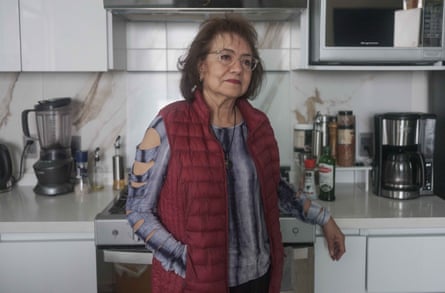
When she received the news from her daughter, Cruz was inconsolable. It came not long after a court hearing in which Cruz had questioned the story around Hugo’s disappearance and pointed to evidence that he himself had been in trouble with police. Cruz was convinced the torture was meant as a punishment. “It was clearly revenge,” she told me.
Still, Cruz kept filing complaints to the prosecutor’s office and the CNDH – which was tasked with investigating torture claims – most of which were dismissed. At the same time, she started looking further afield, to international human rights organisations outside Mexico, beyond Wallace’s influence.
“I cried every time I saw a complaint dismissed,” Cruz said. “Then, when I was done, I said to myself: What can I try next? What haven’t I done yet?”
On 24 December 2009, the verdict in the trial of González, Freyre and the Castillo brothers was finally delivered. All four were convicted of aggravated kidnapping and organised crime offences. Their sentences ranged from 28 to 47 years. In Wallace’s view, this was too lenient. Over the next few months, she met with members of the supreme court and held an event calling for the death penalty for kidnappers. The sentences were finally set by a federal appellate court at 78 years for González, 131 years for Freyre and 93 years for the Castillo brothers.
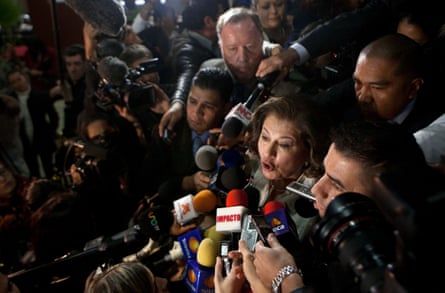
In late 2010, the final suspect, Jacobo Tagle, was arrested in a satellite city on the outskirts of Mexico City. He had been living under a false identity for years, disguising himself with false teeth and wigs. After his arrest, Wallace called a press conference in which rifle-wielding police paraded Tagle before the media. “Now I’d like to invite the press, who have always been so supportive, to take note that Jacobo has not been beaten. Because it is so common for people, once they are in front of a judge, to later claim to have been tortured,” said Wallace, directing the police to lift his shirt for the cameras. Then she addressed the suspect directly. “Jacobo, I’m now going to ask you to confirm what you said yesterday about the role of all of the accused – Brenda Quevedo Cruz, Cesar Freyre Morales, the Castillo brothers, Juana Hilda [González] and you, in the kidnapping of my son.” Tagle, his hair greasy, gaze vacant and voice barely audible, assented.
Less than a fortnight later, President Calderón awarded Wallace Mexico’s top human rights prize. “Her story is one of pride, courage and dignity, and serves as an example to all of us,” he declared.
Wallace was now firmly at the centre of national security policy. She met with supreme court judges, attended meetings usually reserved for top officials and helped allies get elected to oversee the CNDH. Wallace also weighed in on legislation. She became an increasingly useful voice of support for the government. In 2011, when protesters demanded the resignation of Calderón’s security chief, Genaro García Luna, Wallace publicly defended his record. The following year, Calderón’s party picked Wallace to be its candidate for governor of the Mexico City region, one of the most important jobs in the country.
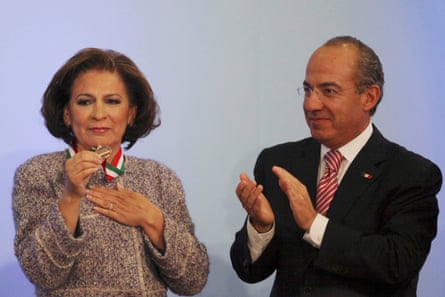
Mexico’s national human rights award in 2010. Photograph: Alexandre Meneghini/AP
Her entrance into electoral politics brought Wallace her first real taste of press scrutiny. During the campaign, it was revealed that she had been arrested in July 1998 after a violent dispute with officials who were trying to remove three of her company’s billboards, which had been deemed unsafe. Wallace, assisted by a man matching Hugo’s description, had reportedly cut the cables of a hydraulic crane that was removing the billboards, before trying to flee the scene. (Wallace had spent several days in jail for resisting arrest, though she was eventually acquitted.) After a bumpy campaign, she finished in third place with 13% of the vote, a historic low for the party.
Although she had failed to win office, Wallace retained access to allies within the highest levels of government. In 2016, at an event about miscarriages of justice, she presented Calderón’s successor, Enrique Peña Nieto, with a birthday cake, and led the crowd in a rendition of Mexico’s happy birthday song, Las Mañanitas.
In 2010, five years after Hugo’s disappearance, the Wallace case was still working its way through the courts. González, Freyre and the Castillo brothers were appealing against their conviction, while the case against Tagle and Quevedo was still in the investigation phase. There seemed little hope for the defendants. The few journalists, lawyers and activists to publicly defend the accused had faced a vicious backlash.
Soon after the first sentence was handed down, the defence lawyer Treviño had, after years of dogged work, reluctantly withdrawn from the case. It began with death threats, she said. Then a group of masked men with assault rifles broke into her home. Shortly after, authorities detained her. The allegations were almost comically trivial: Treviño had submitted a medical note excusing her from a hearing because of back pain, but contrary to requirements, the note came from a doctor who had not examined her in person. At Treviño’s first hearing before a judge, the charges were dismissed.
Treviño had never been naive, but she still found herself shocked by what she saw as the power of Wallace and her allies in the prosecutor’s office to go after anyone who stood in their way. She had spent a total of two months in custody for not having obtained the proper paperwork relating to a minor medical condition. “I’m the smallest grain of sand in the desert in this whole story, and this is what they did to me,” she said. “You genuinely fear what the state is capable of.”
This was exactly the kind of cause that animated David Bertet, head of a tiny Canadian NGO working on wrongful convictions. He came across the case in 2010, when he met with Wallace in a downtown Mexico City restaurant to discuss a separate case. She was forthright, though not unpleasant. But Bertet left the meeting troubled by what he saw as Wallace’s belief in her ability to determine guilt by gut reaction. Soon after, he began hearing stories about people who had been detained or threatened after criticising her.
Bertet decided to look at Hugo’s case himself and, almost immediately, he found inconsistencies. Bertet’s day job was teaching college philosophy, but he spent his spare time chugging energy drinks and reading the case file. “It amazed me how easy it was to find things that clearly did not add up,” he recalled. Yet the Mexican authorities seemed uninterested in re-examining the Wallace case. “There was one version, and that could not be undermined,” Bertet said.
For several years progress was slow. Then, in 2014, as Bertet and a colleague scanned through Hugo’s documents, they realised the missing man had multiple identities and several birth certificates, issued years apart and listing different fathers. Bertet was aware that DNA from a drop of blood found in the flat had been key to the investigation. It had placed Hugo at the flat on the night of his disappearance. But if Hugo’s parentage was in question, Bertet realised, so was the DNA evidence that underpinned the prosecution’s case. “It was exciting,” Bertet recalled. “And at the same time it was like, fuck, it’s actually true.” Now he had to decide how to use it – and anticipate Wallace’s response.
As a child, Quevedo’s hero was her father. A strong-willed lawyer who loves to debate, he would push her to express herself precisely and know her rights. He encouraged her to be independent and adventurous. Her mother, who worked as an administrative assistant at a bank, was a quieter presence. With his legal background, Quevedo’s father, Roberto, initially led efforts to organise his daughter’s defence. But, particularly after his health deteriorated, it was Enriqueta Cruz who would become her daughter’s most implacable champion.
In June 2019, Cruz arrived at the public defender’s office in Mexico City, which had just opened a new unit to tackle the widespread use of torture in criminal investigations. There she met Salvador Leyva, a 28-year-old public defender. He was a teenager when Hugo had disappeared, and like many of his peers he had grown up seeing Wallace as a national hero. But when he met Cruz, he was struck by her humility and the obvious toll the case had taken on her. “She wasn’t asking for anything; she just wanted someone to listen,” recalled Leyva. In the weeks that followed, he travelled the country’s prisons, interviewing the four people convicted, as well as Tagle and Quevedo. He pored over hundreds of thousands of pages of evidence. Later, he spoke to Bertet, who pointed him to the doubts around Hugo’s paternity.
To Leyva, one of the things about the prosecution case that did not add up was the discovery of Hugo’s DNA in the apartment where he had supposedly been murdered. In a combative 2018 television interview, Wallace had insisted that her second husband, José Enrique del Socorro Wallace, was Hugo’s father. Watching from his home, Wallace’s first husband, Carlos León, was galled. He contacted journalists to insist that Hugo was his son, throwing into doubt the central forensic evidence of the case: a single drop of blood found at the scene of the crime, which matched both Wallace and José Enrique.
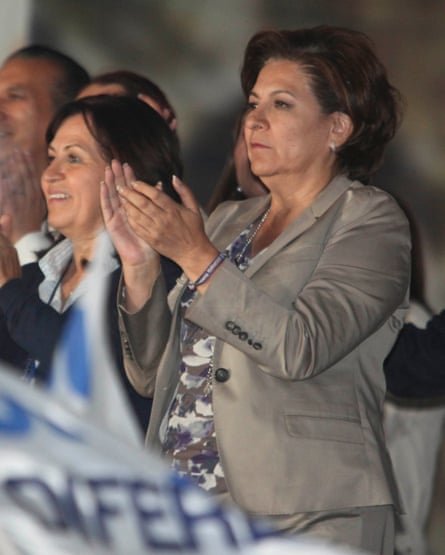
In October 2019, DNA tests confirmed that Wallace’s first husband was telling the truth. Hugo really was his son. But in that case, why had a blood sample found at the scene of the crime been shown to match her second husband, rather than her first? In the early days of the investigation, León told a judge in May 2021, Wallace convinced him to give a DNA sample, but when she handed the DNA sample to prosecutors, she told them it came not from León but from José Enrique. By doing so, Wallace ensured that any tests of Hugo’s DNA would match her and the man she claimed was his father, her second husband. For Bertet, this small, unnecessary lie was an act of hubris on Wallace’s part, and one that would ultimately undermine the whole case. “She was too self-confident and she believed that it wouldn’t ever come to light,” he suggested. “Or that if it did, no one would care.”
Then, in April 2021, Leyva found that the apartment where Hugo had purportedly been killed had not been secured by police for the seven months between the first and second search. Not only that: it had been rented in the interim to a new tenant – a man who happened to work for Wallace, and later married into her extended family.
Since the case’s inception, the accused and their families had maintained their innocence. A few dogged journalists such as Anabel Hernández and Guadalupe Lizárraga had argued the case against defendants was fabricated. But now there was compelling witness testimony from Wallace’s ex-husband saying that she had tampered with evidence, and strong circumstantial evidence that the key physical evidence could have been planted.
In July 2021, Leyva filed a criminal complaint against Wallace, accusing her of lying under oath and fabricating evidence by allegedly renting the apartment to plant the blood sample and later falsifying the DNA submission to ensure it matched. It followed an earlier complaint lodged by his office naming those it said were responsible for torturing Quevedo: more than a dozen officials – and Wallace, for allegedly ordering it. Now, for the first time, Wallace’s role in the case was being investigated.
Wallace still wielded considerable power. And she was far from the only person whose reputation was intertwined with the theory of Hugo’s kidnapping. A whole cast of career prosecutors and politicians had supported her cause for years. This began to change in 2020, after a UN group that works on cases of arbitrary detention called for Quevedo’s immediate release, citing allegations of coercion and failure to investigate claims of torture. “That completely changed how the media treated the case,” Leyva said. “Media that had never spoken about this case from the victim’s perspective started doing so.”
In 2022, Mexico’s supreme court took up an appeal against the conviction of González, who was now 16 years into her 78-year sentence. Her lawyers argued that her confession had been obtained through torture. Wallace struck back by accusing the then president of Mexico’s supreme court, Arturo Zaldívar, of accepting bribes to review González’s case. Zaldívar told reporters: “If she is capable of falsifying evidence and making complaints against the president of a court, what wouldn’t she have done to defenceless people when she had total power and enjoyed the protection of [former presidents] Fox, Calderón and [former security chief] García Luna?” (Neither Calderón nor Fox responded to requests for comment for this article.)
Wallace’s political influence was fading. After the election of leftwing populist Andrés Manuel López Obrador in 2018, she no longer had the same close ties to the presidency. Meanwhile, the powerful figures Wallace had allied herself with were now in trouble. In 2023, García Luna was convicted by a US court of working with the Sinaloa cartel. García Luna had overseen the federal police force that began the investigation into Hugo’s kidnapping, then later the prosecutors who developed the case, and the federal prison system in which Quevedo and her co-accused were allegedly tortured.
Amid the slow drip of revelations, many Mexicans were coming to see Wallace not as a critic of a corrupt system but as an example of its worst excesses. In October 2022, on Wallace’s instructions, billboards appeared across Mexico City plastered with confessions made by some of the accused, even though there was strong evidence that the statements had been made under torture. (A judge quickly ruled the billboards illegal, and ordered them to be taken down.)
A few weeks later, in another attempt to control the narrative, Wallace opened a pop-up “Wallace case” museum in Mexico City. Using mannequins and stage sets, the exhibit recreated key scenes from the prosecution’s case, including Hugo’s death itself. In one room, a video of Tagle taken during a police reconstruction played in the background. Onscreen, in a confession he had retracted soon after, Tagle explained how they dismembered the body. Nearby, a blindfolded and bound mannequin representing Hugo in his final moments lay on a mattress. “You will see for yourselves how the narrative told by those responsible for this crime is false,” Wallace said of the exhibit. “They were never tortured or coerced in any way, nor were any of their rights violated. And in fact they confessed spontaneously.”
Some 16 years after first being hailed a hero by the media, Wallace’s promotional efforts were largely ignored. At the exhibition, a text message from Hugo to his mother on the night of his disappearance was displayed on a wall. “I’m going into the cinema, Mum,” it said. “I’ll call you when I get out.” The message was followed by a string of emojis. No such message had ever been filed in evidence, and even more strikingly, the emojis in question had not been introduced in 2005, when the message was supposedly sent.
When the judgment from the supreme court finally came, it was damning. On 11 June 2025, it ordered Juana Hilda González’s immediate release after nearly 20 years in prison, ruling that her confession was obtained through torture, and that “there is not a single piece of evidence directly linking Juana Hilda to [Hugo’s] disappearance”. The court added that because González had been characterised as a bad mother and an ambitious woman, she had received a heavier sentence, and that this gender stereotyping constituted an additional violation of her rights. The court also threw out all the evidence that derived from her coerced confession, including the controversial second search of the apartment, which found the blood sample and Hugo’s expired driving licence.
Yet the supreme court decision did not lead to the immediate release of the five other people implicated in Hugo’s disappearance, even though they were partly convicted on the basis of González’s coerced confession. The decision merely opened the door to review of their cases. In the meantime, they remain in detention.
Wallace did not live to see the collapse of the case she had built. Three months before the judgment, she died after suffering complications following surgery. Her funeral was private, and little is known about the circumstances of her death.
Many of Wallace’s former allies and advocates see her as the victim of a politically motivated witch-hunt. After her death, one of the country’s leading broadcasters condemned what he said was the left’s “perverse vilification” of Wallace. Calderón and a host of senators and political heavyweights offered their condolences. Samuel González Ruiz, her former adviser, claimed Wallace was targeted in retaliation for exposing corruption and her aggressive, sometimes misguided campaigning in several complex, politicised cases. “Those cases enraged them and that’s the reason they fabricated these accusations against Isabel Wallace,” he told me.
While most of Wallace’s supporters reject claims that she fabricated evidence, some concede that she sometimes acted outside the law. “Isabel did things that, to be honest, don’t align with human rights – because in her desperation, she had to do what the government wasn’t doing,” the conservative politician and ally Döring said. “She lost her faith in government, she lost her faith in justice. And she carried out justice herself.”
Wallace always categorically denied the allegations against her. She refused to answer questions about Hugo’s parentage, saying it was a personal matter. The organisation she founded, Alto al Secuestro, now headed up by her family’s lawyer, declined my requests to answer questions about Wallace or her work. “Neither the family, her former employees or anyone from the NGO [is] interested in giving interviews,” it said. Mexico’s prosecutor’s office did not respond to requests for comment.
Even from beyond the grave, Wallace continued to push her story. In a letter published posthumously, she predicted the supreme court decision would go against her, saying it was part of a plot. “I know that sooner or later those trying to free my son’s kidnappers will get their way,” she warned.
More than 20 years after Hugo disappeared, his body has still not been found. But from the early days of the investigation, Treviño had insisted there were signs that the story Wallace was telling about Hugo didn’t add up. Nine days after he disappeared, his bank card was used several times: to pay for a seafood meal, for a purchase in a department store and for a paintballing game. A few months later, a payment was made on another of his cards, this time to a dating site. In May 2006, one of his friends and her partner went to the police to report being contacted multiple times by Hugo and later meeting him in person after his disappearance. They later claimed their statements were ignored by prosecutors.
Police efforts to track calls made from Hugo’s multiple phones after his death also turned up intriguing results. After being contacted by investigators, one recipient of these calls pointed police to a strange answerphone message they had received from an unknown number at around 3am three months after Hugo’s disappearance. The caller, whom multiple listeners identified as Hugo, said: “I’m sick of this shit, man. Yeah, I know I messed up, but honestly? I don’t give a damn. I’m out here drinking, man – look at me. Whatever. You know what? You know who screwed me over?” But these oddities were brushed over by the media and the legal system.
Last year, on the request of some defendants, Claudia Muñoz, one of Hugo’s former partners and the mother of his child, gave a deposition at a consulate in the US. She spoke about a phone call she received almost two years after Hugo is presumed to have died. “When he called, I couldn’t believe it was him. But then I recognised his voice,” Muñoz told me.
She said Hugo called asking about their daughter. “He told me he was going through something very serious. But he wanted to see our girl,” Muñoz said. Muñoz told him he needed to resolve his problems first. The call ended abruptly. After they spoke, Muñoz said she contacted Wallace. “As soon as I said I had spoken to Hugo, she became angry and told me it couldn’t be true,” she recalled. Muñoz said Mexican prosecutors ignored her requests to give evidence at the trial of the accused.
What happened to Hugo remains a mystery. Hugo’s security concerns and a 2001 conviction for smuggling suggest he may have been involved in criminal activity. It is plausible, as the journalist Ricardo Raphael has suggested, that Hugo owed money to some dangerous figures and his mother helped him to “disappear”. To cover up one crime, this theory goes, Wallace invented a second crime out of thin air. For now, however, this remains speculation.
The point, for Leyva, is that this is a story about much more than Wallace herself. “She wouldn’t have been able to do anything if there wasn’t someone in the government, in the judiciary or in the prosecutor’s office or in politics allowing it,” he said. Mexico’s human rights commission has now concluded that there was evidence to corroborate claims all six defendants were tortured with the intention of forcing them to incriminate themselves and their co-accused.
After 19 years in prison, González is now free, trying to rebuild her life. (She declined to speak for this article.) Yet her three co-defendants remain in prison pending their own separate appeals. Meanwhile, Tagle and Quevedo are still awaiting trial for their alleged role in Hugo’s kidnapping. Tagle and Quevedo’s cases are exceptional in their duration, but they are not uncommon in their outline. This year, almost half of all detainees in Mexican prisons had no sentence and were being held under a system of mandatory pre-trial detention. Two international court rulings have declared this system incompatible with human rights law.
Theirs are not the only lives affected. Many of the accused’s family members were targeted by prosecutors based on scant evidence, as were their lawyers. Leyva himself was a frequent target of Wallace, who made multiple procedural complaints against him, and in 2020 implied he was involved in an alleged kidnapping attempt against her lawyer. In 2022, the UN criticised the use of “criminal investigations and acts of intimidation” against Leyva and several colleagues after their work on Quevedo’s case. Leyva now lives in Ireland and does not plan to return to Mexico. “I would have definitely been better without this case,” he told me. “Still, I don’t regret it.”
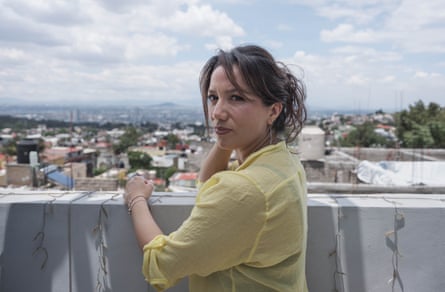
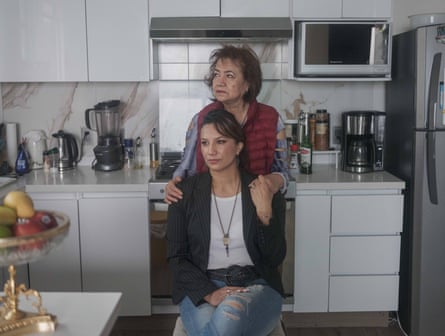
In 2024, after almost 18 years in jail, thanks to a petition lodged by her defence years earlier, Quevedo was released and placed under house arrest. She lives in a small house with her mother on the hilly outskirts of Mexico City. Her case remains stuck in the investigation phase, bogged down by technical legal disputes. “How can it be possible for the system to be this slow?” Quevedo said when we spoke recently. “Almost 20 years waiting for a resolution. It’s unbelievable.”
Quevedo returned to a world that felt alien – technology that she couldn’t understand, cousins she had last seen as children now with their own families. She was 25 when she was first branded a murderer on a billboard. She is now 45, and worries she may never have the chance to get married, have children or pursue a career.
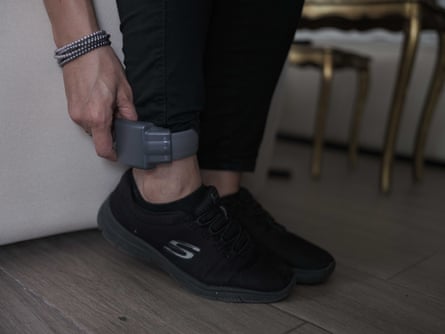
Outside her house, the endless urban sprawl stretches out like a muddy blur beyond the horizon, but Quevedo is bound to a few dozen square metres. Just out of sight, a police car sits on the street. “It’s another incarceration, just a more comfortable one,” Quevedo told me. She must wear an ankle tag at all times.
Last month, a new group of lawyers took on Quevedo’s case, calling for the judge to finally rule on her case and acquit Quevedo. She is grateful for the growing support after so many years of struggle. “Nobody believed us, nobody helped us, nobody wanted to know or even talk about the case. Whoever tried – it went terribly for them.” But for more than 20 years, her mother never stopped trying to advocate for her daughter. “The one who was most out there fighting,” Quevedo said, “was my mum.”
The Long Read magazine summer edition
AI in the classroom, vending machines in the canteen, homeless people in the library, no one in the pub. Surprising stories from our strange new world in the new edition of the Long Read magazine. Buy your copy here.